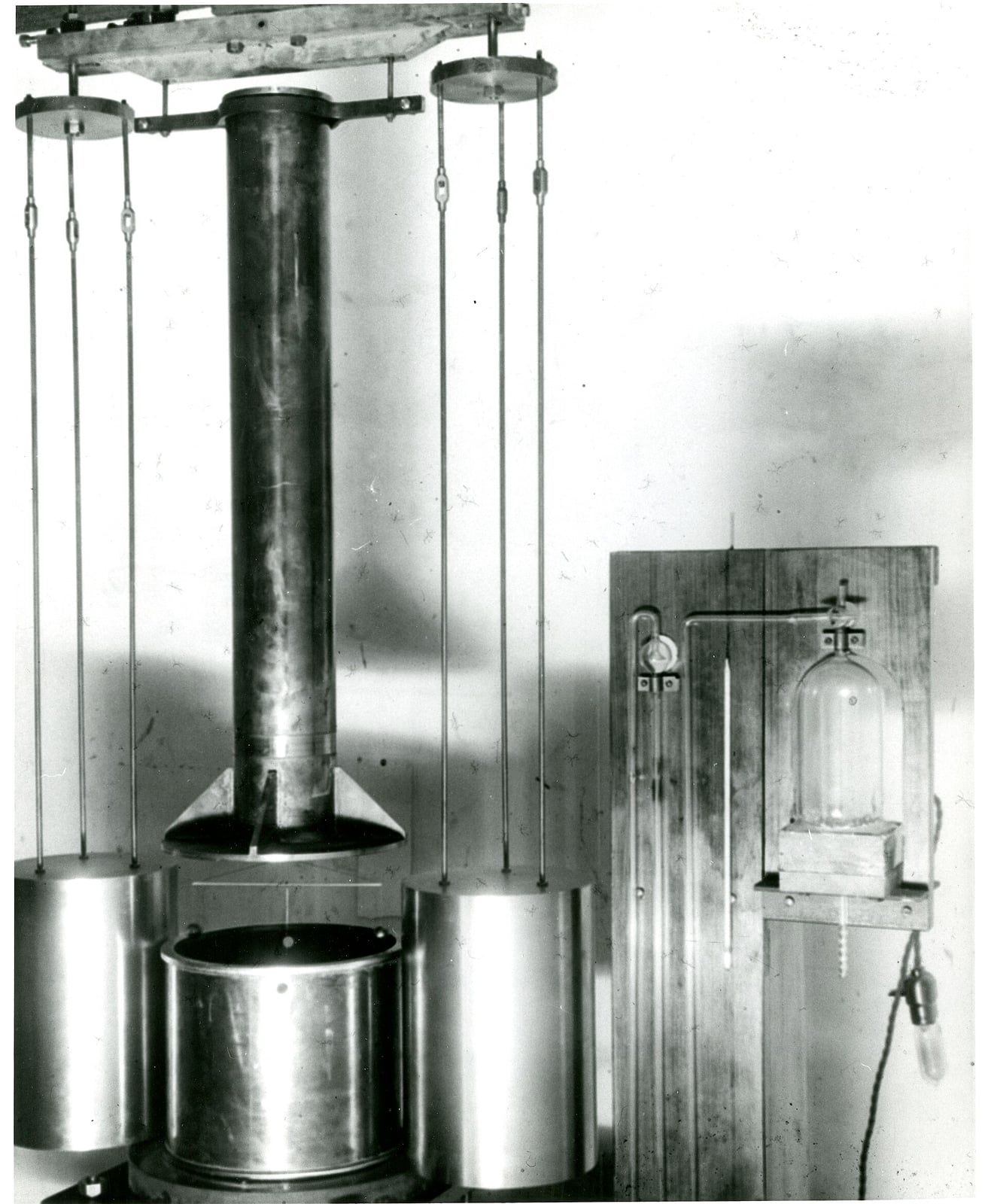
Cavendish Measures the Density of Earth
A delicate experiment detected the attraction between laboratory masses.
In 1797 and 1798, the English natural philosopher Henry Cavendish conducted a delicate laboratory investigation that yielded the first accurate measurement of the density of Earth. The core concept and initial hardware originated with the English geologist John Michell, who had constructed a torsion balance before 1783. Michell died in 1793 before he could finish his planned trials, leaving the apparatus to Francis John Hyde Wollaston. The equipment subsequently passed to Cavendish, who reconstructed the mechanism closely according to Michell's design before initiating an exhaustive series of observations.
The reconstructed balance centered on a horizontal wooden rod six feet long, suspended by a wire. At each end of this rod hung a lead sphere measuring two inches across and weighing 1.61 pounds. Outside this suspended system, two massive lead spheres, each one foot in diameter and weighing 348 pounds, swung on separate supports. When Cavendish brought these large masses within 8.85 inches of the smaller spheres, their gravitational attraction exerted a slight twisting force on the suspension wire, pulling the horizontal beam toward them.

Keep reading in Yester
Coming soon to the App Store
Keep following the story
Sources
- Experiments to determine the Density of the Earth, Philosophical Transactions 88 (1798) (Royal Society Publishing)
- June 1798: Cavendish weighs the world (APS News, American Physical Society)
- Henry Cavendish, Scientist of the Day (Linda Hall Library)
- Background to Boys' experiment to determine G (University of Oxford Department of Physics)
- A song of Schiehallion (The Royal Society)
- Cavendish experiment
Image: National Institute of Standards and Technology