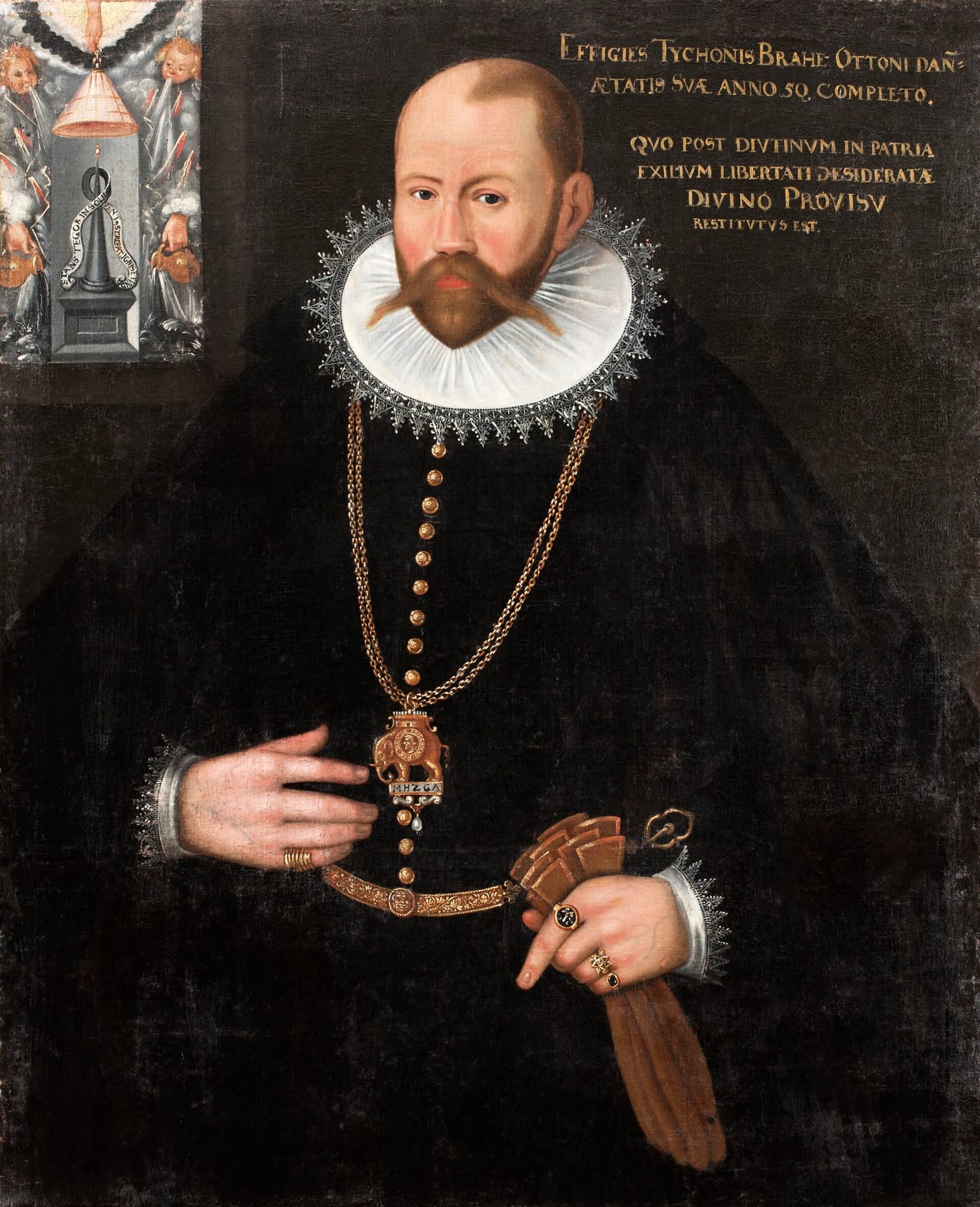
Tycho Brahe Makes Astronomy an Observational Enterprise
An island research center assembled instruments, workers and records that helped transform the study of planetary motion.
In 1572, the Danish nobleman Tycho Brahe witnessed the sudden appearance of a brilliant star in the constellation Cassiopeia. By tracking the object and detecting no daily parallax against the backdrop of the fixed stars, he determined that it lay far beyond the Moon rather than in the upper atmosphere. Published the following year in his treatise De nova stella, this finding directly challenged the traditional Aristotelian doctrine that the celestial sphere was eternally immutable. The discovery secured Tycho widespread recognition among European scholars and persuaded him to devote his career to reforming observational astronomy.
Seeking to keep the prominent astronomer in Denmark, King Frederick II granted Tycho the island of Hven in the Oresund in 1576, alongside extensive financial support. Over the next fifteen years, Tycho transformed the island into an integrated scientific estate centered around Uraniborg, a large observatory influenced by Italian Renaissance architecture. The facility brought together observation, instrument fabrication, and publication in a single institution. It incorporated an alchemical laboratory with sixteen distillation furnaces, a printing press, and a dedicated paper mill driven by an engineered system of canals and ponds.

Keep reading in Yester
Coming soon to the App Store
Keep following the story
Sources
Image: Unknown author Unknown author