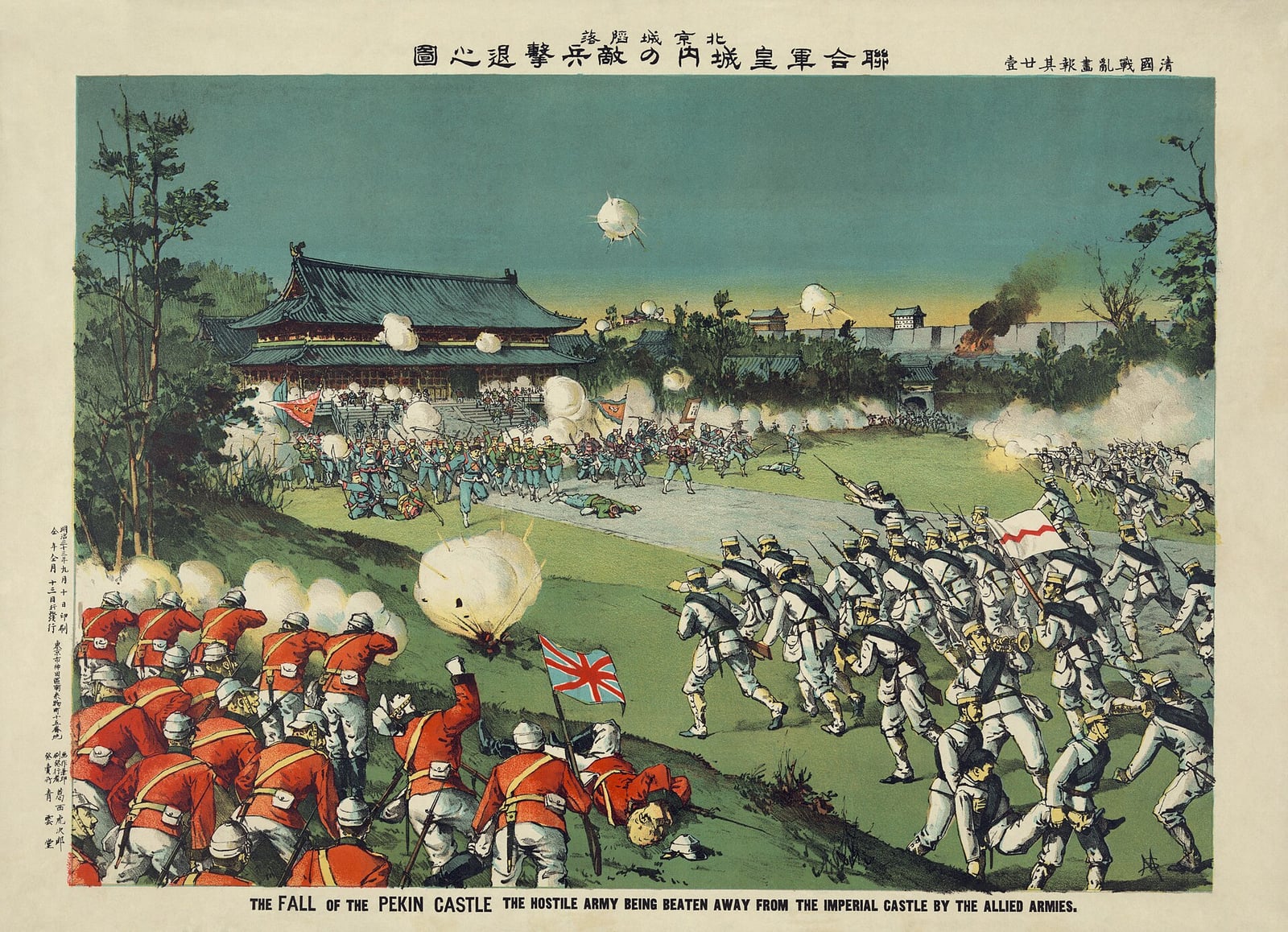
The Boxer Uprising Besieges Beijing’s Legation Quarter
An anti-foreign movement was crushed by an eight-nation intervention.
In the closing years of the nineteenth century, severe economic disruption and foreign encroachment provoked deep unrest across northern China. In rural Shandong, where trade changes, missionary activities, and consecutive natural disasters such as droughts and floods brought widespread distress, local martial groups began organizing against outside influence. Known in English as the Boxers because of their physical and martial arts rituals, members of the Society of Righteous and Harmonious Fists held beliefs in supernatural protection against firearms and blade weapons. They directed their animosity toward Western imperialists, Christian missionaries, and Chinese converts, whom they accused of disrupting local traditions and sacred sites.
The movement quickly gained momentum across the North China Plain throughout 1899, marked by attacks on foreign-built railways, Christian churches, and converts. While the Boxers initially operated as disparate village networks, they unified around the slogan of supporting the ruling Qing dynasty while eradicating foreigners. At the imperial court in Beijing, opinions were sharply divided. Conservative officials argued that the rural militia could be harnessed to resist foreign demands, whereas reform-minded administrators advocated conciliation. Empress Dowager Cixi, initially undecided, began leaning toward the movement following mounting military threats from foreign powers along the coast.

Keep reading in Yester
Coming soon to the App Store
Keep following the story
Sources
- The Boxer Rebellion (National Army Museum)
- U.S. Marines in the Boxer Rebellion, Prologue Magazine (U.S. National Archives)
- The Invasion of the Eight-Nation Alliance (Academy of Chinese Studies, Hong Kong)
- Boxer Protocol, 1901, text (UCLA Asia Pacific Center)
- Secretary of State John Hay and the Open Door in China, 1899-1900 (U.S. Department of State, Office of the Historian)
- Boxer Rebellion
Image: Kasai Torajirō