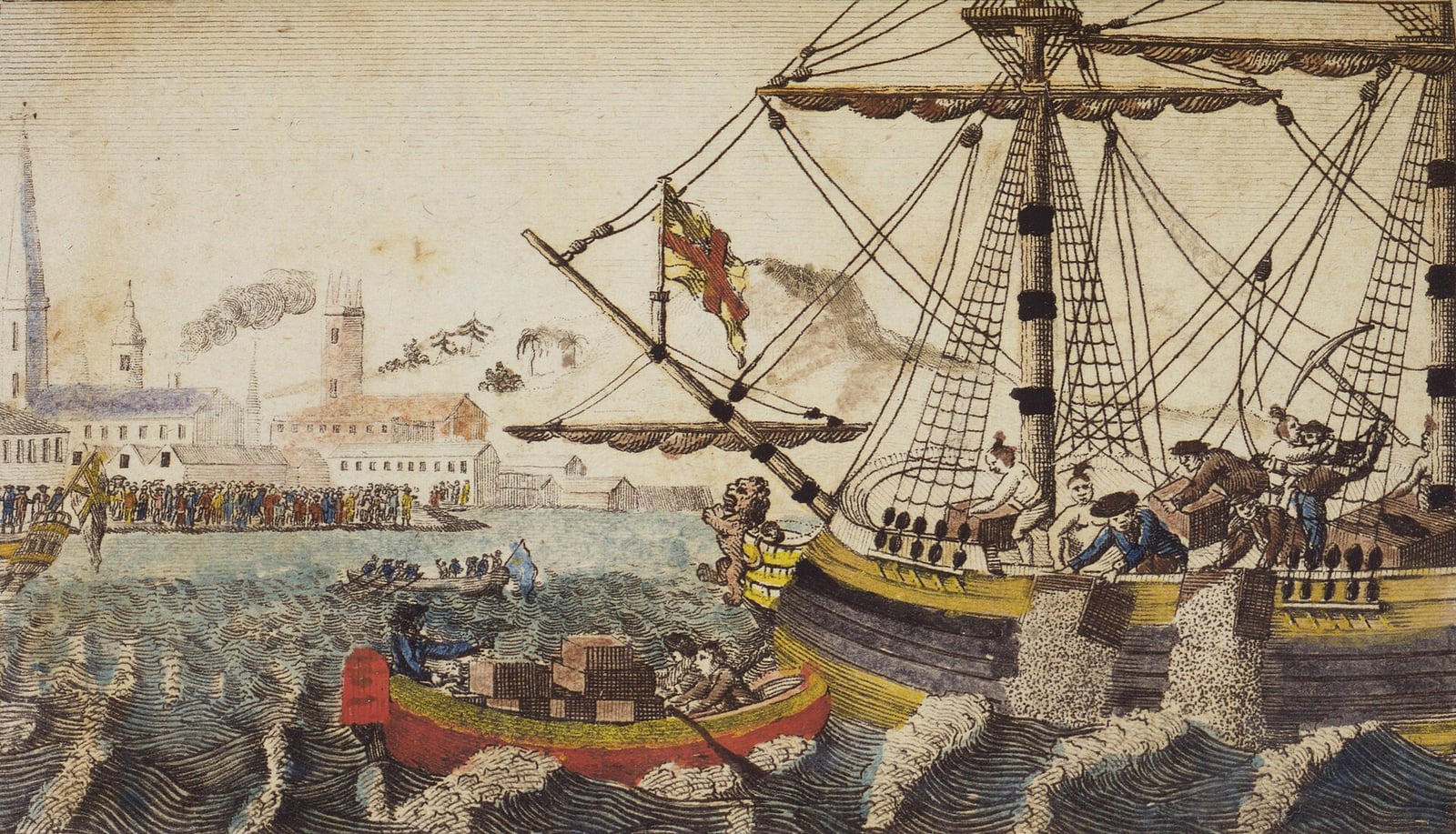
Colonists Dump Tea into Boston Harbor
A protest against a tax on tea pushed Britain and its colonies toward war.
On December 16, 1773, a group of colonial protesters in Boston boarded three merchant vessels and cast their entire cargoes of tea into the harbor. The raid targeted shipments carried by the Dartmouth, Eleanor, and Beaver, which had arrived laden with East India Company tea. Over the course of three hours, dozens of men dumped either 340 or 342 wooden chests containing more than 92,000 pounds of tea into the water. Contemporary observers and early records knew the event simply as the destruction of the tea, with the familiar moniker Boston Tea Party only gaining wide currency decades later during the 1830s.
The demonstration arose from the British Parliament passing the Tea Act in May 1773. Intended primarily to salvage the financially distressed East India Company, which faced huge unsold tea surpluses and falling revenues from India, the legislation allowed the company to export tea directly to the American colonies on its own account. This measure bypassed London wholesale auctions and eliminated independent middlemen. Even while retaining the Townshend duty of three pence per pound, the law reduced the overall price of legal tea, enabling the East India Company to undercut local colonial importers as well as the substantial illicit market in smuggled Dutch tea.

Keep reading in Yester
Coming soon to the App Store
Keep following the story

Sources
- Coming of the American Revolution: Boston Tea Party (Massachusetts Historical Society)
- Tea leaves in glass bottle collected on the shore of Dorchester Neck, 17 December 1773 (Massachusetts Historical Society)
- The Boston Tea Party, education resource (The National Archives, UK)
- Boston Tea Party (December 16, 1773) (Colonial Williamsburg Foundation)
- Radicalization (National Park Service, Minute Man National Historical Park)
- Boston Tea Party Damage (Boston Tea Party Ships & Museum)
- Boston Tea Party
Image: Original uploader was Cornischong at lb.wikipedia