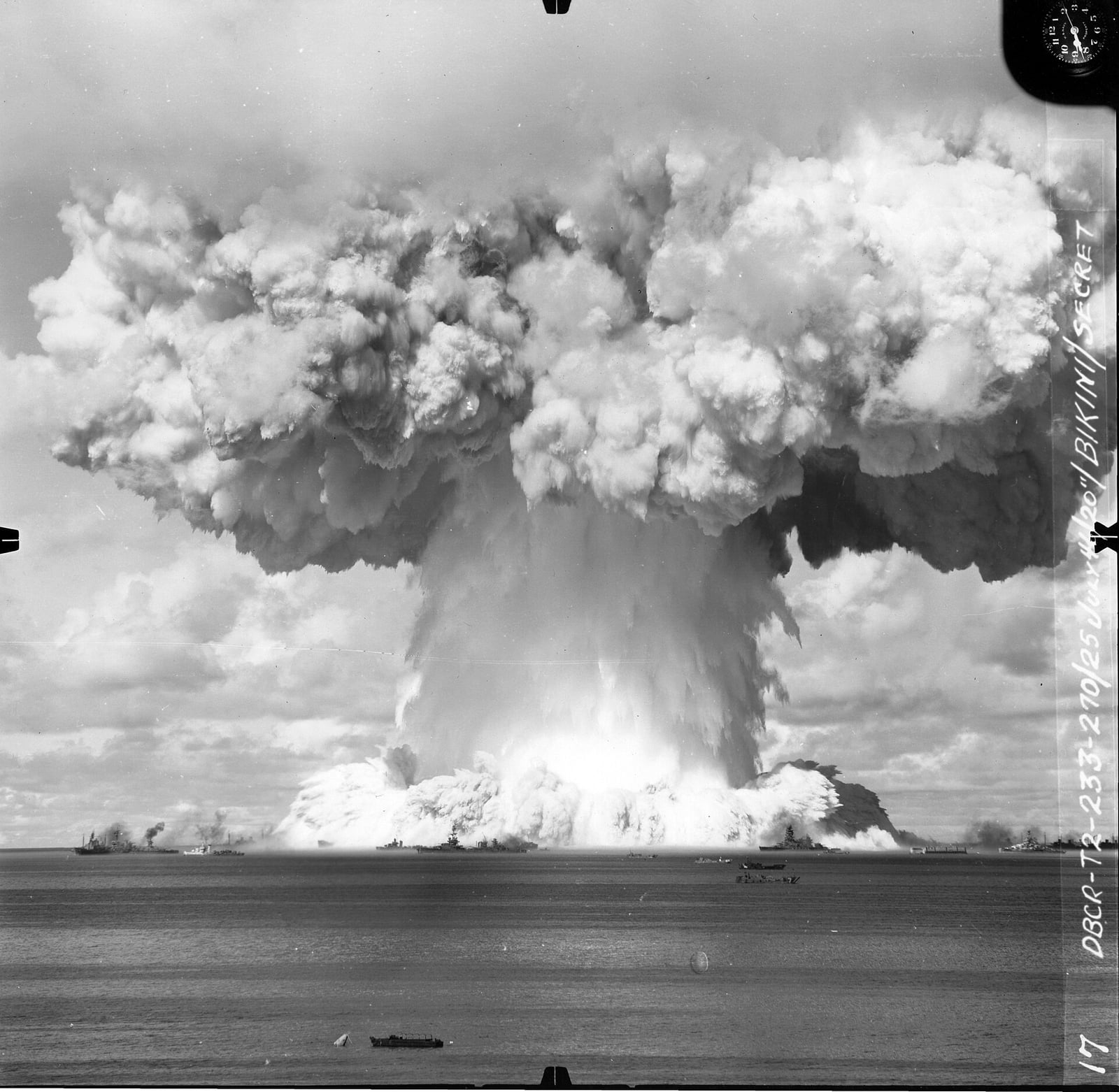
Nuclear Tests Begin at Bikini Atoll
The islanders were moved so that atomic bombs could be tested on their lagoon.
In early 1946, the United States military prepared Bikini Atoll in the Marshall Islands to serve as a testing ground for atomic weapons. Following the atomic bombing of Hiroshima and Nagasaki the previous year, American military planners sought to examine how modern naval vessels would hold up against nuclear strikes. The archipelago had come under American control following the Second World War, and the lagoon offered a sheltered anchorage large enough to gather dozens of surplus and captured warships. To clear the area, military authorities evacuated the 167 indigenous inhabitants of Bikini in March 1946, transporting them eastward to Rongerik Atoll.
Operation Crossroads assembled an array of more than ninety target vessels inside the lagoon. The fleet included obsolete American battleships and aircraft carriers, alongside surrendered Axis warships such as the German cruiser Prinz Eugen and the Japanese battleship Nagato. Joint Army/Navy Task Force One, commanded by Vice Admiral William H. P. Blandy, positioned these vessels in varying densities to assess structural damage, air pressure, and radiation exposure. Some vessels also carried test animals to determine the biological hazards that crews might face during a nuclear attack.

Keep reading in Yester
Coming soon to the App Store
Keep following the story
Sources
- Operation Crossroads (Naval History and Heritage Command)
- Operation Crossroads: Bikini A-Bomb Tests, July 1946 (National Security Archive, George Washington University)
- History of Bikini Atoll (Bikini Atoll local government)
- Bikini Atoll Nuclear Test Site (UNESCO World Heritage Centre)
- Operation Crossroads
Image: U.S. Navy (Rear Admiral S. Quackenbush collection)