The Ifugao Carve Rice Terraces into the Cordillera
Mountain terraces fed by forest water have been farmed for centuries.
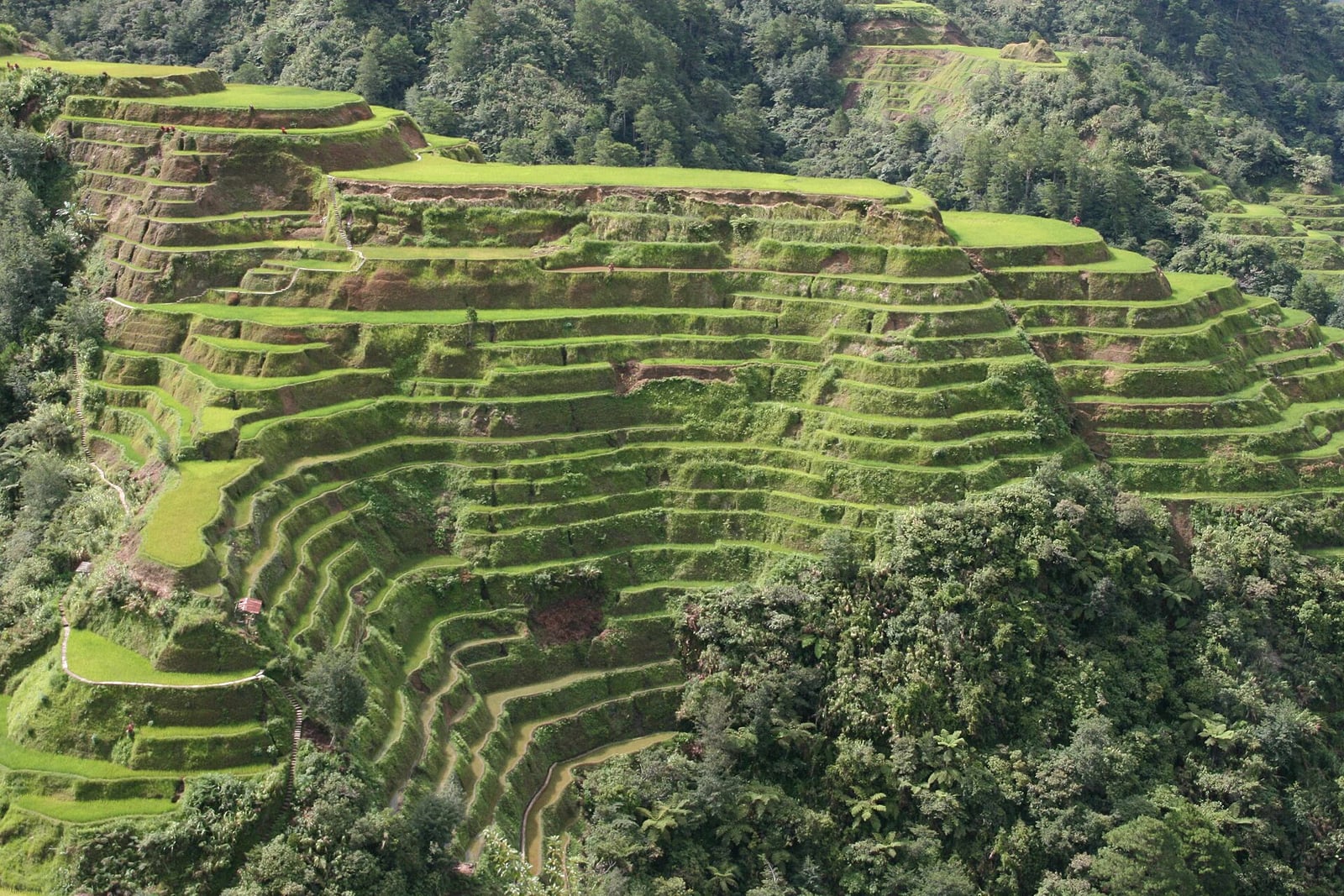
Rising roughly 1,500 meters above sea level in the northern highlands of Luzon, the Banaue Rice Terraces represent an intricate agricultural landscape shaped by the ancestors of the indigenous Ifugao people. Built across steep mountain slopes in the province of Ifugao, the earth and stone tiers rely on gravity-fed water channeled from the high rainforests above. Construction across this rugged topography was undertaken largely by hand with minimal tools, transforming difficult terrain into an enduring system of stepped pond fields.
The antiquity of the terraces remains a topic of scientific debate. The anthropologist H. Otley Beyer proposed that the structures were more than two millennia old, suggesting a prolonged local development dating back to antiquity. Several contemporary researchers dispute this extensive chronology, presenting evidence that the Banaue complex arose considerably later, with some estimates placing significant expansion around the seventeenth century. While Austronesian migrations introduced rice cultivation to the Philippine archipelago by at least 1500 BCE, scholars continue to investigate whether the massive highland terracing was an ancient adaptation or an intensified response to lowland pressures under Spanish colonial rule.

Keep reading in Yester
Coming soon to the App Store
Keep following the story
Sources
- Rice Terraces of the Philippine Cordilleras (UNESCO World Heritage Centre)
- Presidential Decree No. 260, August 1, 1973 (Supreme Court of the Philippines E-Library)
- The Short History of the Ifugao Rice Terraces: A Local Response to the Spanish Conquest, Acabado et al. 2019 (UNLV Digital Scholarship)
- Rice Terracing Facilitated Village Growth in Pericolonial Highland Ifugao, Philippines (Max Planck Institute)
- ICOMOS evaluation No 722 (UNESCO)
- Banaue Rice Terraces
Image: User: (WT-shared) Roundtheworld at wts wikivoyage