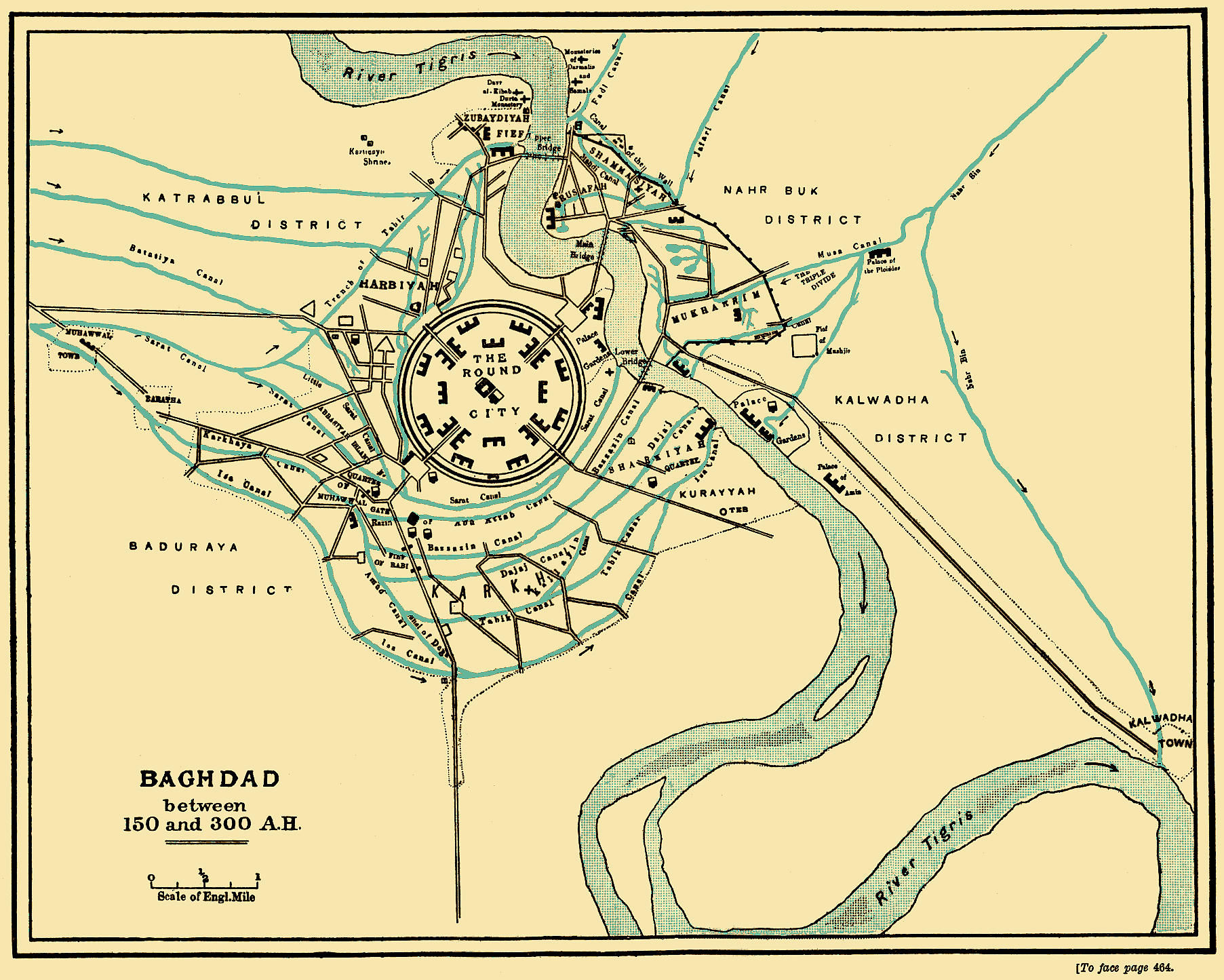
The Abbasids Found Baghdad as a Round City
Caliph al-Mansur laid out a circular capital on the Tigris.
On 30 July 762, the second Abbasid caliph, al-Mansur, initiated the construction of a new imperial capital on the banks of the Tigris River. Officially designated Madinat as-Salam, meaning the City of Peace, the settlement was intended to serve as the official capital of the Abbasid caliphate. A small pre-Islamic village named Baghdad already existed in the area. The Abbasid foundation rapidly surpassed the nearby former Sasanian capital of Ctesiphon, which had fallen under Muslim control in 637 and experienced swift depopulation as the new imperial core took shape.
The planning and construction of the complex mobilized immense resources. Medieval Arab chroniclers preserved reports of a vast workforce of craftsmen and laborers and of enormous expenditures. The court astrologers Naubakht, a convert from Zoroastrianism, and Mashallah ibn Athari, a Jewish astrologer from Basra, selected the auspicious moment for laying the foundations. Al-Mansur was able to establish his residence at the site by 763 following the completion of the main administrative offices, the grand mosque, and the Palace of the Golden Gate, while the remainder of the central enclosure was completed around 766.

Keep reading in Yester
Coming soon to the App Store
Keep following the story

Sources
- Baghdad i. The Iranian Connection: Before the Mongol Invasion, Hugh Kennedy (Encyclopaedia Iranica)
- Abu Sahl Nawbakht, David Pingree (Encyclopaedia Iranica)
- Masha'allah ibn Athari, Biographical Encyclopedia of Astronomers (McGill University, Islamic Science archive)
- Astrologers Were the Quants of the Ancient World, Alexander Boxer (Atlas Obscura)
- Round City of Baghdad
Image: William Muir