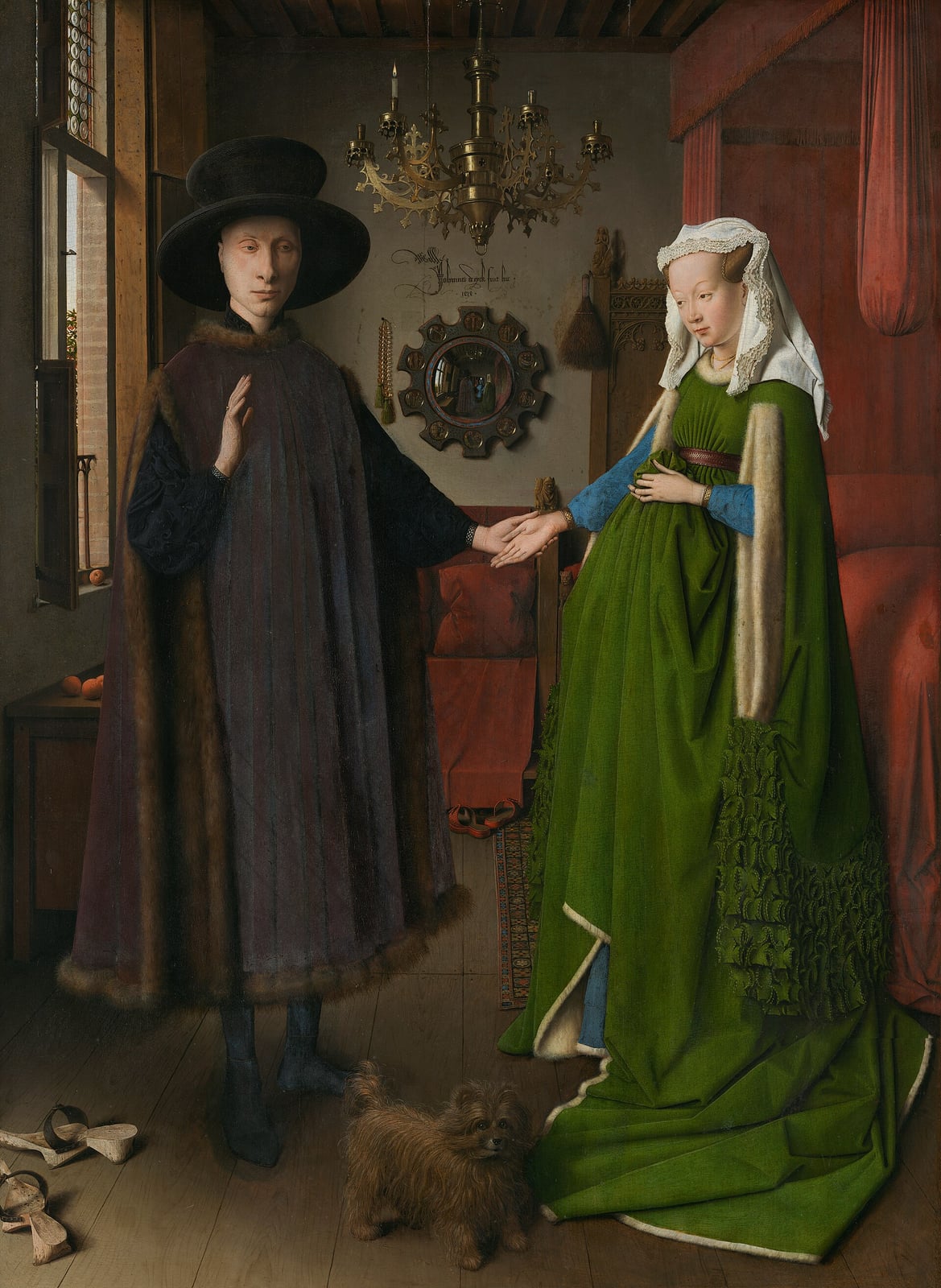
Van Eyck Paints the Arnolfini Portrait
A small double portrait became famous for its mirror, its detail and its unanswered questions.
In 1434, the Netherlandish painter Jan van Eyck completed a double portrait on a wooden panel, probably oak, that would become one of the most closely scrutinized works of European art. Today displayed in the National Gallery in London, the painting shows a man and a woman standing in an upstairs interior, believed to represent their residence in the Flemish city of Bruges. The artist signed and dated the composition directly onto the wall above the rear mirror with an unusual Latin phrase, recording that he was present in that year. Executed in oil rather than tempera, the work stands alongside the Ghent Altarpiece as one of the oldest celebrated panel paintings completed in the oil medium.
Van Eyck achieved a remarkable illusion of three dimensions and tactile texture by applying successive layers of thin, translucent glazes. Benefiting from the slower drying time of oil paints compared to egg tempera, he worked wet paint into wet paint, allowing delicate transitions between light and shadow. Light entering through an open window on the left falls unevenly across the interior, reflecting off textiles, brass, and timber. Infrared examinations have revealed that the panel contains numerous underdrawing revisions, or pentimenti, indicating adjustments made to the figures' faces, the mirror, and surrounding furnishings before the final surface was completed.

Keep reading in Yester
Coming soon to the App Store
Keep following the story
Sources
Image: Jan van Eyck