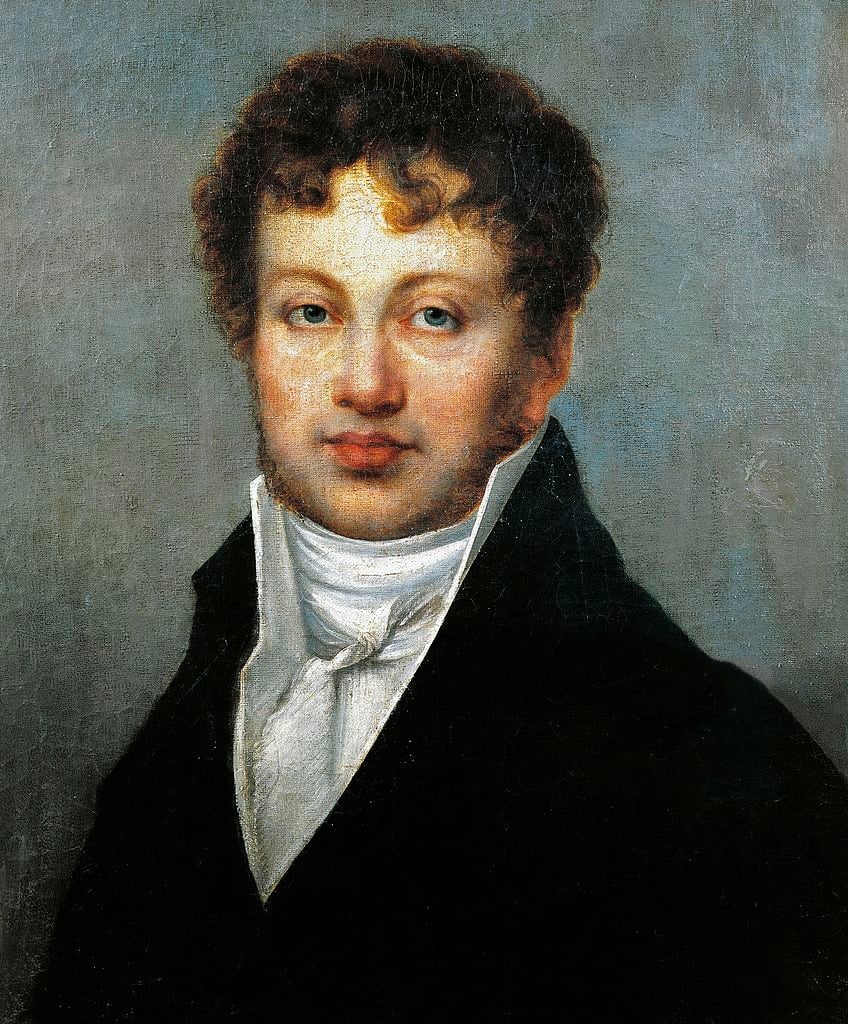
Ampère Studies the Forces Between Electric Currents
Experiments helped establish a mathematical account of electrodynamics.
In September 1820, François Arago demonstrated before the French Academy of Sciences in Paris a striking discovery recently announced by the Danish researcher Hans Christian Ørsted. Ørsted had shown that an electric current circulating through a wire caused a nearby magnetic needle to swerve from its normal orientation. The phenomenon revealed an unexpected physical interaction between electricity and magnetism. André-Marie Ampère, an established mathematician and professor who was present among the audience, recognized that Ørsted had uncovered only one part of a broader physical relationship, and he immediately set to work designing experiments to explore the underlying forces at play.
Ampère approached the problem by removing ordinary iron magnets from the interaction entirely, choosing instead to test what occurred between multiple active currents. He constructed apparatuses consisting of two parallel lengths of wire carrying electrical charges. Through careful observation, Ampère proved that the wires exerted measurable mechanical forces upon one another. When the currents flowed in the same direction, the wires attracted each other, whereas currents traveling in opposite directions produced mutual repulsion. By showing that electricity in motion produced attractive and repulsive forces identical in kind to those observed in magnetic bodies, he established that magnetism itself could be understood through electrical motion.

Keep reading in Yester
Coming soon to the App Store
Keep following the story
Sources
Image: Anonymous Unknown author