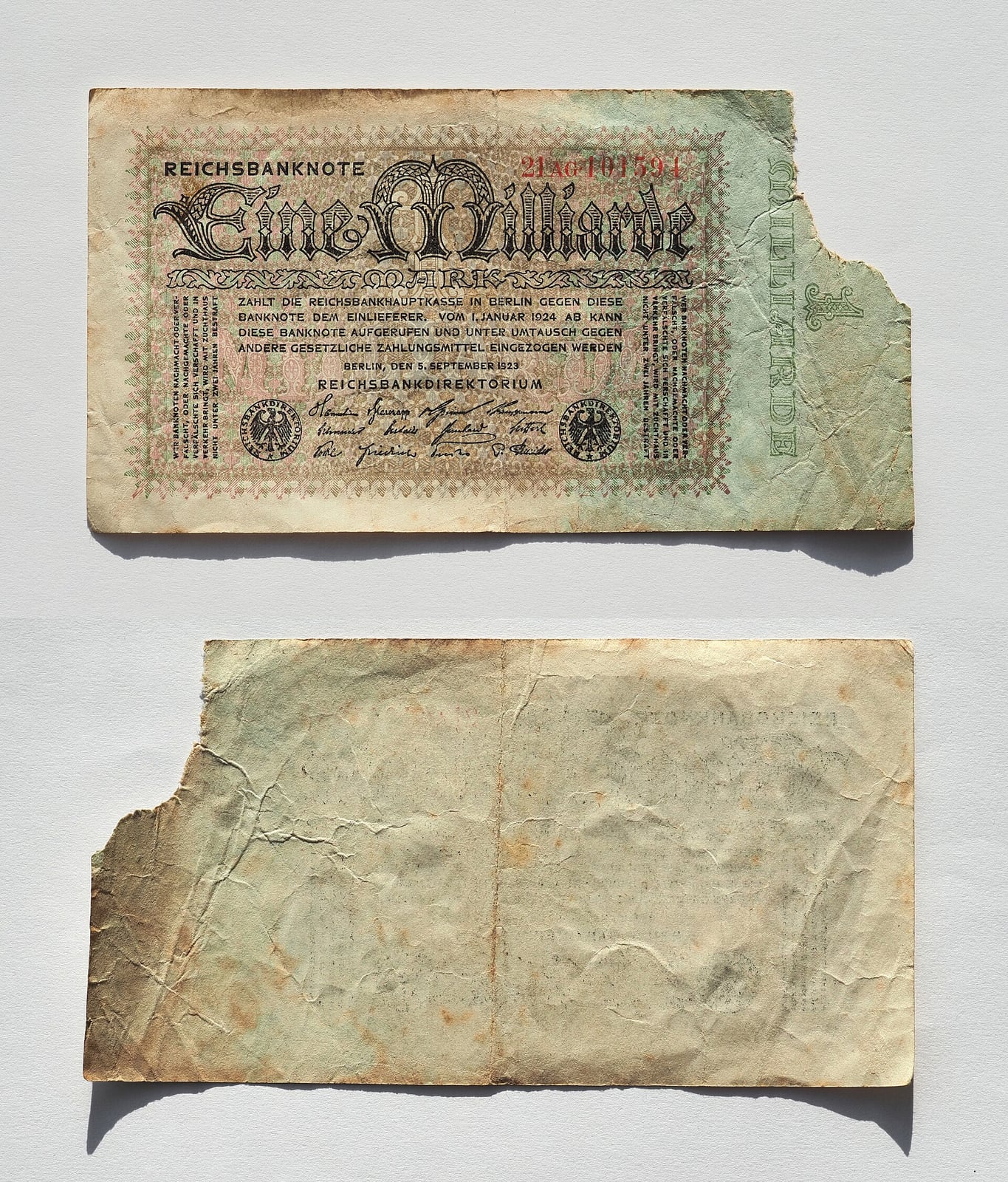
German Money Becomes Almost Worthless
By November 1923 one US dollar cost 4.2 trillion marks.
In November 1923, the economic collapse of the Weimar Republic reached an extreme peak when a single United States dollar commanded 4.2105 trillion German marks. Just a year earlier, a loaf of bread in Berlin cost around 160 marks. By late 1923, that same loaf cost 200 billion marks. The rapid depreciation transformed the national paper currency into virtually worthless scrip, prompting citizens to trade goods directly or rely on alternative mediums of exchange such as cigarettes and foreign currency.
The roots of this monetary failure lay in the financing of the First World War. In 1914, Imperial Germany abandoned the gold standard and decided to fund its war expenditures through borrowing rather than heavy taxation, expecting to recover costs by annexing industrial territories and demanding indemnities from defeated enemies. Defeat in 1918 eliminated that strategy, saddling the fledgling Weimar Republic with an existing national debt of 156 billion marks. The mark, which had traded at 4.2 to the dollar in 1914, dropped to 7.9 by the end of hostilities and fell further to 48 by late 1919.

Keep reading in Yester
Coming soon to the App Store
Keep following the story

Sources
Image: Issued by the Reichsbank in Berlin , reproduced by ThoBel-0043 from an original banknote.