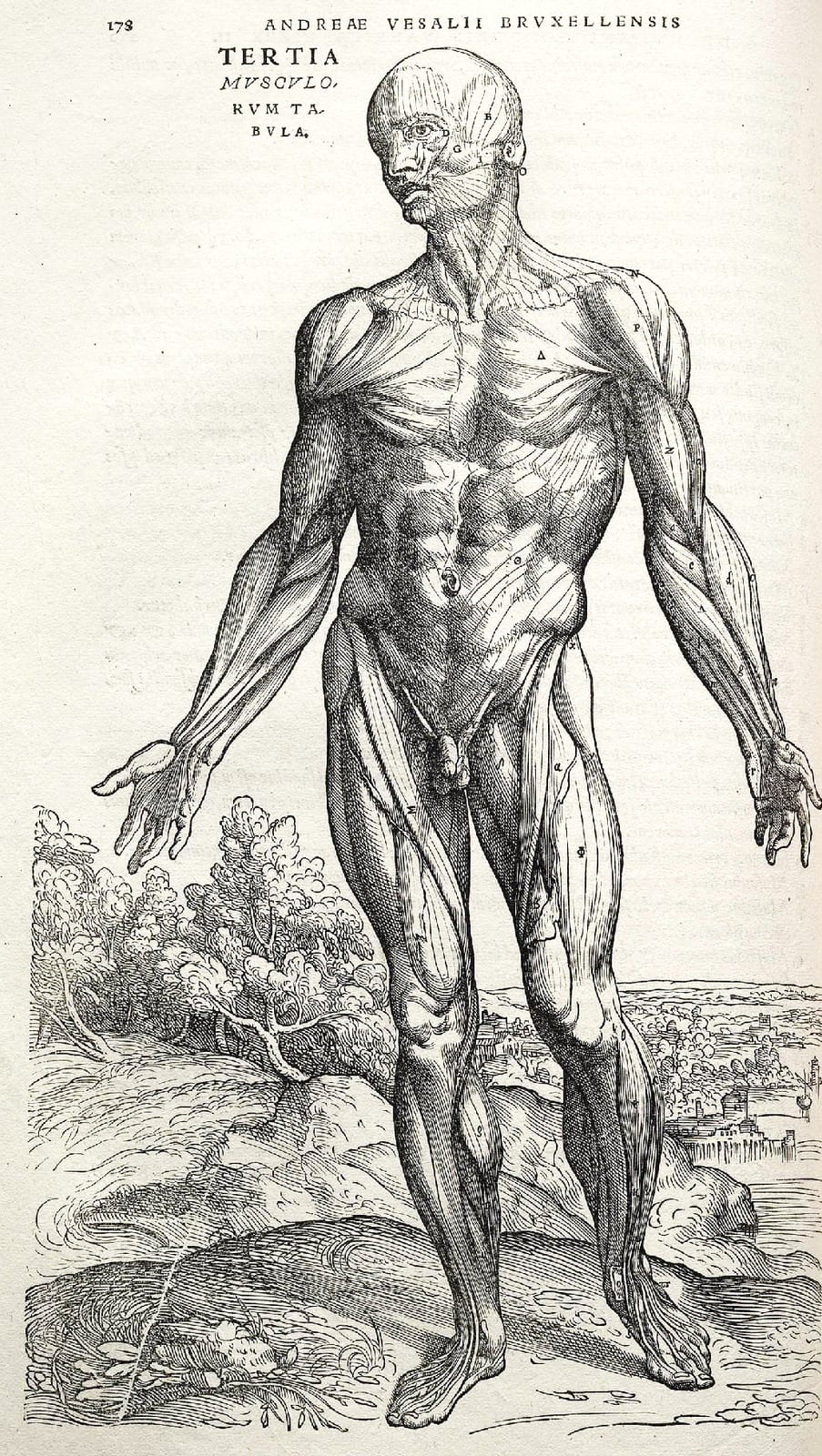
Vesalius Puts Human Anatomy on a Different Foundation
Dissection and detailed illustration challenged errors inherited from older anatomical authorities.
In 1537, after earlier study at Leuven and Paris and receiving his doctorate at Padua, Andreas Vesalius immediately accepted the chair of surgery and anatomy at the University of Padua. Medical education across European universities had long relied on the authoritative texts of Galen, written during antiquity. Professors conventionally read aloud from these classical treatises while barber-surgeons performed dissections, rarely questioning whether the written descriptions matched the flesh before them. Vesalius broke with this academic convention by conducting dissections personally, making direct tactile inspection the core method of anatomical instruction and urging students to verify physical structures with their own eyes.
This shift in teaching method revealed a fundamental flaw in the received medical tradition. By the time he lectured in Bologna in 1540, Vesalius had concluded that Galen had never dissected human corpses because Roman customs prohibited the practice. Instead, Galen had relied on animal dissections, primarily using Barbary macaques as structural stand-ins for humans. Because this reliance had gone unrecognized for centuries, medical faculties had accepted descriptions of animal morphology as accurate accounts of human anatomy.

Keep reading in Yester
Coming soon to the App Store
Keep following the story
Sources
- Vesalius, Andreas (Complete Dictionary of Scientific Biography, via Encyclopedia.com)
- Historical Anatomies on the Web: Vesalius, Author and Title Description (U.S. National Library of Medicine)
- Vesalius, Andreas (Historisches Lexikon der Schweiz)
- The Oldest Surviving Articulated Human Skeleton in Europe, Articulated by Andreas Vesalius (HistoryofInformation.com)
- Andreas Vesalius