Turner Paints the Railway in Motion
Steam transport entered painting through weather, light and blurred form.
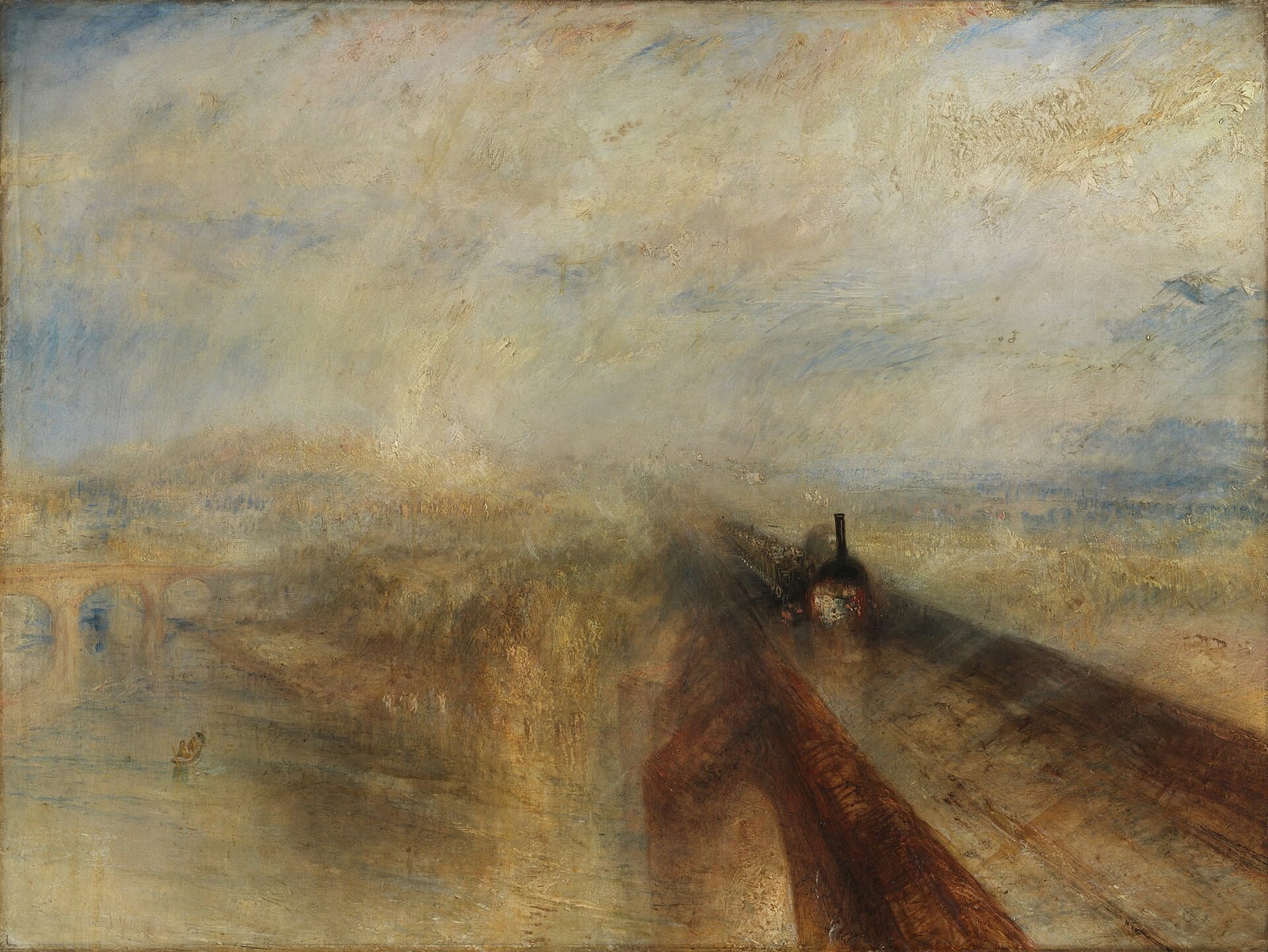
In 1844, the British landscape painter J. M. W. Turner exhibited his oil painting Rain, Steam, and Speed – The Great Western Railway at the Royal Academy in London. The canvas captured an unprecedented encounter between traditional landscape painting and the mechanical developments reshaping Victorian Britain. Turner had long been recognized for dramatic depictions of maritime storms and classical vistas, but in this work, he chose the emerging rail network as a principal focus. The painting, which eventually entered the permanent collection of the National Gallery in London, presented a modern technological subject enveloped within an intense atmospheric squall.
The setting of the composition is widely identified as the Maidenhead Railway Bridge, designed by civil engineer Isambard Kingdom Brunel and completed across the River Thames in 1838. Turner had explored that section of the river between Taplow and Maidenhead over three decades, and he oriented this view looking eastward toward London. Rather than rendering the masonry structure with architectural precision, Turner positioned the viaduct receding into a hazy expanse of weather and mist. At the far left, a small boat floats on the river below, while an older road bridge sits in the distance, establishing a quiet comparison between older rural ways of crossing the river and the massive infrastructure of the new line.

Keep reading in Yester
Coming soon to the App Store
Keep following the story
Sources
- Joseph Mallord William Turner, Rain, Steam, and Speed - The Great Western Railway, NG538 (National Gallery, London)
- Building record: Maidenhead Railway Bridge, Maidenhead Viaduct (Buckinghamshire Council Heritage Portal)
- Thackeray on Turner's Rain, Steam and Speed, from May Gambols, Fraser's Magazine 1844 (The Victorian Web)
- Scientist of the Day: J.M.W. Turner (Linda Hall Library)
- Rain, Steam and Speed – The Great Western Railway
Image: J. M. W. Turner