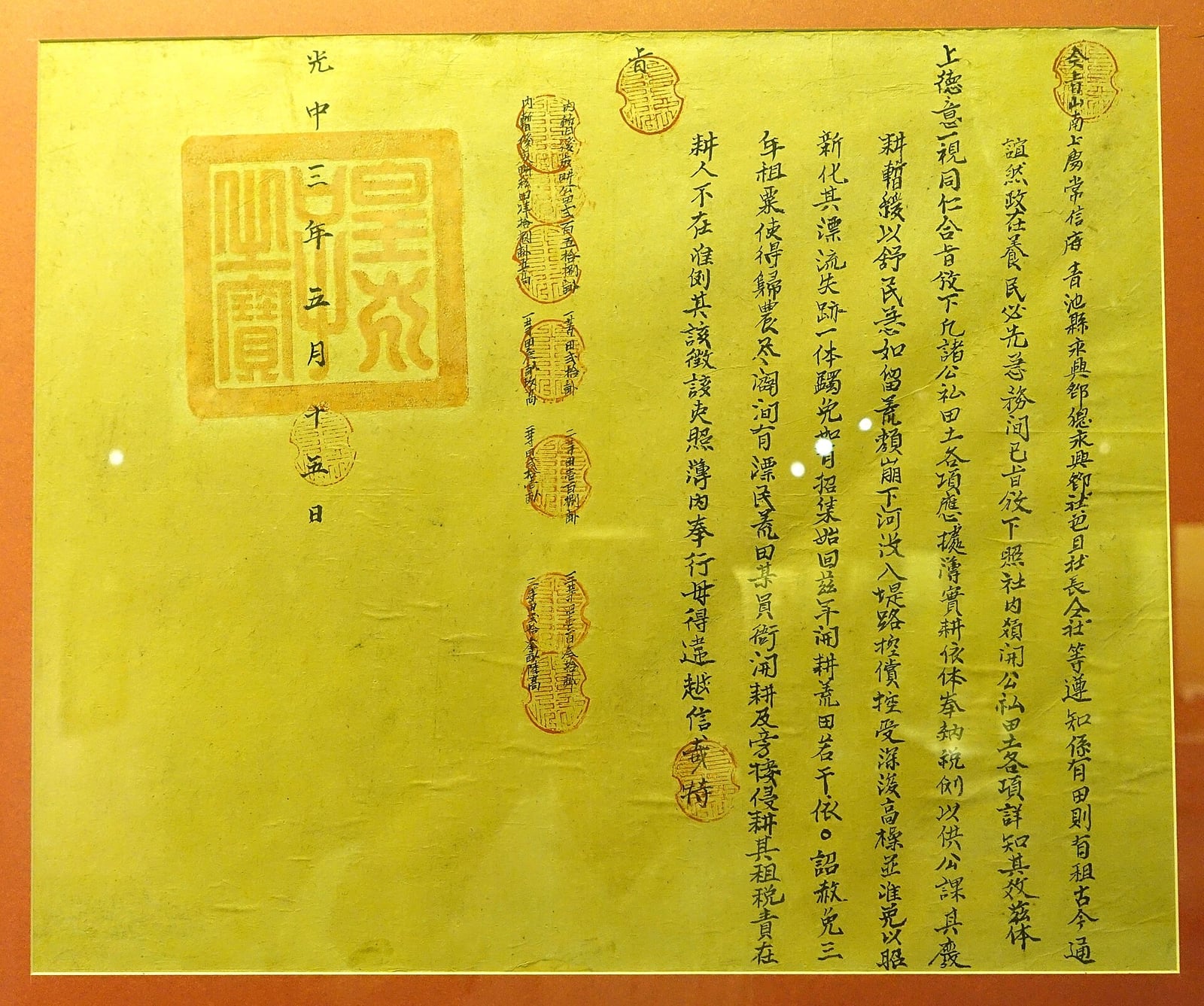
The Tây Sơn Brothers Launch a Rebellion
Three brothers from a mountain village overturned the order of Vietnam.
In the eighteenth century, Vietnam was divided between two entrenched ruling houses while the Lê emperors remained merely nominal monarchs. To the north, the Trịnh lords governed from Thăng Long, while the southern territory fell under the administration of the Nguyễn lords based in Phú Xuân. Across both domains, wealth accumulated among influential landlords, leaving rural cultivators to shoulder steep taxation and administrative corruption. In the south, recurring military confrontations against Cambodia and Siam strained state resources further. When Lord Nguyễn Phúc Khoát died in 1765, the ascent of the regent Trương Phúc Loan provoked severe factional instability, eroding the court's authority.
Against this backdrop of agrarian distress and administrative decay, three peasant brothers from the village of Tây Sơn in Bình Định province initiated an uprising in 1771. Bearing the common surname Nguyễn but sharing no genealogical link to the ruling dynasty, Nguyễn Nhạc, Nguyễn Huệ, and Nguyễn Lữ framed their cause as a campaign against official corruption and economic oppression. Their movement drew essential manpower from impoverished farmers alongside regional highland populations. Promising the redistribution of agricultural land, the brothers gradually secured broader local backing and defeated initial punitive forces sent southward to suppress them.

Keep reading in Yester
Coming soon to the App Store
Keep following the story

Sources
- Vietnam: The Tay Son Rebellion (U.S. Library of Congress Country Study, countrystudies.us)
- The state and law under the Tay Son dynasty (1776-1802) (Vietnam Law & Legal Forum)
- Siamese-Vietnamese War (EBSCO Research Starters)
- Thailand: The Bangkok Period, 1767-1932 (U.S. Library of Congress Country Study, countrystudies.us)
- Long trọng kỷ niệm 240 năm Chiến thắng Rạch Gầm – Xoài Mút (Sài Gòn Giải Phóng)
- Tây Sơn dynasty
Image: Daderot