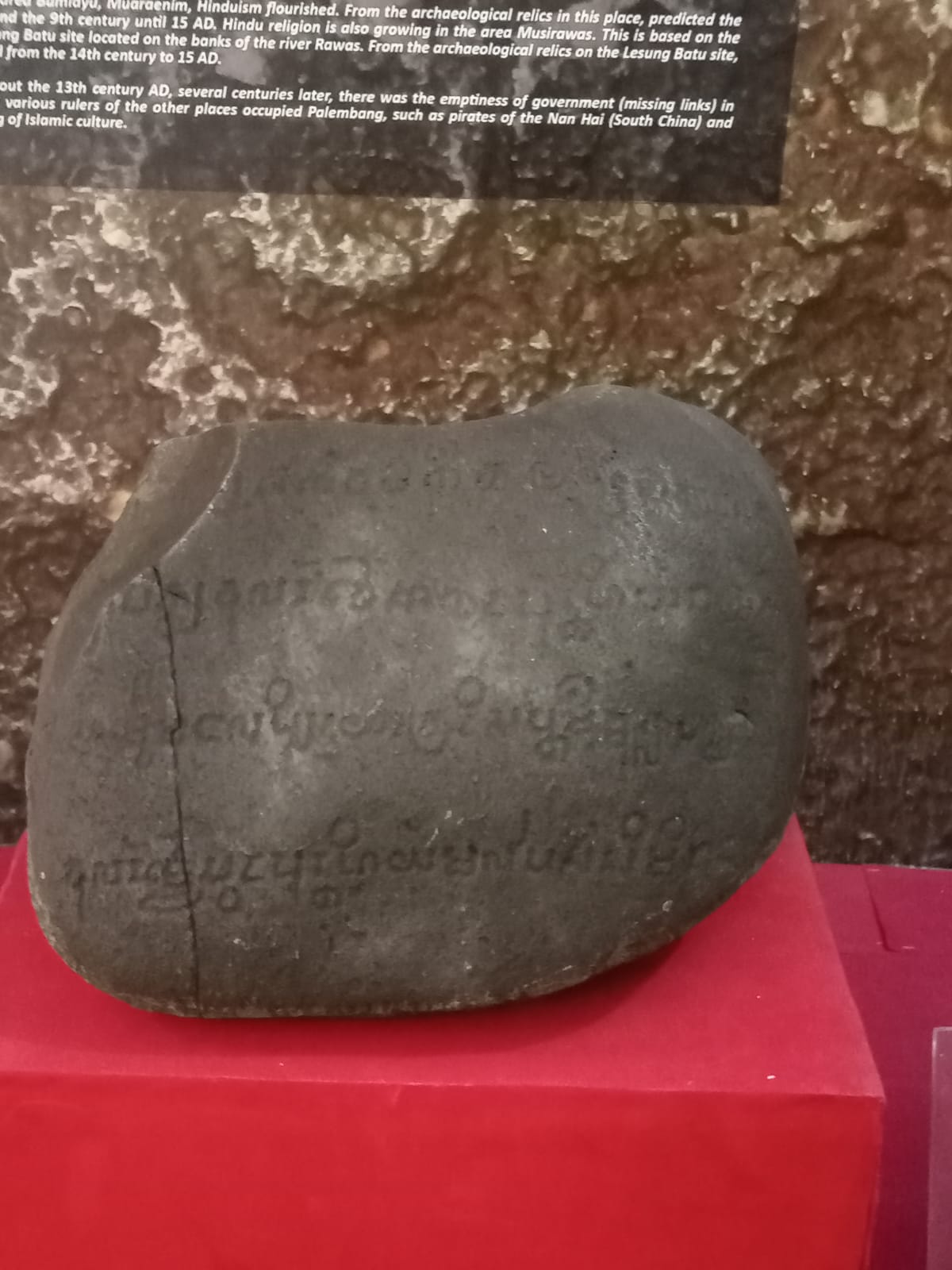
An Inscription Marks the Rise of Srivijaya
A maritime kingdom in Sumatra came to control trade through the straits.
In 683, stone carvers near modern Palembang on the island of Sumatra incised an inscription recording the sacred journey of a ruler named Dapunta Hyang Sri Jayanasa. Known as the Kedukan Bukit inscription, this Old Malay text describes the leader setting out with an army of thousands to establish a domain called Srivijaya. The event marked the formal emergence into the historical record of a kingdom that would expand across Sumatra, the Malay Peninsula, and surrounding waters, transforming into a dominant regional power across western Maritime Southeast Asia.
Earlier outside references had begun to note the settlement around the same period. The Chinese Buddhist pilgrim Yijing spent six months in the area in 671 studying Sanskrit grammar on his voyage toward India, later observing that the community supported more than a thousand monks. Through its location along the Musi River basin and adjacent sea routes, Srivijaya developed into an essential entrepot. Ships moving between China, India, and the Middle East relied on its ports, guided by seasonal monsoons and encouraged by the empire's command over traffic traversing the Strait of Malacca and the Sunda Strait.

Keep reading in Yester
Coming soon to the App Store
Keep following the story



Sources
Image: Anpoetri