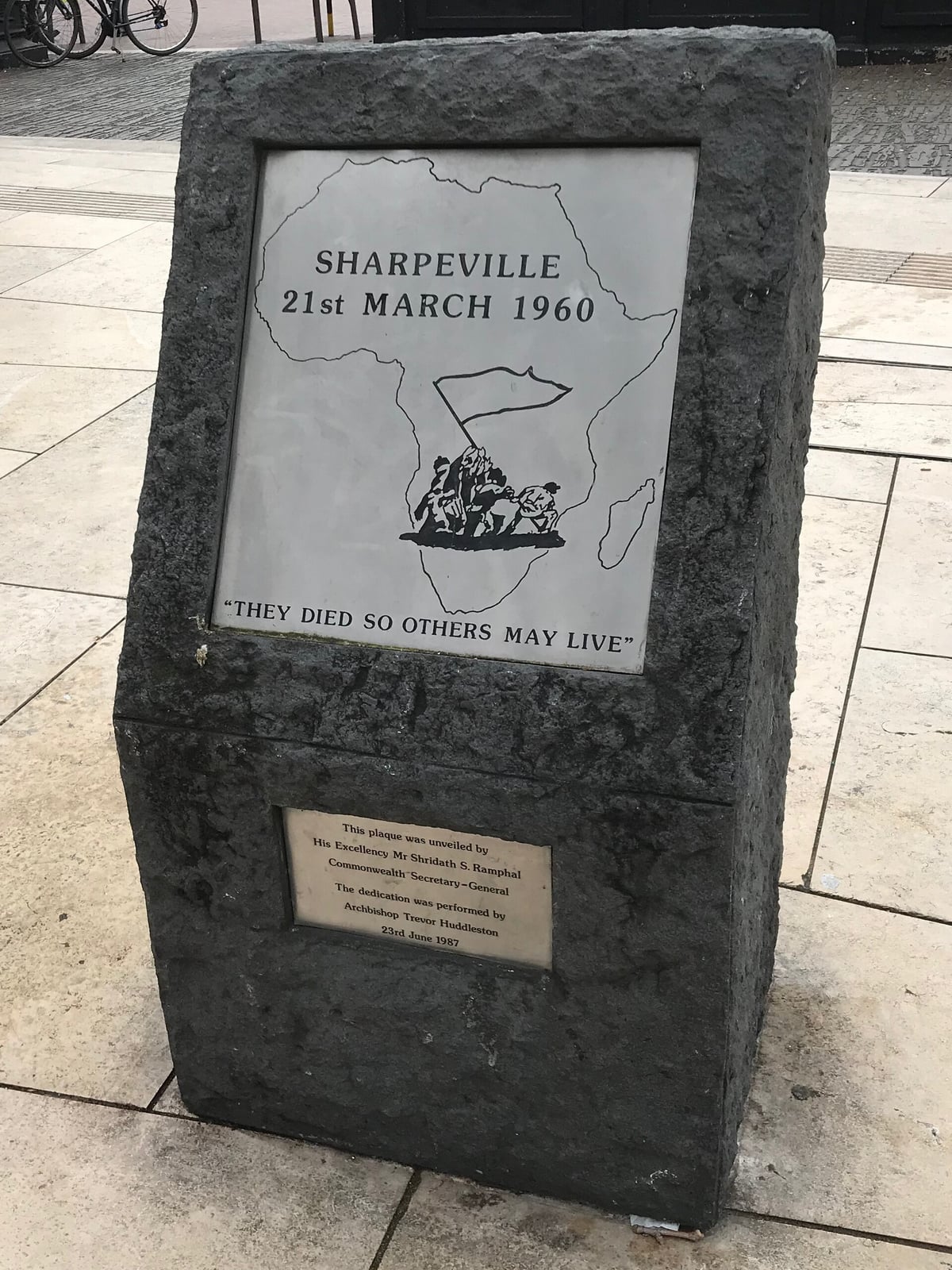
Police Fire on Protesters at Sharpeville
The killing of demonstrators against pass laws drew worldwide condemnation.
On 21 March 1960, thousands of black South Africans assembled outside the police station in the township of Sharpeville, located south of Johannesburg in what was then the Transvaal Province. The demonstration was organized as part of a nationwide campaign by the Pan-Africanist Congress, which urged residents to leave their mandatory passbooks at home and present themselves for arrest. Under South Africa's influx control laws, African residents were legally required to carry identity books that regulated where they could live, work, and travel. By midday, a crowd of several thousand people stood outside the station fence, waiting to be addressed by government officials.
Tensions escalated as police reinforcements arrived, bringing the number of police to about 300, backed by Saracen armoured cars. Air force jets flew low overhead, but the demonstrators remained. Apart from stones thrown toward the police, there was no evidence that the protesters carried weapons. Early in the afternoon, following a scuffle near the station entrance, the police opened fire without first ordering the crowd to disperse. Over the course of about two minutes, officers, some armed with Sten submachine guns, fired directly into the crowd.

Keep reading in Yester
Coming soon to the App Store
Keep following the story

Sources
- Sharpeville Massacre, 21 March 1960 (South African History Online)
- TRC Final Report, Volume 3, Chapter 6, Subsection 5 (Truth and Reconciliation Commission, via SAHA)
- Sharpeville: new research on 1960 South African massacre shows the number of dead and injured was massively undercounted (Daily Maverick / The Conversation)
- 18,000 people have been detained since the declaration of the State of Emergency in March (South African History Online)
- International Day for the Elimination of Racial Discrimination (United Nations)
- Human Rights, Liberation and Reconciliation: Nelson Mandela Legacy Sites (UNESCO World Heritage Centre)
- Constitution of the Republic of South Africa 1996 (South African History Online)
- Sharpeville massacre
Image: Matt Brown