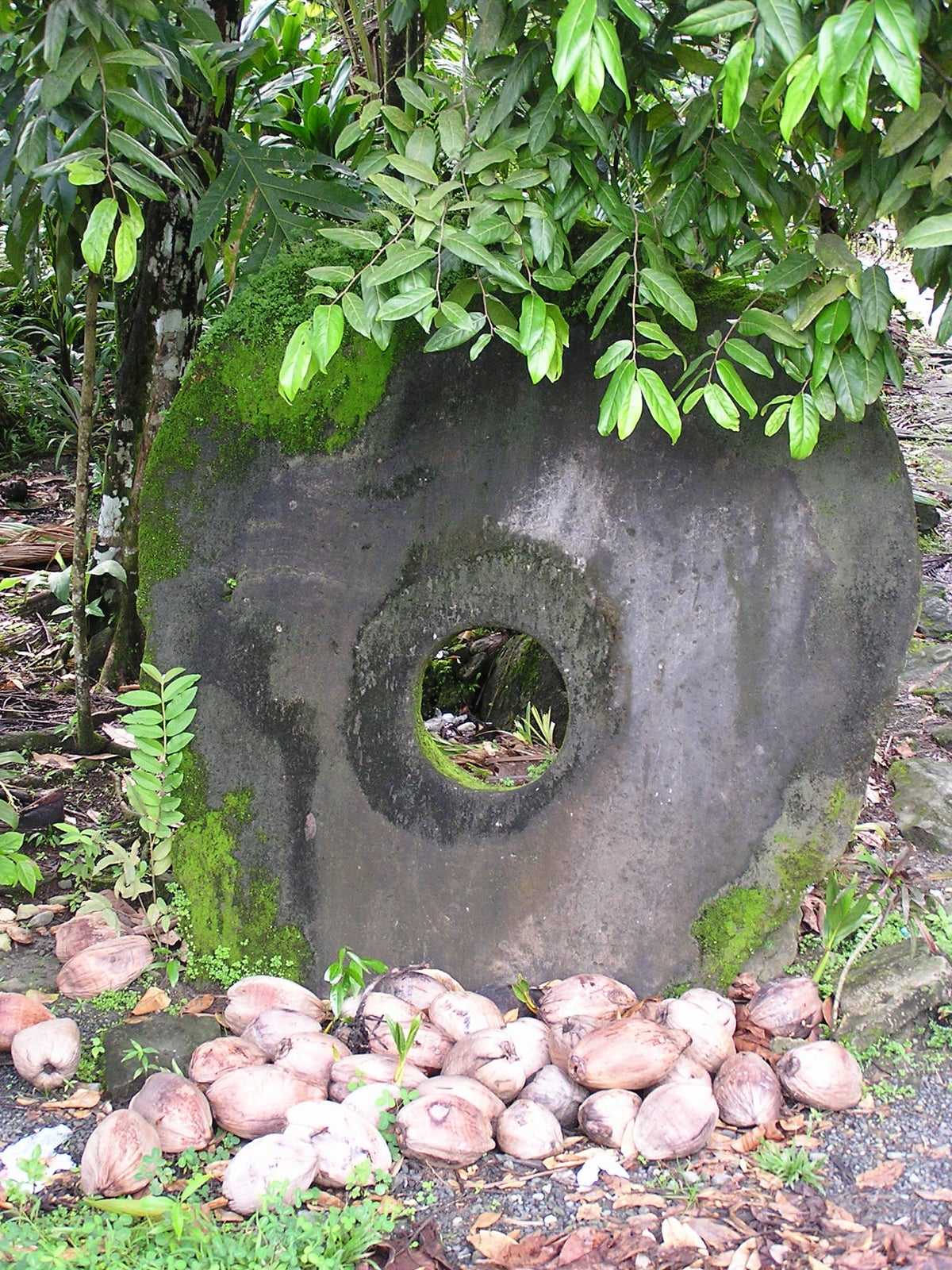
Yap Islanders Trade Stone Money Too Big to Move
Huge limestone discs quarried in Palau changed owners without changing places.
On the islands of Yap in western Micronesia, traditional wealth took the shape of vast limestone discs known as rai stones. Carved primarily from crystalline calcite deposits found in the caves of Palau, roughly four hundred kilometres to the southwest, these circular stones featured central holes and ranged in size from tiny ornaments mere centimetres across to monolithic specimens measuring over three metres wide. Because Yap itself consists largely of metamorphic rock devoid of such calcite flowstones, voyagers undertook perilous maritime journeys to secure the prized material. Hundreds of these monuments remain standing across Yap today, leaning against community meetinghouses or resting beside village pathways.
The valuation of an individual rai stone did not depend solely on its dimensions or geological quality, though stones displaying white or brown bands were particularly prized. Instead, value was inextricably bound to provenance and lineage. Each significant piece carried an oral history detailing the craftsmen who shaped it, the expeditions that conveyed it across open water, and the hardships endured along the way, including any lives lost during quarrying or transit. Rather than circulating in daily markets, the discs served as ceremonial wealth, transferred during crucial social events such as marriages, political agreements, inheritances, and settlements between communities.

Keep reading in Yester
Coming soon to the App Store
Keep following the story

Sources
Image: Scot Nelson