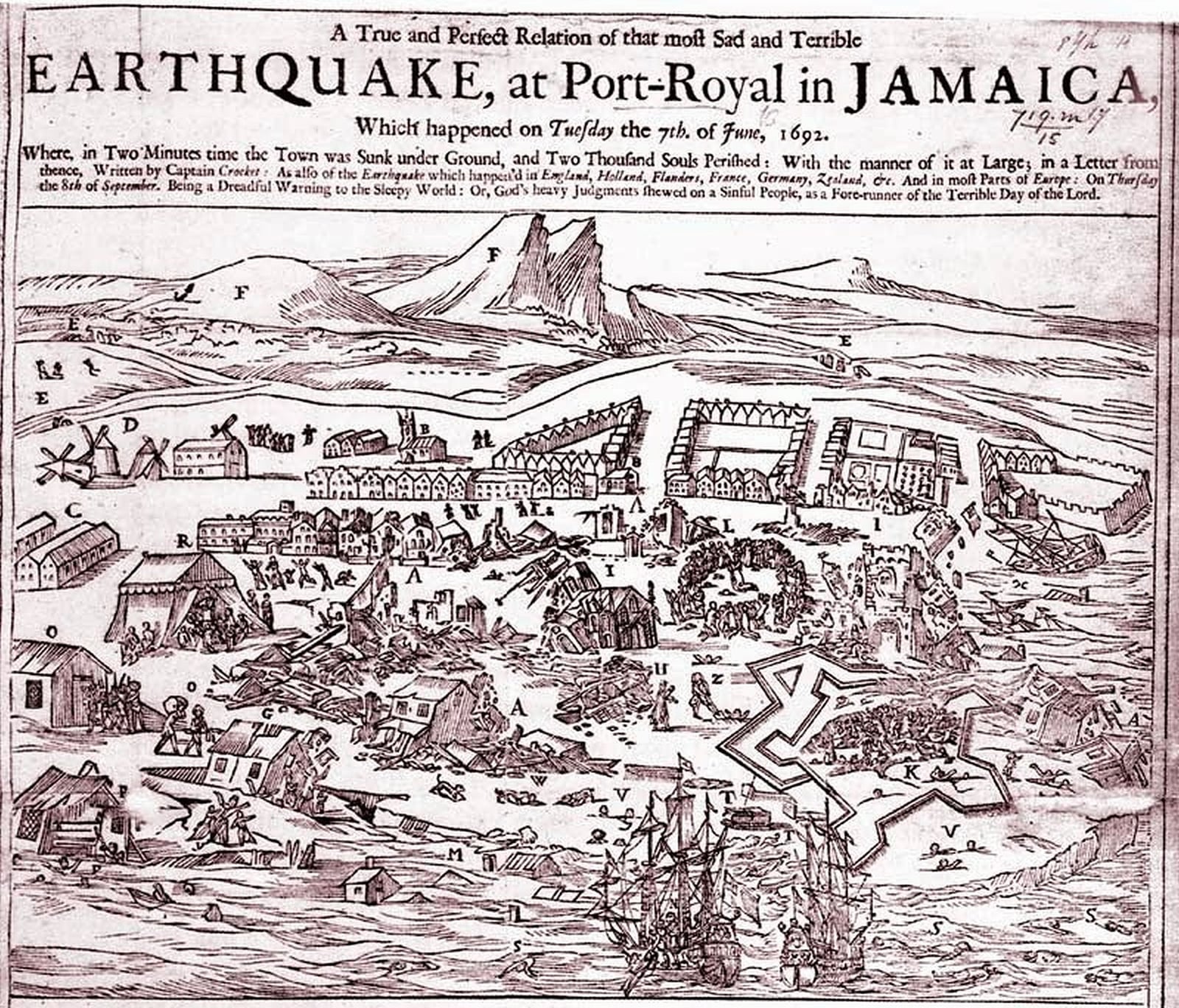
An Earthquake Sinks Much of Port Royal
A Jamaican harbor town famous for pirates slid into the sea in minutes.
On 7 June 1692, a violent earthquake struck the Jamaican port of Port Royal. The maritime settlement occupied the tip of the Palisadoes sand spit guarding Kingston Harbour. Within moments of the tremors, large portions of the crowded urban waterfront collapsed into the sea. Eyewitness accounts recorded structures sliding directly beneath the water, while a following tsunami battered the coast. The catastrophe destroyed much of the northern district along with critical coastal fortifications such as Fort Carlisle and Fort James.
The physical destruction was drastically heightened by the local geology. Port Royal had expanded across roughly twenty metres of loose, water-saturated sand, with a water table resting barely two feet below the surface. Modern geologists and underwater archaeologists attribute the sudden disaster to widespread liquefaction. Under the intense seismic shocks, water pressure between the sand grains surged, turning the ground beneath the heavy English-style brick buildings into a quicksand-like fluid. Rather than remaining upright on solid earth, rows of houses, wharves, and defensive batteries sank straight down or slithered directly outward into the harbour basin.

Keep reading in Yester
Coming soon to the App Store
Keep following the story

Sources
Image: Unknown author Unknown author