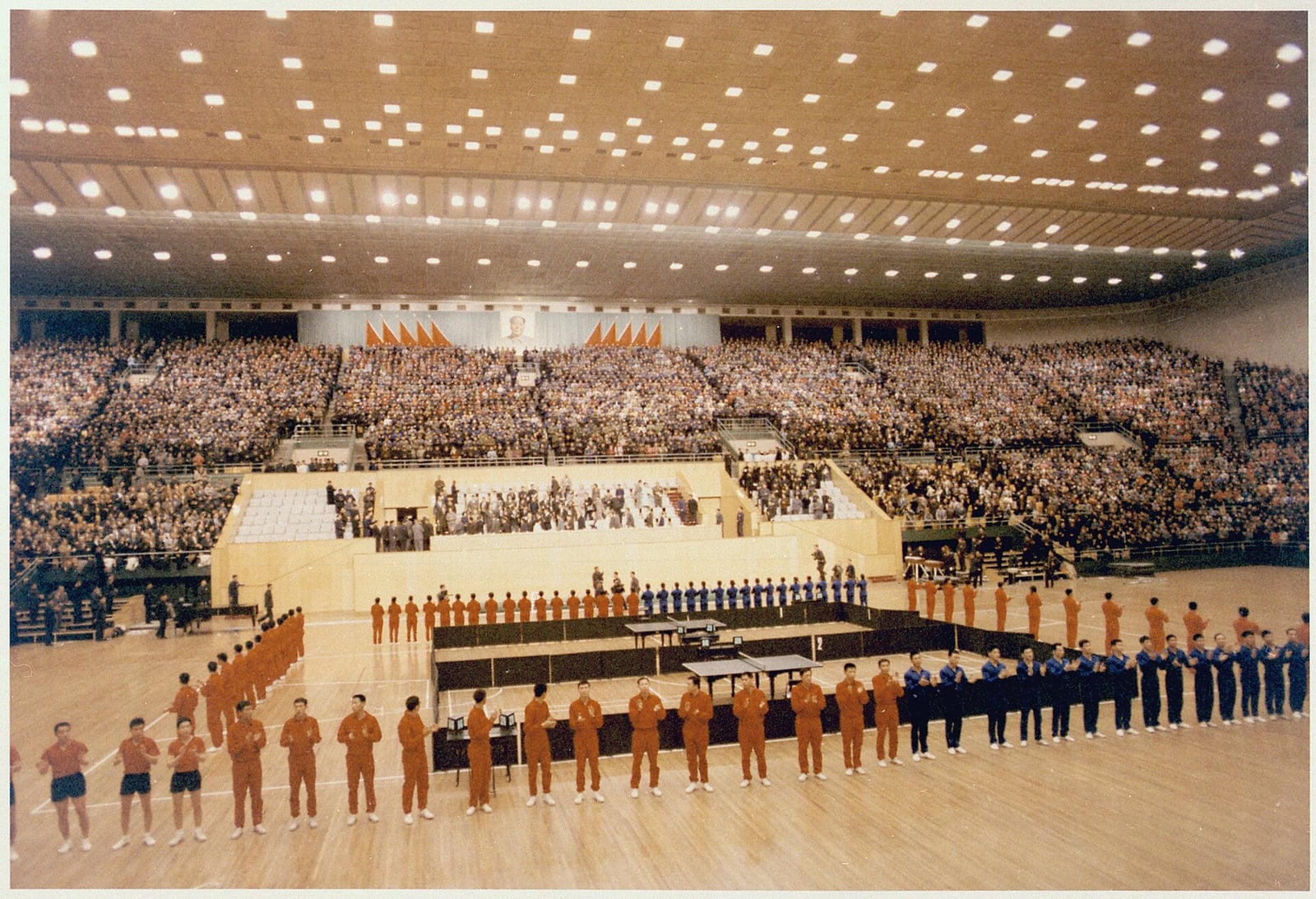
American Table Tennis Players Visit China
An invitation to a team opened a path to diplomatic contact.
Relations between the United States and the People's Republic of China had remained frozen for more than two decades, marked by trade embargoes and ideological hostility following the outbreak of the Korean War in 1950. By the early 1970s, shifting strategic realities prompted both nations to consider a thaw. Beijing sought a counterweight against the Soviet Union following violent border disputes, while Washington desired diplomatic leverage to assist peace negotiations with North Vietnam. Despite this mutual interest, neither government possessed direct official channels to initiate dialogue without appearing to compromise ideological commitments.
Sports had long served as a rare diplomatic instrument for Chinese leaders under the official motto of friendship first, competition second. Athletes were among the few citizens permitted to travel abroad during periods of diplomatic isolation. When the Chinese national table tennis team traveled to the 1971 World Table Tennis Championships in Nagoya, Japan, its players reportedly arrived under orders to avoid contact with American competitors. Meanwhile, the United States had recently lifted its ban on travel to China, leading American player Graham Steenhoven to express interest in future athletic exchanges during a brief conversation with Chinese officials in Nagoya.

Keep reading in Yester
Coming soon to the App Store
Keep following the story

Sources
- Rapprochement with China, 1972 (U.S. Department of State, Office of the Historian)
- Ping-Pong Diplomacy: Artifacts from the Historic 1971 U.S. Table Tennis Trip to China (National Museum of American Diplomacy, U.S. Department of State)
- How Ping-Pong Diplomacy Thawed the Cold War (HISTORY / A&E)
- Table Tennis Delegation (1972) (National Committee on U.S.-China Relations)
- Connie Sweeris, Ping-Pong Diplomat (Smithsonian Magazine)
- Ping-pong diplomacy
Image: Unknown author Unknown author or not provided