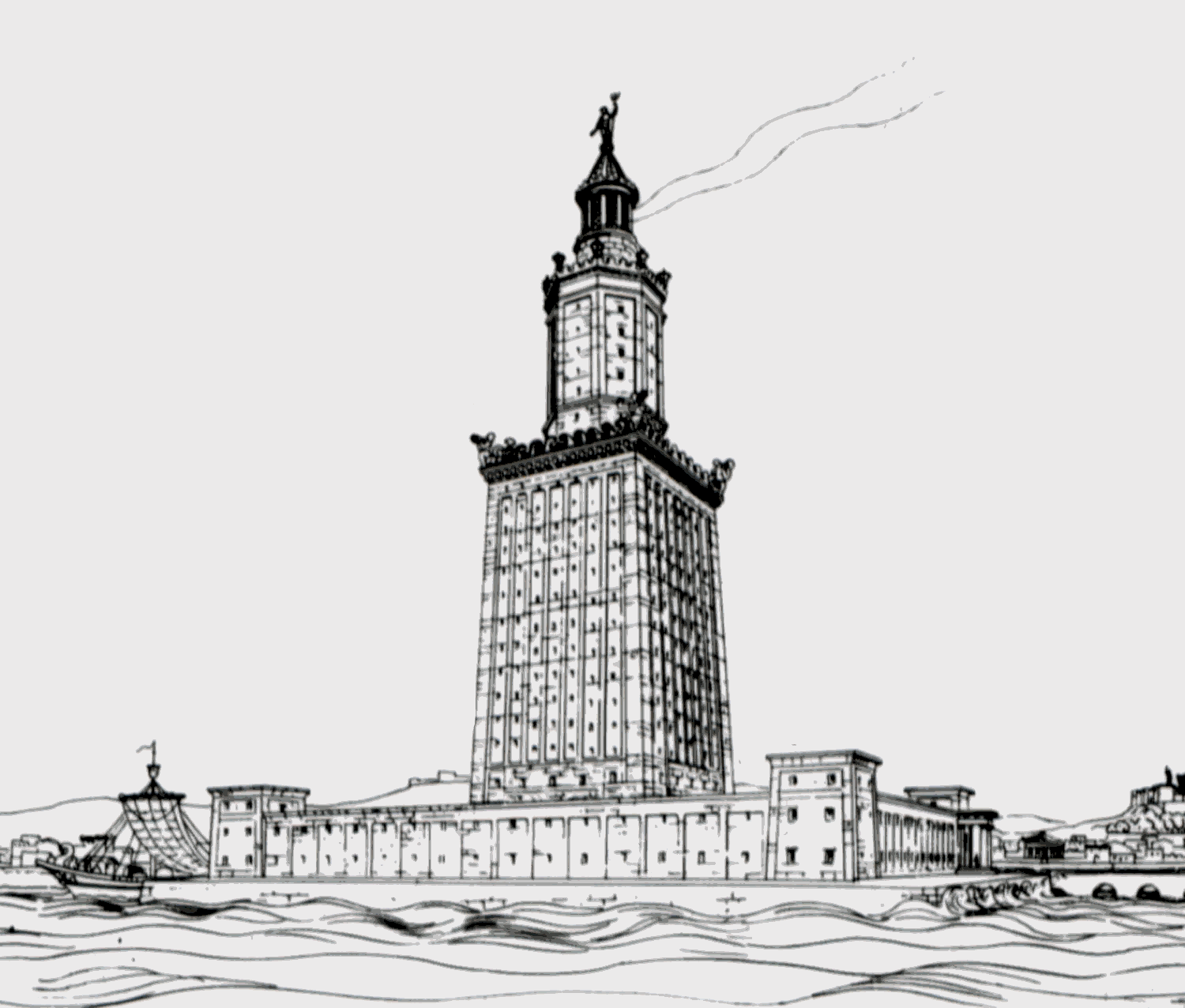
The Pharos Lights the Harbor of Alexandria
The towering lighthouse guided ships for centuries and gave many languages their word for lighthouse.
Approaching the northern coast of Egypt by ship in antiquity was notoriously hazardous, as flat shores offered few natural visual landmarks to alert crews to shallow shoals and submerged reefs. After Alexander the Great founded Alexandria across from the island of Pharos in 332 BC, the need for a secure maritime entrance became paramount. Following Alexander's death, Ptolemy I Soter declared himself king in 305 BC and initiated the construction of a monumental beacon on the eastern tip of Pharos. The engineering project took more than a decade and concluded during the reign of his successor, Ptolemy II Philadelphus, at an reported cost of 800 talents of silver.
Rising to an estimated overall height of at least 100 metres, the tower ranked among the tallest man-made edifices of the ancient world. The structure was fashioned primarily from substantial blocks of light-coloured limestone, sandstone, and granite. According to the geographer Strabo, an inscription presented the tower as an offering by Sostratus of Cnidus for the safety of mariners, while later classical authors debated whether Sostratus had acted as its architect or had merely secured the public inscription.

Keep reading in Yester
Coming soon to the App Store
Keep following the story
Sources
- Pliny the Elder, Natural History 36.18, Bostock translation (Perseus Digital Library, Tufts University)
- Strabo, Geography 17.1, Jones translation (LacusCurtius, University of Chicago)
- Lighthouse of Alexandria, Secrets of the Seven Wonders (Archaeology, Archaeological Institute of America, 2025)
- Lighthouse of Alexandria
Image: Prof. Hermann Thiersch (1874–1939)