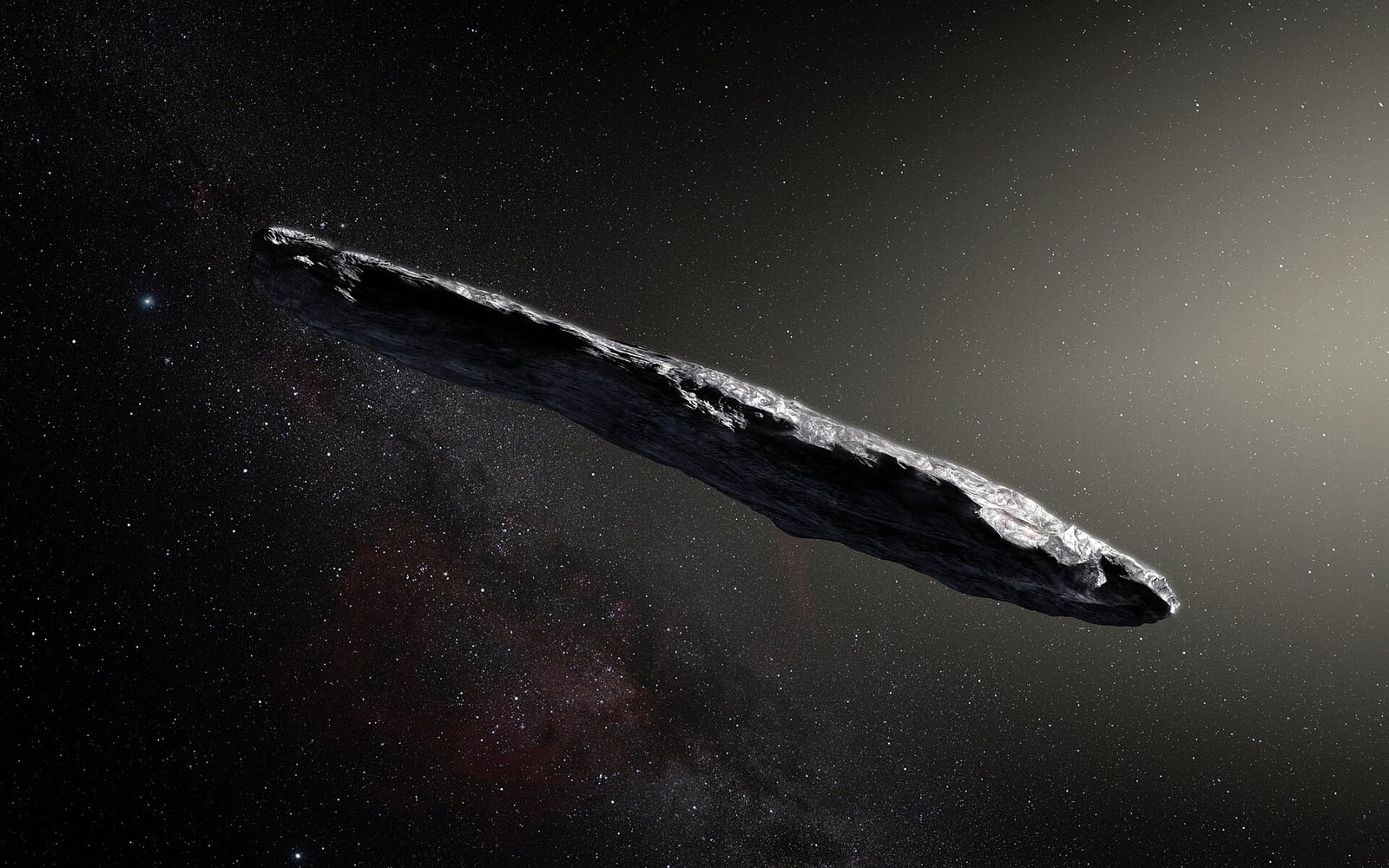
ʻOumuamua Is the First Known Visitor from Another Star
A strange, elongated object spotted from Hawaii was racing through the solar system on a one-way path.
On 19 October 2017, astronomer Robert Weryk of the University of Hawaii's Institute for Astronomy identified a fast-moving astronomical body while examining data from the Pan-STARRS telescope at Haleakalā Observatory in Hawaii. The object was detected approximately forty days after its perihelion, having swept within 0.255 astronomical units of the Sun on 9 September. When first spotted, it was about 30 million kilometers from Earth and speeding along an outward course. Trajectory calculations based on an eighty-day observation window revealed an orbital eccentricity of 1.20, far exceeding the threshold required to break free of solar gravitational capture. This extreme hyperbolic path confirmed that the body came from beyond the Solar System, marking the first verified detection of an interstellar visitor.
Recognizing the unprecedented nature of the discovery, the International Astronomical Union established a new classification system for extrasolar visitors, formally designating the object 1I/2017 U1. It received the Hawaiian name ʻOumuamua, meaning a messenger from afar arriving first, selected by the Pan-STARRS team in consultation with linguists Larry Kimura and Kaʻiu Kimura. Because initial stacked images gathered at the Very Large Telescope revealed no surrounding cloud of gas or dust, the object was initially reclassified from a comet to an asteroid. Subsequent observations from observatories worldwide tracked its reddish hue, which matched the spectroscopic characteristics of organic-rich surfaces in the outer reaches of the Solar System.

Keep reading in Yester
Coming soon to the App Store
Keep following the story

Sources
- The IAU approves new type of designation for interstellar objects (International Astronomical Union)
- ESO Observations Show First Interstellar Asteroid is Like Nothing Seen Before (ESO press release eso1737)
- ESO's VLT Sees `Oumuamua Getting a Boost (ESO press release eso1820)
- 'Oumuamua (NASA Science)
- Surprisingly simple explanation for the alien comet 'Oumuamua's weird orbit (ScienceDaily, University of California, Berkeley)
- Acceleration of 1I/`Oumuamua from radiolytically produced H2 in H2O ice (arXiv, Bergner and Seligman, Nature 2023)
- 1I/ʻOumuamua
Image: ESO/M. Kornmesser