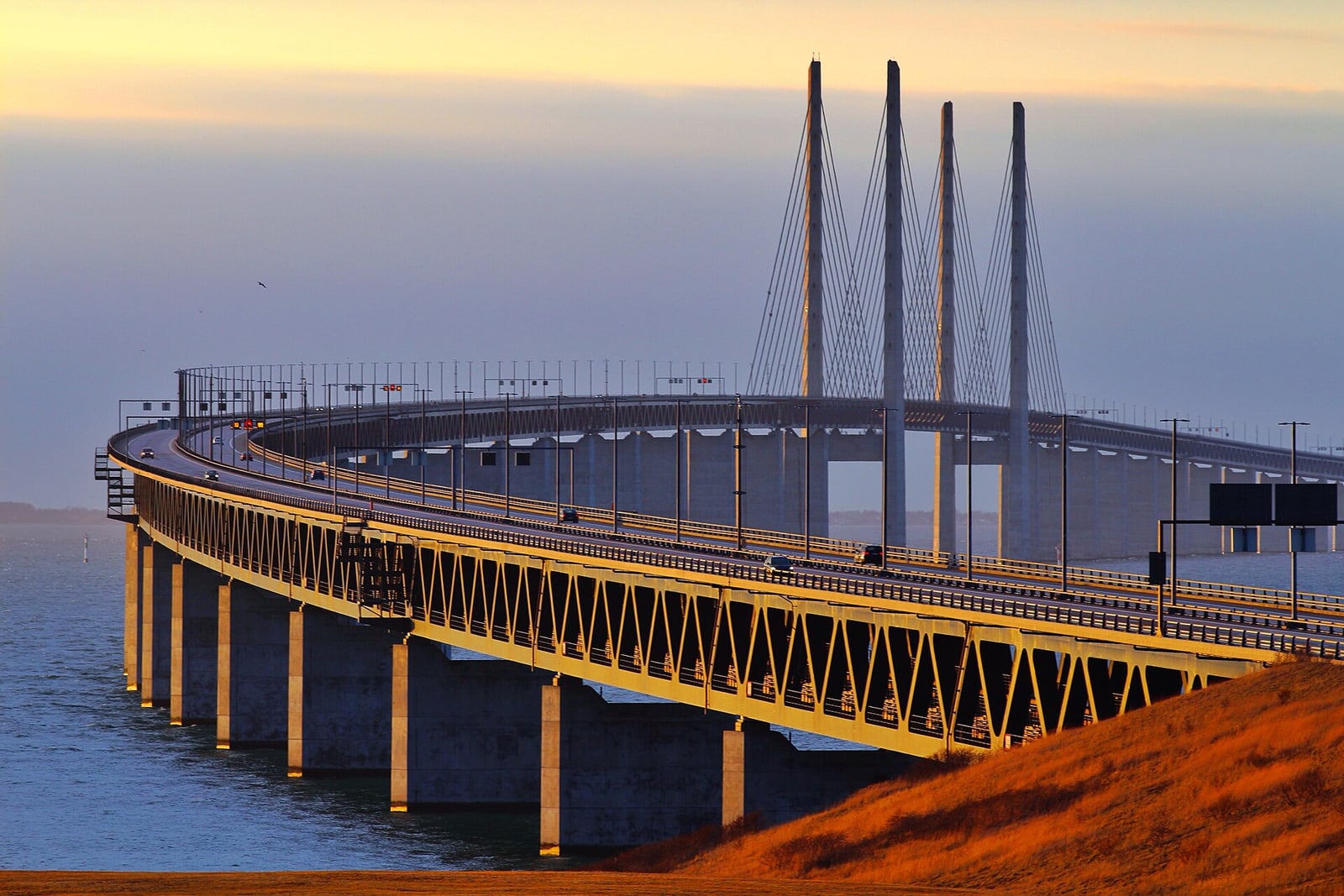
The Øresund Bridge Links Sweden and Denmark
A bridge and an undersea tunnel joined Copenhagen and Malmö by road and rail.
On 1 July 2000, Queen Margrethe II of Denmark and King Carl XVI Gustaf of Sweden officially inaugurated the fixed link crossing the sound between Copenhagen and Malmo. Public traffic began crossing later that afternoon, uniting the road and railway systems of the Scandinavian Peninsula with the Danish network and wider continental Europe. The passage spans nearly sixteen kilometres across the sound, combining an immersed undersea tunnel, a newly constructed artificial island, and an elevated cable-stayed bridge.
Proposals for a permanent crossing had circulated for over a century, beginning with late nineteenth-century concepts and a 1910 railway scheme presented to the Swedish Parliament. Although Denmark and Sweden signed a preliminary agreement in 1973, financial strains and ecological arguments caused the project to be abandoned in 1978. Negotiations resumed during the 1980s, culminating in a bilateral treaty signed on 23 March 1991. The accord designated a route between Kastrup, south of Copenhagen, and Limhamn, on the southern outskirts of Malmo.

Keep reading in Yester
Coming soon to the App Store
Keep following the story

Sources
- Historical Milestones (Øresundsbron)
- Facts about Øresundsbron (Øresundsbron)
- The Øresund Bridge: linking Scandinavia to the continent (Ingenia, Royal Academy of Engineering)
- Öresund Bridge (Bridgeinfo, broer.no)
- Fact Sheet: The Effects of the ID- and Border Checks between Scania and Zealand (Øresund Institute)
- Øresund Bridge
Image: Håkan Dahlström