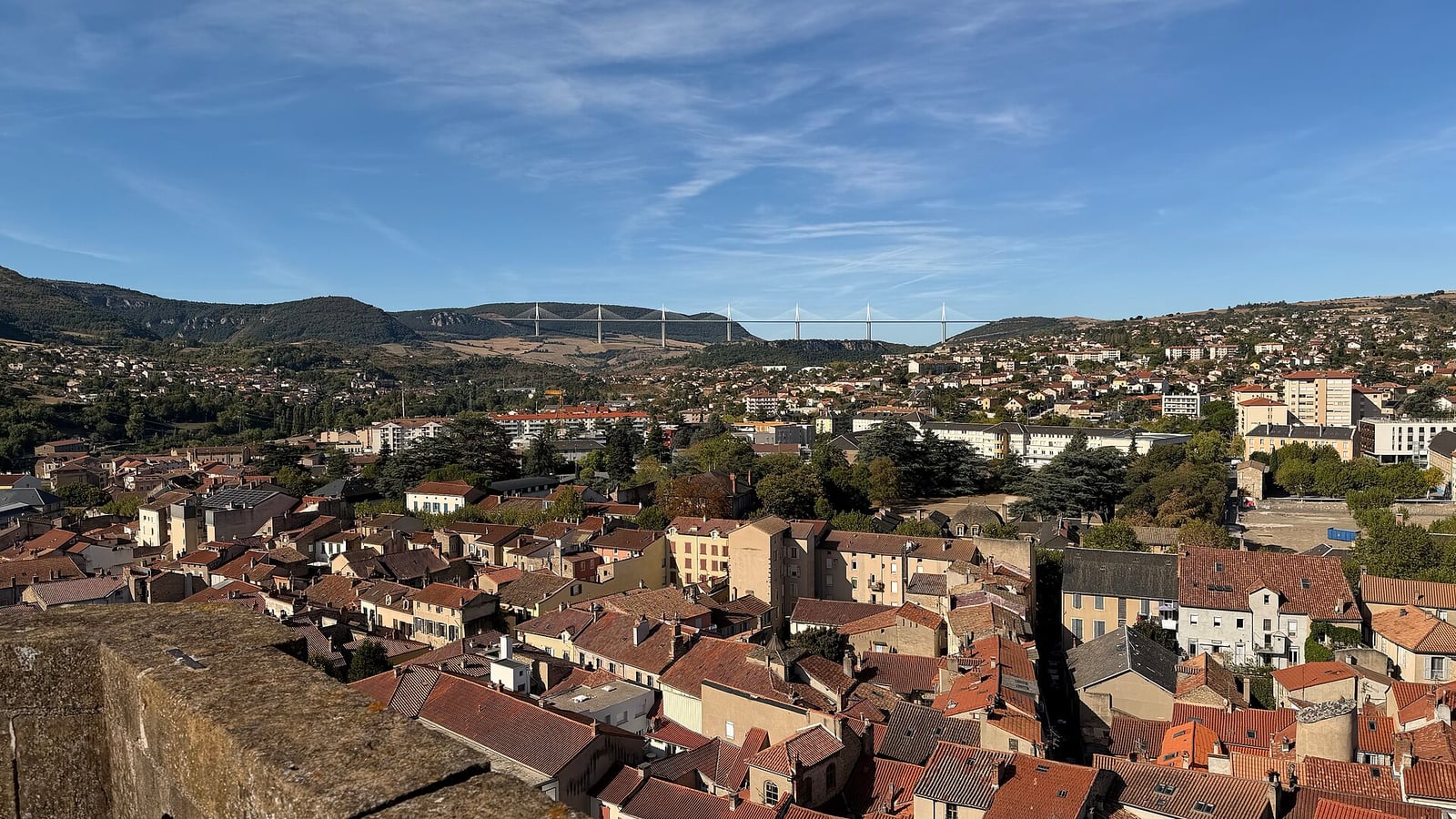
The Millau Viaduct Spans the Tarn Valley
A cable-stayed bridge with the world’s tallest piers opened in southern France.
During the 1980s, the French commune of Millau became notorious for chronic traffic gridlock. Situated in the deep Tarn River valley within the Aveyron department, the town served as a natural choke point on the route connecting Paris to Béziers and the Mediterranean coast. Holiday traffic bound for southern France and Spain had to descend into the gorge along Route Nationale 9, regularly producing severe delays during July and August. To solve this bottleneck and complete the A75 autoroute, the French Ministry of Public Works initiated preliminary studies in 1987 to examine bypass solutions, ultimately focusing on a high-level viaduct that would span the entire valley rather than dropping into it.
Selecting a viable engineering strategy required years of consultation among transport officials, civil engineers, and architects. State planners evaluated four main geographic corridors, ranging from an eastern route requiring two long bridges to a western option traversing delicate rural landscapes. In October 1991, ministerial authorities settled on an intermediate route west of Millau. This alignment demanded a continuous crossing roughly two and a half kilometers long, elevated more than 200 meters above the river. An international competition concluded in July 1996 with the selection of a multi-span cable-stayed design developed by structural engineer Michel Virlogeux, architect Norman Foster, and their collaborating engineering consortia.

Keep reading in Yester
Coming soon to the App Store
Keep following the story

Sources
Image: Isabelle Blanchemain from Agglomération de Montpellier, France