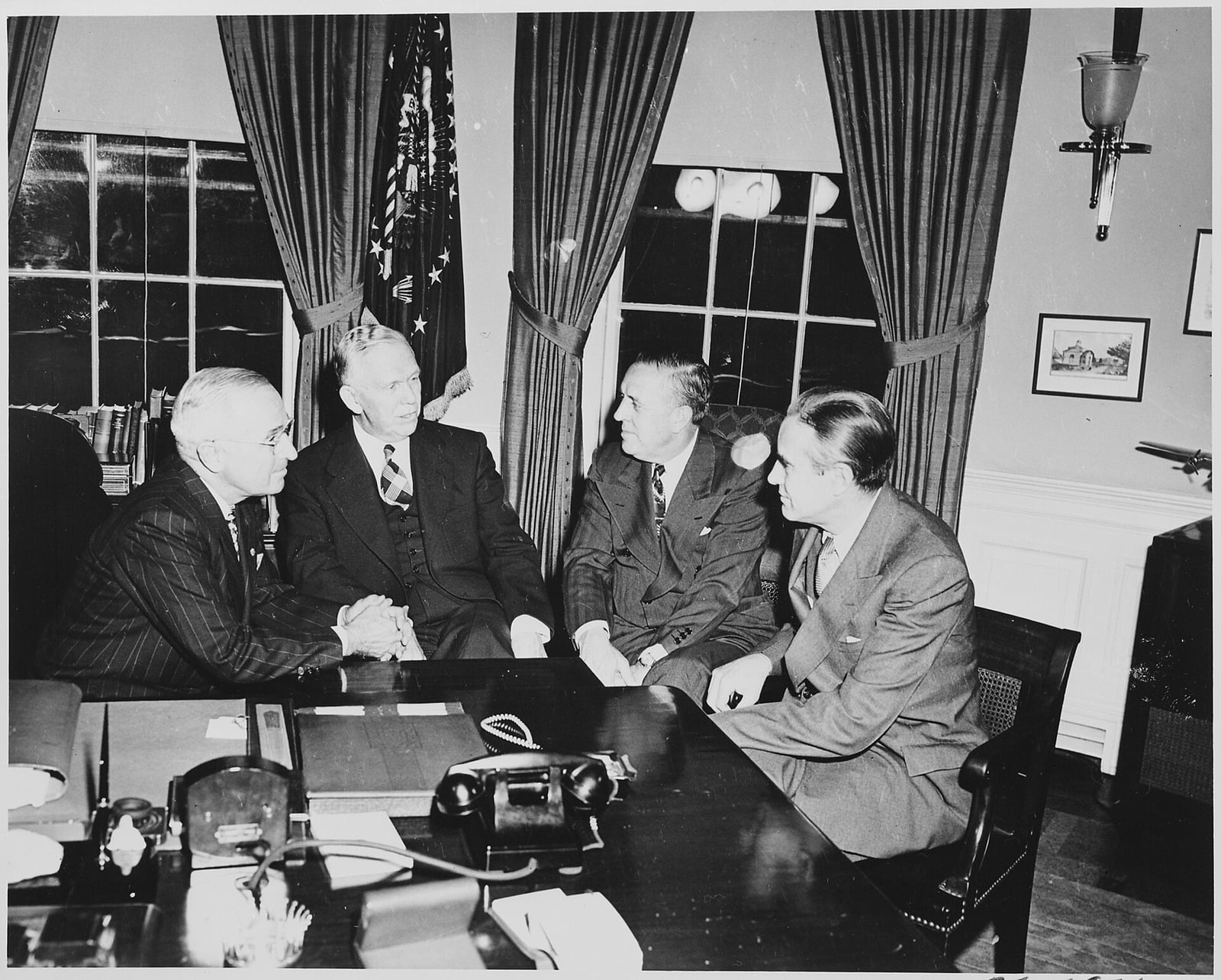
The Marshall Plan Begins Rebuilding Europe
American aid helped restart economies devastated by war.
On April 3, 1948, President Harry S. Truman signed the Economic Cooperation Act, inaugurating the European Recovery Program, a multi-billion-dollar foreign aid initiative popularly named after Secretary of State George C. Marshall. The postwar United States confronted widespread disruption across Western Europe, where aerial bombing had devastated urban centers and shattered transportation links such as railways, docks, and bridges. Severe food shortages during the harsh winter of 1946–1947 forced populations onto limited daily rations. At the same time, earlier American relief programs, including food shipments and funding through the United Nations Relief and Rehabilitation Administration, had treated immediate deprivation without establishing a coordinated mechanism to restore production across the continent.
American policy shifted decisively as officials concluded that European recovery required reviving the industrial capacity of Germany. Earlier directives had favored demilitarization and import restrictions, but by mid-1947 the State Department determined that a stable and productive Germany was essential to European prosperity. The Truman administration also acted on the doctrine of containment, seeking to halt Soviet influence and counter the rise of Moscow-aligned communist parties in nations such as France and Italy. Delivering a commencement address at Harvard University in June 1947, Marshall proposed financial aid on the condition that European nations jointly assemble their own program for economic rehabilitation.

Keep reading in Yester
Coming soon to the App Store
Keep following the story



Sources
- Marshall Plan (1948), Milestone Documents (U.S. National Archives)
- Marshall Plan, 1948 (U.S. Department of State, Office of the Historian)
- The Marshall Plan: Design, Accomplishments, and Significance, R45079 (Congressional Research Service, via EveryCRSReport)
- J. Bradford De Long and Barry Eichengreen, The Marshall Plan: History's Most Successful Structural Adjustment Program (NBER Working Paper 3899)
- The Marshall Plan (Encyclopedia.com, Gale)
- Marshall Plan
Image: Abbie Rowe