Lemaître Proposes an Expanding Universe
A Belgian priest and physicist argued that the universe is growing.
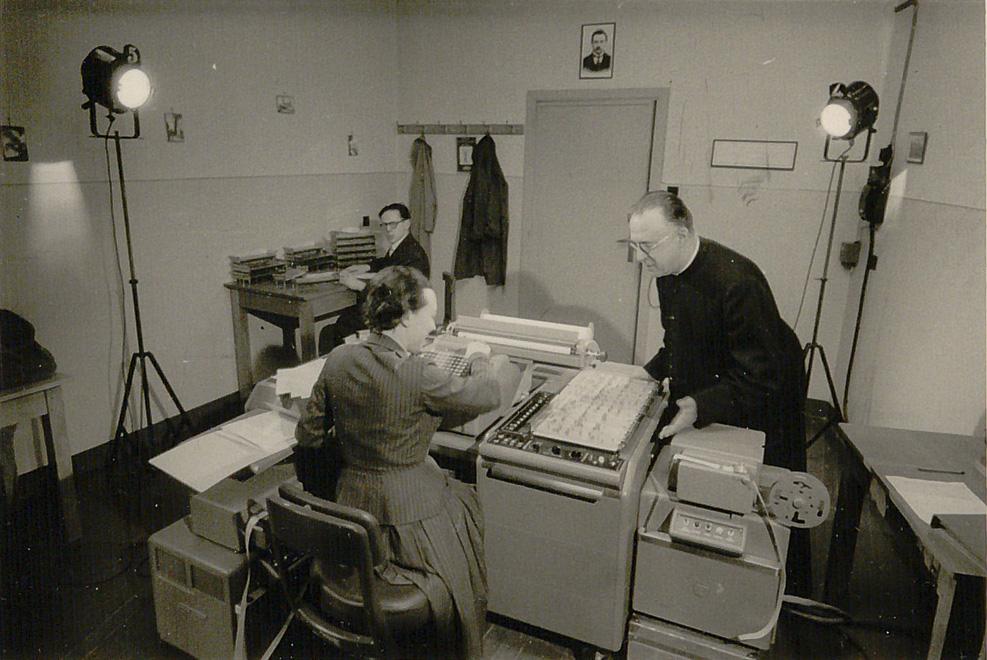
In 1927, Georges Lemaitre, a Belgian Catholic priest and theoretical physicist who had recently completed his doctoral dissertation at the Massachusetts Institute of Technology, published a theoretical paper in the Annales de la Societe Scientifique de Bruxelles. Within its pages, Lemaitre demonstrated that the field equations of Albert Einstein's general theory of relativity allowed for a universe that was non-static and continually expanding. He paired this mathematical deduction with astronomical observations of distant extragalactic nebulae, pointing out an apparent proportional relationship between their distances from Earth and their radial velocities.
Lemaitre's innovative conclusion challenged the prevailing scientific consensus of the 1920s, which favored an eternal, static cosmos. When Lemaitre met Einstein in Brussels in 1927 to discuss his conclusions, Einstein resisted the dynamic model. Although Einstein acknowledged that Lemaitre's mathematical calculations were accurate, he dismissed the physical implications as unacceptable, maintaining his preference for a static universe maintained by a finely tuned cosmological constant.

Keep reading in Yester
Coming soon to the App Store
Keep following the story
Sources
- Mystery of the missing text solved, M. Livio, Nature 479 (2011)
- Was the real discovery of the expanding universe lost in translation? (Phys.org / STScI)
- The Beginning of the World from the Point of View of Quantum Theory, G. Lemaitre, Nature 127 (1931)
- Georges Lemaitre biography (MacTutor, University of St Andrews)
- IAU recommends renaming Hubble's law to include Lemaitre (Astronomy Now, reproducing IAU release)
- Georges Lemaitre: Life, Science and Legacy, S. Mitton (arXiv, Cambridge)
- The Pius XII - Lemaitre Affair (1951-1952) on Big Bang and Creation (Inters.org, Pontifical University of the Holy Cross)
- Georges Lemaître
Image: Archives de l'Université catholique de Louvain