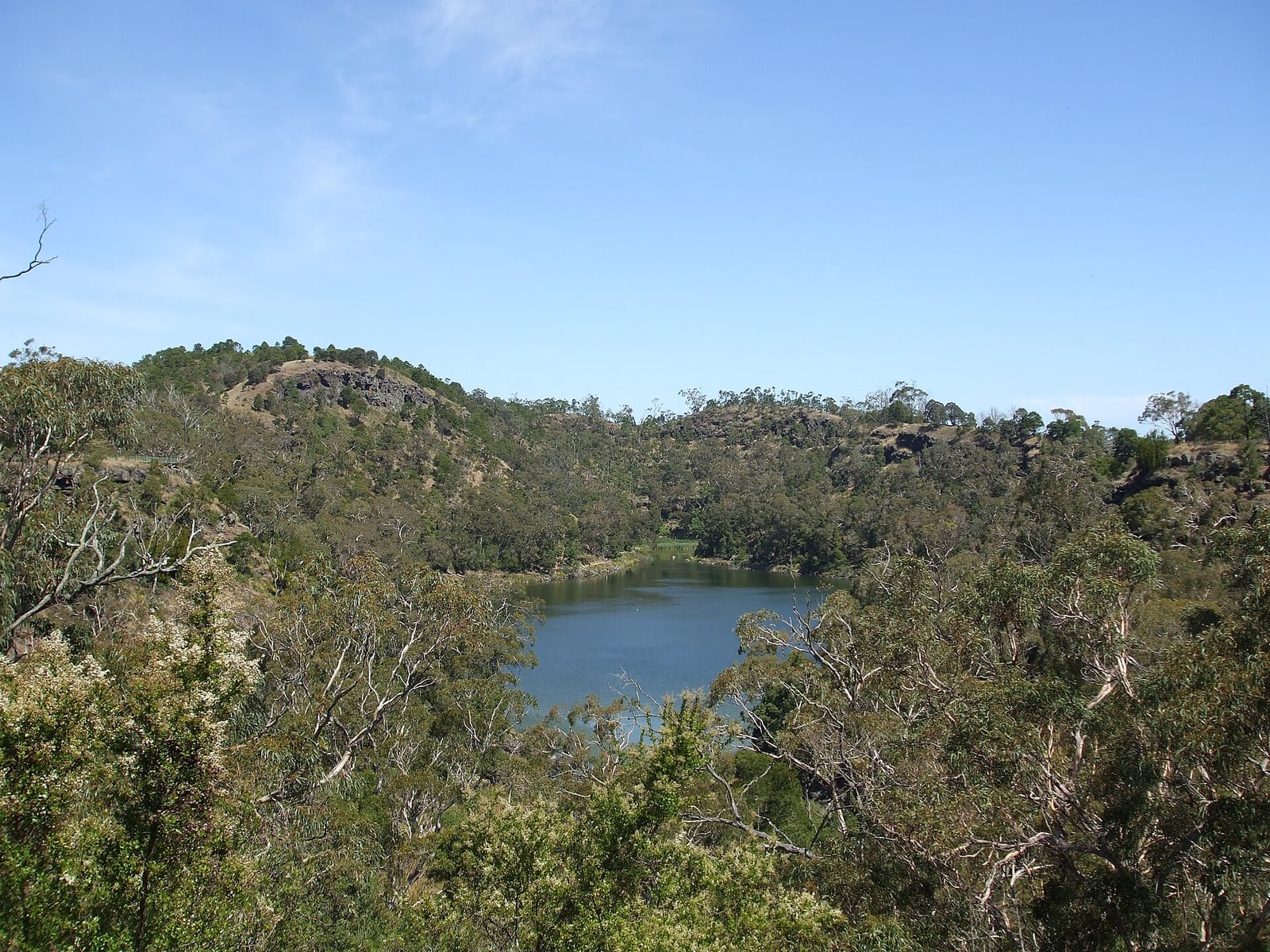
The Gunditjmara Build Eel Traps at Budj Bim
Channels cut through lava flows formed one of the world’s oldest aquaculture systems.
In southwestern Victoria, Australia, the traditional territory of the Gunditjmara people spans an estimated seven thousand square kilometres, reaching from the coast at Portland and Port Fairy inland toward Lake Condah and Hamilton. Across this basalt country, the ancestral volcano known as Budj Bim erupted roughly thirty-seven thousand years ago, spilling lava flows that shaped a complex terrain of rocky wetlands. Rather than treating this volcanic surface as an obstacle, the Gunditjmara transformed it over millennia into an extensive, highly organised infrastructure for aquatic management.
Across more than one hundred square kilometres of wetlands and stony ground, the Gunditjmara constructed kilometres of channels, holding ponds, weirs, and stone races designed primarily to manage and harvest short-finned eels, or kooyang. Women made large woven baskets that were positioned in the channels to cull mature eels, while stone dams retained water across the swampy basalt country. Palynological research by Peter Kershaw documented shifts in regional vegetation consistent with artificial ponding systems, and dating evidence shows that the Gunditjmara have been building and managing the system for at least 6,600 years. In addition to stone cairns and canals, the Gunditjmara erected stone house sites built from local basalt with roofs of turf and branches.

Keep reading in Yester
Coming soon to the App Store
Keep following the story
Sources
Image: Dhx1