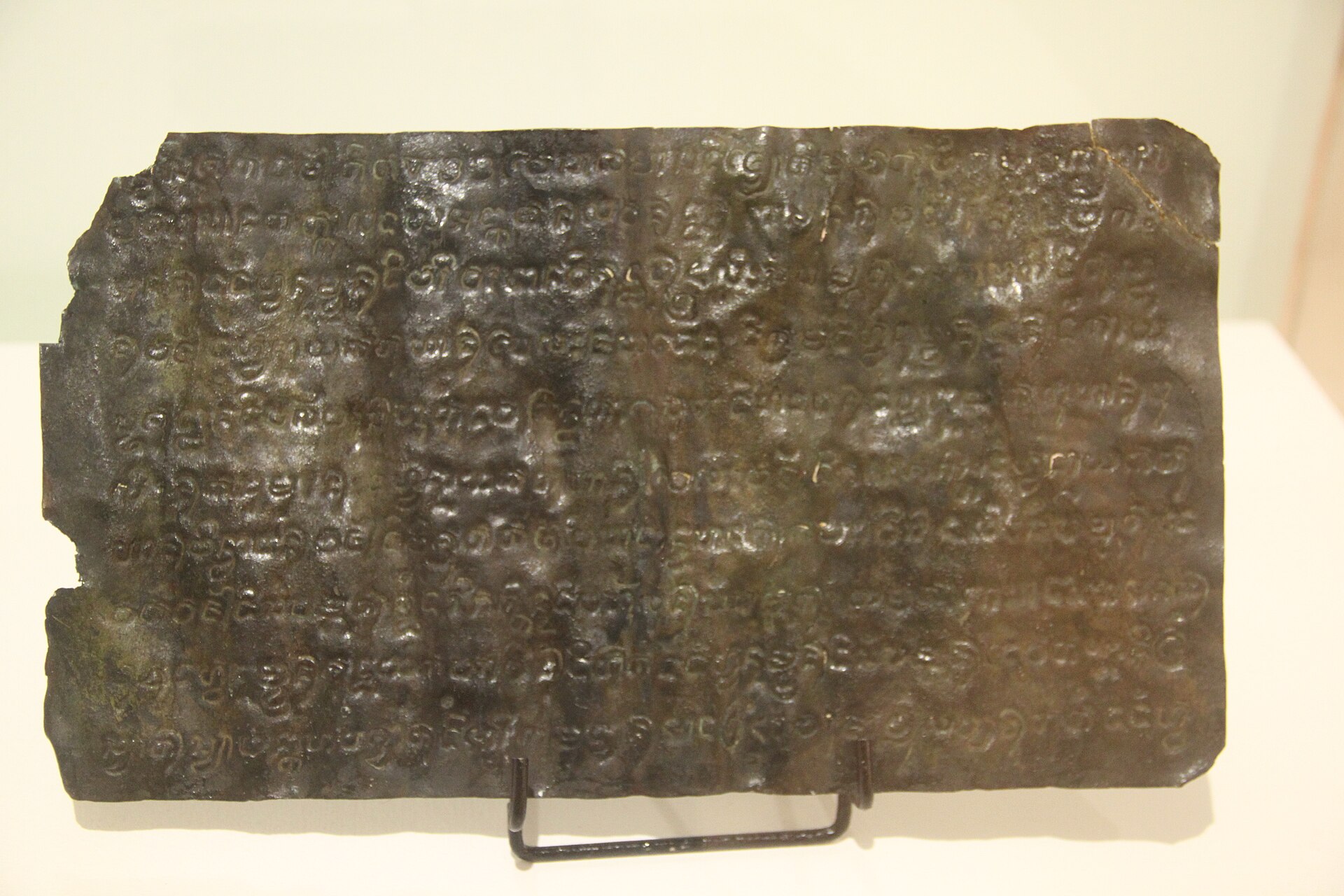
A Copper Plate Records a Debt in Ancient Luzon
The oldest known document from the Philippines was found in the late 1980s.
In the late 1980s, a laborer dredging sand near the mouth of the Lumbang River in Laguna, Luzon, retrieved a blackened sheet of metal from the riverbed. Measuring roughly twenty by thirty centimeters, the thin copper plate bore ten lines of fine text. It eventually reached the National Museum of the Philippines, where Dutch anthropologist Antoon Postma examined the artifact and recognized its lettering as the early Southeast Asian Kawi script. By 1991, Postma published the first decipherment of the text, identifying it as the oldest surviving calendar-dated document recovered within the Philippine archipelago.
The opening passage fixes its creation with remarkable precision, noting the weekday Somavara, the fourth day of the waning moon in the month of Vaishakha, and the year 822 of the Shaka era. This astronomical tally aligns with Monday, April 21, 900, on the Julian calendar. Written primarily in Old Malay, the text incorporates numerous Sanskrit terms for technical and astronomical vocabulary alongside honorifics and expressions that show Old Javanese or Old Tagalog characteristics. Rather than an imperial decree or religious hymn, the inscription constitutes an official legal clearance: it confirms that the children of an individual named Namwaran were fully released from an inherited debt of one kati and eight suwarnas of gold.

Keep reading in Yester
Coming soon to the App Store
Keep following the story
Sources
- The Laguna Copperplate Inscription: Tenth-Century Luzon, Java, and the Malay World, Clavé and Griffiths (Philippine Studies: Historical and Ethnographic Viewpoints, Ateneo de Manila University)
- A receipt in copper, Ambeth Ocampo (Philippine Daily Inquirer)
- Bapa Antoon (The Philippine Star)
- Laguna Copperplate Inscription
Image: Gary Todd from Xinzheng, China