The Knickerbocker Club Writes Rules for Baseball
A New York club codified rules for an American bat-and-ball game.
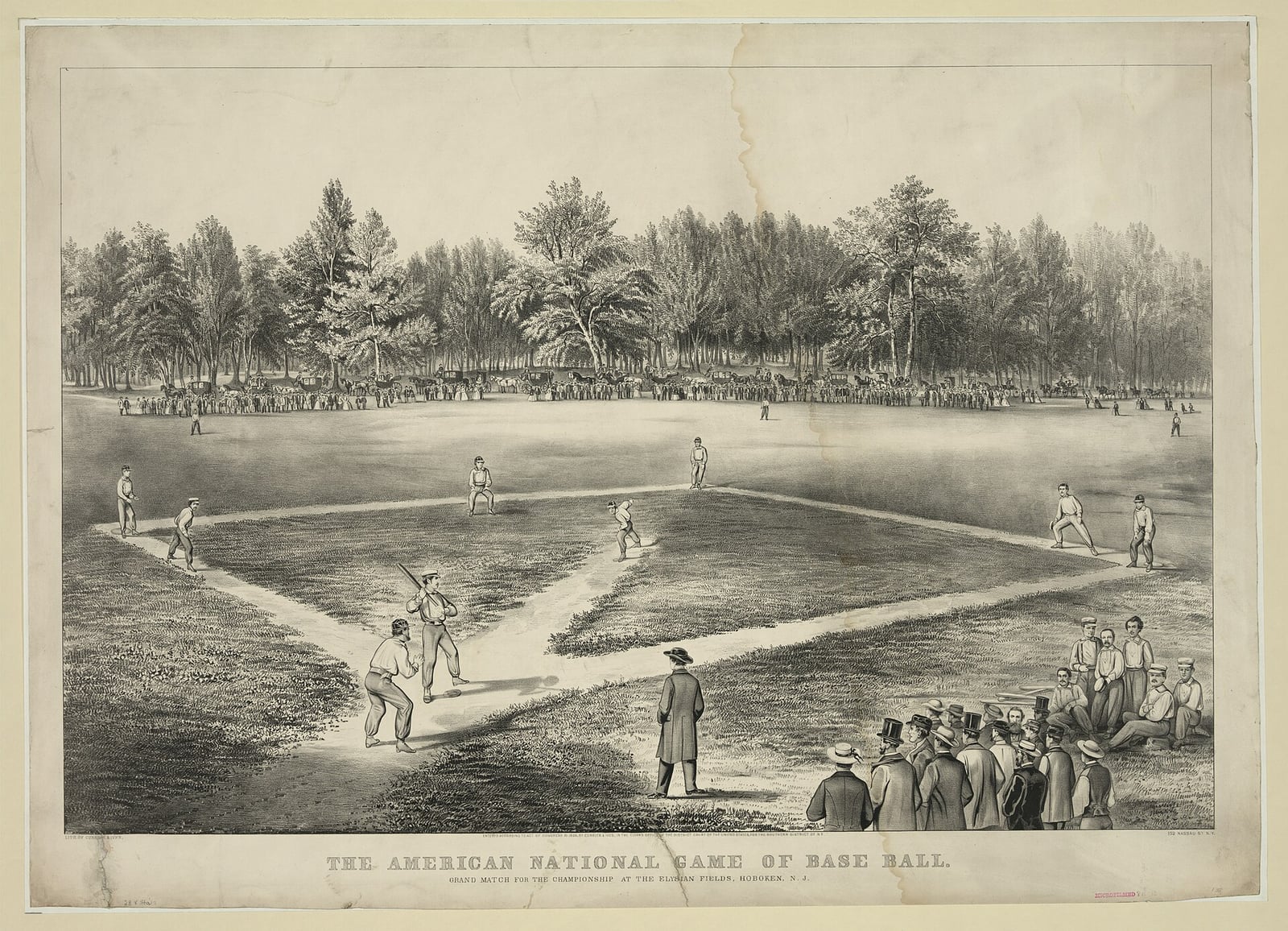
In 1845, members of the Knickerbocker Base Ball Club in New York formalized a written code to regulate their bat-and-ball contests. Formulated by William R. Wheaton and William H. Tucker, the document came to be known as the Knickerbocker Rules. For many decades, popular histories treated these regulations as the foundational basis of modern baseball, distinguishing the New York style of play from contemporary regional alternatives such as Philadelphia town ball or the Massachusetts Game. However, modern scholarship treats claims of their absolute originality with caution. Research indicates that other regional clubs predated the Knickerbockers, including the Gotham Club, for which Wheaton, by his own later account, had written down playing rules in 1837. Historian Jeffrey Kittel has argued that virtually none of the 1845 provisions were entirely original, perhaps apart from the concept of three-out half-innings. Despite this dispute over priority, the Knickerbocker code remains the oldest surviving written rule set from which the lineal evolution of the organized sport can be clearly traced.
The 1845 regulations described an amateur game that bore notable structural differences from modern competition, alongside several provisions that remain recognizable. Rather than spanning nine fixed innings, a match ended once a team scored twenty-one aces, or runs, provided both sides had completed an equal number of turns at bat. Because an offensive frame concluded after three hands were put out, a contest could theoretically conclude in a single turn if one club amassed the required tallies immediately. Fixed nine-inning contests were not established until an 1857 convention. Infield dimensions were measured not in precise feet, but by setting forty-two paces diagonally across the diamond from home to second base and from first to third base. Depending on contemporary interpretations of a pace as either two and a half or three feet, the distance between the bases ranged from approximately seventy-five to just under ninety feet, with the ninety-foot standard likewise receiving formal ratification in 1857.

Keep reading in Yester
Coming soon to the App Store
Keep following the story
Sources
- Knickerbocker Rules (New York): 1845 (Vintage Base Ball Association)
- October 1845: The first recorded baseball games in New York (SABR)
- Nine innings, nine players and other rules: The recodification of base ball in 1857 (SABR)
- Baseball Americana: Baseball's Magna Carta (Library of Congress)
- Why there are three strikes and four balls (MLB.com)
- Baseball 1858-1865: By the Numbers (SABR Baseball Research Journal)
- June 8, 1885: Cannonball Morris dominates after overhand pitching is suddenly legalized (SABR)
- Knickerbocker Rules
Image: Currier & Ives.