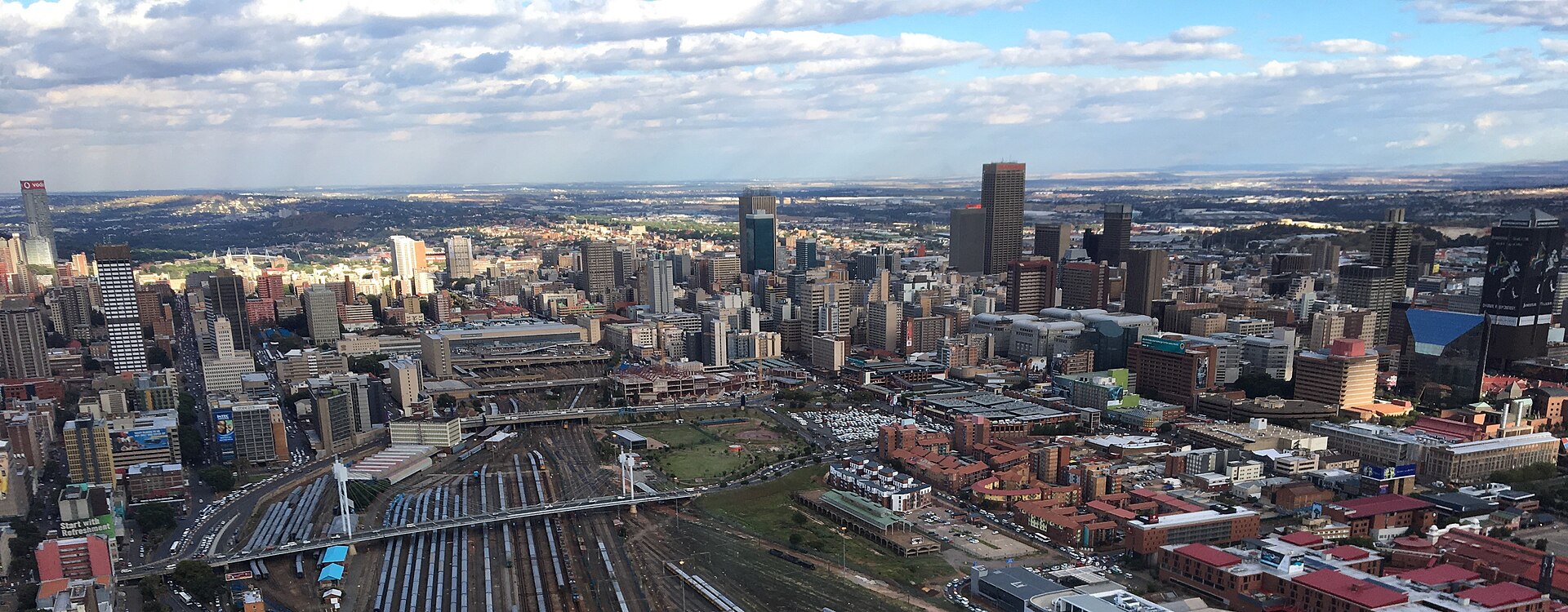
Gold on the Witwatersrand Creates Johannesburg
A gold reef found in 1886 turned a highveld farm into a city within a decade.
Prior to the rise of commercial mining, the highveld plateau was shaped by long sequences of human habitation. Stone-tool using San hunter-gatherers lived across the surrounding landscape hundreds of years before diverse Sotho-Tswana farming communities formed extensive networks of stone-walled settlements by the eighteenth century. Regional conflicts in the early nineteenth century displaced many of these towns, leading to the rise of the Ndebele kingdom to the northwest. In the latter half of the nineteenth century, European farmers established rural holdings across the plateau, naming their properties after the natural springs that dotted the terrain, with little expectation of large-scale urban development.
Prospecting transformed the area during the mid-1880s. Jan Gerrit Bantjes made the first recorded gold find on the Witwatersrand, on the farm Vogelstruisfontein in June 1884, and the Struben brothers uncovered the Confidence Reef at Wilgespruit later that year, though both proved to be minor reefs. The decisive find came in 1886, when an itinerant Australian prospector, George Harrison, located the outcrop of the Main Reef on the farm Langlaagte. The influx of diggers gathered initially in makeshift settlements such as Ferreira's Camp, set up in a dip where surface water was accessible. The government of the South African Republic quickly moved to survey the ground, recording the layout of the first formal neighborhood, Randjeslaagte, in late 1886.

Keep reading in Yester
Coming soon to the App Store
Keep following the story
Sources
- Discovery of the Gold in 1884 (South African History Online)
- George Harrison Park (South African History Online)
- The Randjeslaagte Beacon, Parktown Johannesburg (South African History Online)
- The South African War (South African History Online)
- Arrival of Chinese labourers in South Africa (South African History Online)
- Sir Ernest Oppenheimer (South African History Online)
- 1976: Soweto protest turns violent (BBC On This Day)
- Johannesburg
Image: Mark Hillary