Jai Singh II Builds Giant Instruments to Measure the Sky
Masonry observatories in Jaipur still tell the time by the sun.
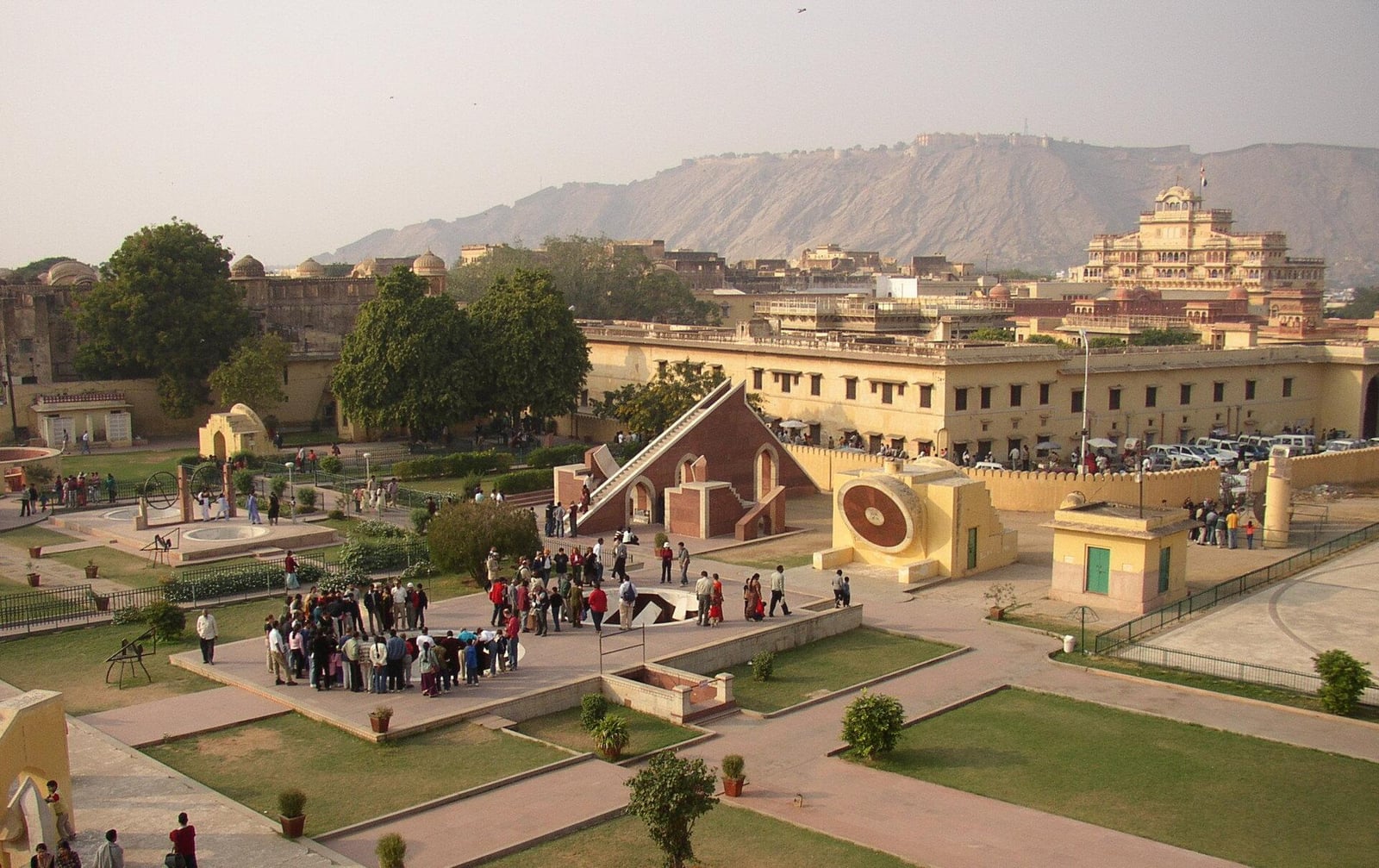
In the early eighteenth century, the Rajput ruler Sawai Jai Singh initiated the construction of five monumental masonry observatories across northern India. Having observed discrepancies between existing astronomical tables and the actual positions of celestial bodies, Jai Singh sought to produce more reliable data. The complex established in his newly founded capital of Jaipur, situated near the City Palace and Hawa Mahal, became the central hub of this scientific initiative. Construction was underway by 1728, reaching its peak around 1735, and the site came to replace Delhi as Jai Singh's primary observatory until his death in 1743.
Known as the Jantar Mantar, derived from Sanskrit terms meaning calculating instrument, the complex features nineteen large-scale structures designed for naked-eye observation within the Ptolemaic positional tradition. Spread across approximately 18,700 square metres, the instruments were constructed from local stone, marble, brick, mortar, and bronze. Each device incorporates finely calibrated astronomical scales, predominantly etched directly onto marble linings. The ensemble encompasses the three primary classical coordinate systems: the local horizon-zenith, the equatorial, and the ecliptic planes.

Keep reading in Yester
Coming soon to the App Store
Keep following the story
Sources
- The Jantar Mantar, Jaipur (UNESCO World Heritage Centre)
- The Observatory Sites (jantarmantar.org, Barry Perlus, Cornell University)
- The Observatories (jantarmantar.org, Barry Perlus, Cornell University)
- The Maharaja's masterpiece! Secrets of Jantar Mantar (BBC Sky at Night Magazine)
- The Jantar Mantar at Jaipur (INCOIS, Ministry of Earth Sciences, Government of India)
- Jai Singh and the Jantar Mantar, Paul Lunde (Saudi Aramco World, March/April 1991)
- Jantar Mantar, Jaipur
Image: Knowledge Seeker