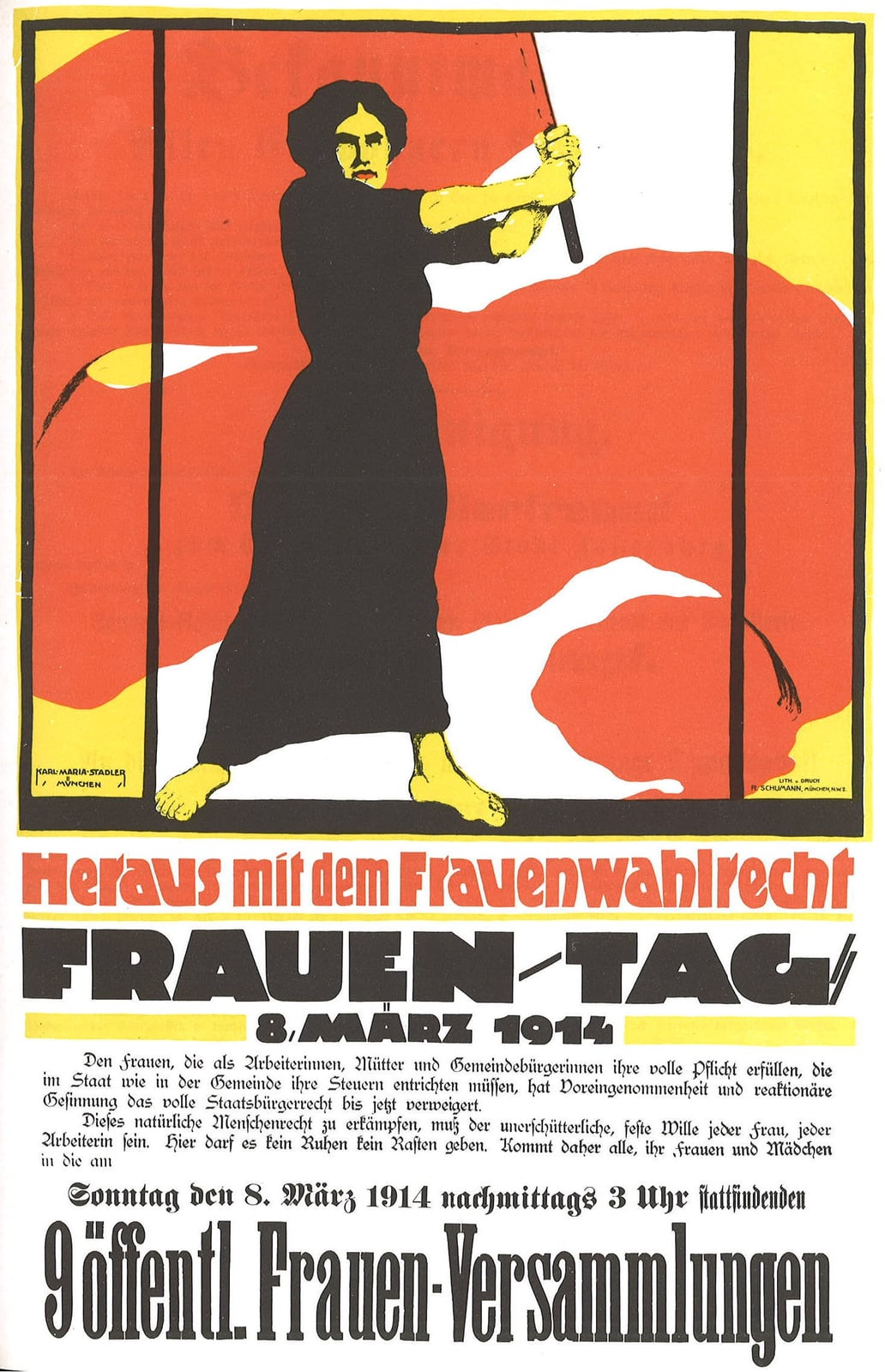
Women March on the First International Women’s Day
Over a million people rallied in Austria, Denmark, Germany and Switzerland.
On 19 March 1911, public squares and boulevards across central Europe filled with crowds marking the first International Women's Day. More than one million women and men assembled across Austria-Hungary, Denmark, Germany, and Switzerland to demand fundamental political and civil entitlements. In Austria-Hungary alone, organizers staged three hundred distinct rallies. Among the most prominent gatherings was a procession along the grand Ringstrasse in Vienna, where marchers hoisted commemorative banners honoring the martyrs of the 1871 Paris Commune while petitioning for the right to vote, the opportunity to hold public office, and an end to sex discrimination in employment.
This coordinated international mobilisation emerged directly from earlier socialist labour initiatives in both North America and Europe. In the United States, the Socialist Party of America had sponsored the earliest recorded Woman's Day in New York City on 28 February 1909, following a proposal by activist Theresa Malkiel. Although later popular accounts asserted that this event commemorated an 1857 protest by local textile workers, historical researchers have identified that narrative as a myth. The American rallies nevertheless captured the attention of European socialists looking for an effective mechanism to advance universal female suffrage.

Keep reading in Yester
Coming soon to the App Store
Keep following the story
Sources
Image: Karl Maria Stadler (1888 – nach 1943)