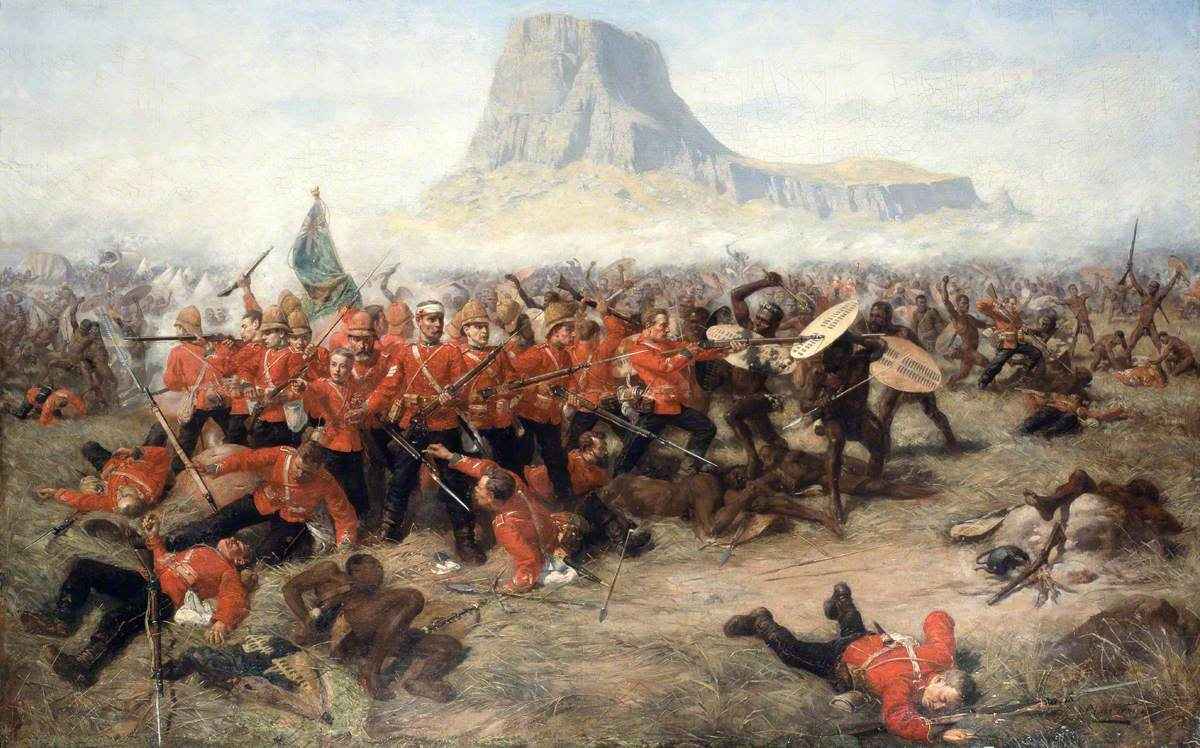
Zulu Forces Defeat a British Army at Isandlwana
A disastrous defeat early in the Anglo-Zulu War halted the first British invasion of Zululand.
On 11 January 1879, British imperial forces crossed the Buffalo River to begin an invasion of Zululand. Sir Henry Bartle Frere, the British High Commissioner for Southern Africa, had pressed for the conflict as part of a plan to bring the region into a confederation, issuing an ultimatum to the Zulu monarch, King Cetshwayo, that demanded he disband his army and that he could not realistically accept. The British commander, Lord Chelmsford, led a primary center column into Zulu territory during the rainy season. Confident that modern firepower would easily overcome indigenous resistance, Chelmsford established a base at the foot of Isandlwana hill on 20 January but neglected basic field precautions, refusing to entrench the position or form a wagon laager.
Chelmsford severely underestimated his opponent and divided his army. Convinced that small groups of warriors spotted in the distance represented the main Zulu force, he rode out at dawn on 22 January with roughly half of his column to pursue them. Left behind under Brevet Lieutenant Colonel Henry Pulleine were around thirteen hundred troops, including six regular companies of the 24th Regiment of Foot, colonial volunteers, local auxiliaries from the Natal Native Contingent, and two seven-pounder artillery guns. Later that morning, Brevet Colonel Anthony Durnford arrived with five hundred additional men and a rocket battery, expanding the force at the camp to roughly eighteen hundred combatants alongside several hundred civilians.

Keep reading in Yester
Coming soon to the App Store
Keep following the story
Sources
Image: Charles Edwin Fripp