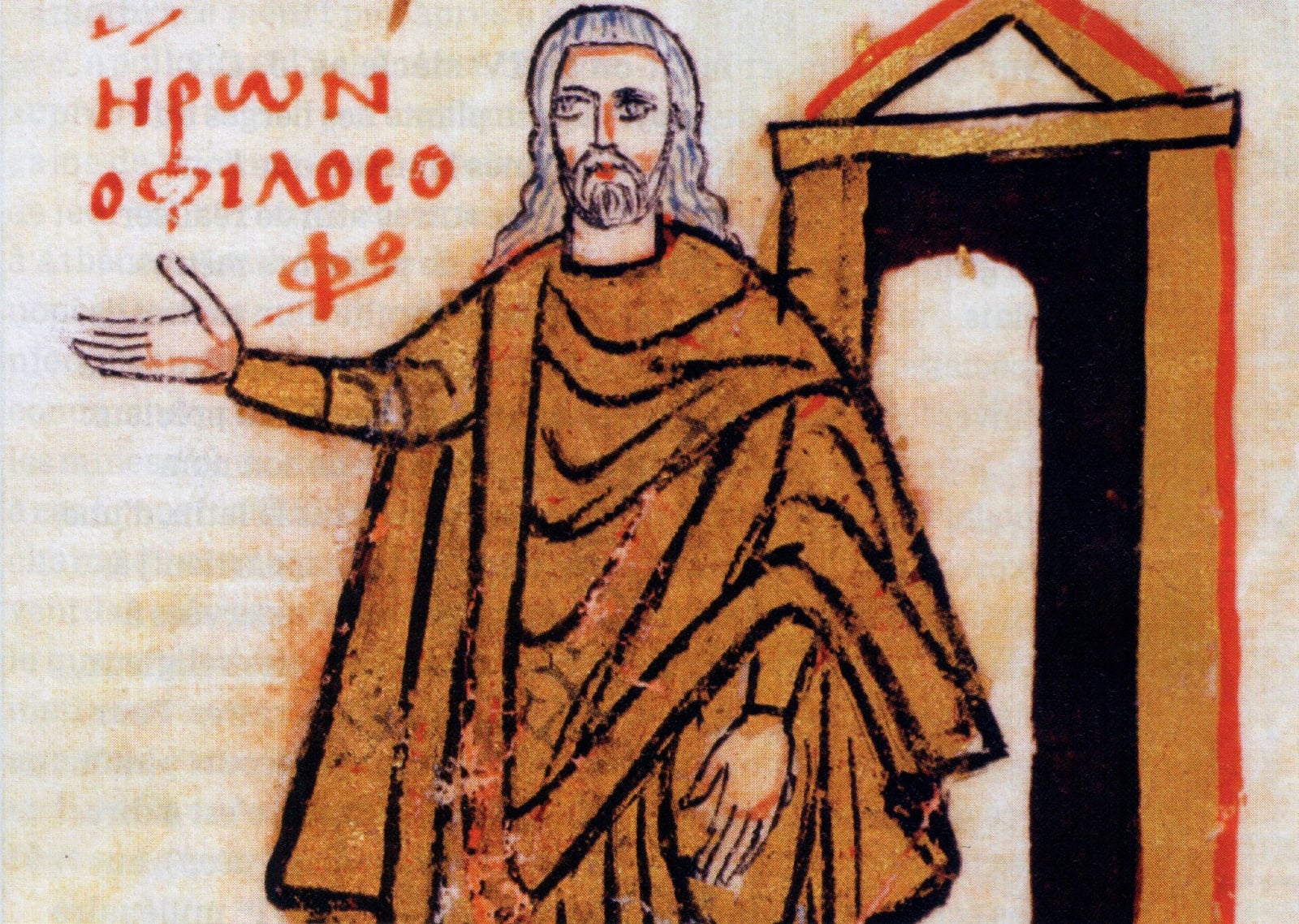
Hero of Alexandria Describes a Steam-Spun Ball
His books also explained a coin-operated holy water dispenser and self-opening temple doors.
Hero of Alexandria, an ancient mathematician and engineer writing in Greek during the Roman period, authored several of the most detailed technical treatises preserved from the classical Mediterranean. Among his accounts is the aeolipile, commonly known as Hero's engine. This device consisted of a hollow sphere mounted on pivots above a heated caldron of water. As steam rose into the ball and escaped through two opposing curved nozzles, the reaction force generated by the escaping vapor caused the sphere to spin rapidly in place. While the Roman architect Vitruvius had mentioned an aeolipile earlier, Hero provided a clear descriptive model of a machine driven directly by steam pressure.
Hero's writings show that he applied mechanical principles across a broad spectrum of curious and practical devices. In his Pneumatica and Automata, he documented machines that harnessed air, steam, and water pressure to create theatrical illusions or assist daily routines. One famous design was an automated dispenser for ceremonial washing. When a worshiper inserted a coin into a slot at the top, the piece landed on an internal pan attached to a balance beam. The weight of the coin momentarily opened a discharge valve to release a measured trickle of water until the coin slipped off the tilting pan, allowing a counterweight to close the valve again.

Keep reading in Yester
Coming soon to the App Store
Keep following the story
Sources
Image: Unknown author Unknown author