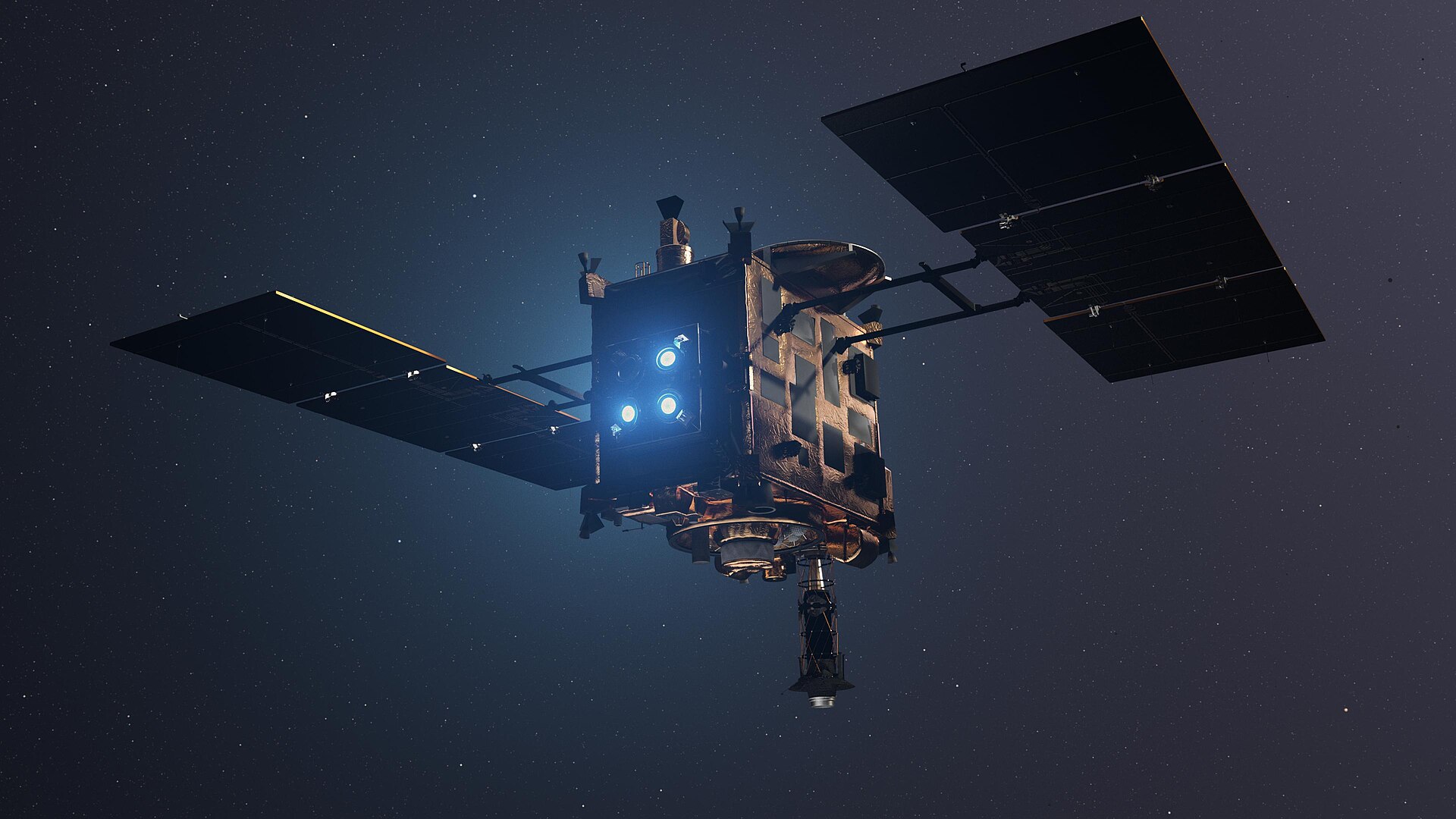
Hayabusa2 Drops Asteroid Dust in the Australian Outback
A Japanese probe returned grains from asteroid Ryugu, including some blasted from below its surface.
On 6 December 2020 local time, a charred space capsule touched down by parachute at the Woomera Test Range in the Australian Outback. Released hours earlier by the Japanese space probe Hayabusa2 before it swung past Earth, the container carried grains gathered from the near-Earth asteroid 162173 Ryugu. Operated by the Japan Aerospace Exploration Agency (JAXA), the mission marked a pivotal achievement in planetary science, returning uncontaminated samples from a primitive carbonaceous asteroid to provide direct evidence regarding the ancient materials and volatile compounds present during the formation of the early Solar System.
The journey began six years earlier when an H-IIA launch vehicle lifted Hayabusa2 into space from Japan on 3 December 2014. Building upon the technical lessons learned from the original Hayabusa mission, which achieved the first asteroid sample return in 2010, the new 600-kilogram spacecraft carried upgraded ion engines, improved navigation sensors, and multiple robotic landers. After a three-and-a-half-year interplanetary cruise, the probe rendezvoused with Ryugu on 27 June 2018, stationing itself approximately twenty kilometers away to conduct remote sensing and map the asteroid's surface.

Keep reading in Yester
Coming soon to the App Store
Keep following the story

Sources
- Hayabusa2 project page (JAXA)
- MASCOT's 17 hours on the surface of Ryugu (German Aerospace Center, DLR)
- MASCOT lander hops around asteroid, exceeding scientists' expectations (Spaceflight Now)
- An artificial impact on the asteroid (162173) Ryugu formed a crater in the gravity-dominated regime (Instituto de Astrofisica de Canarias, Science 2020 abstract)
- Hayabusa2
Image: DLR German Aerospace Center