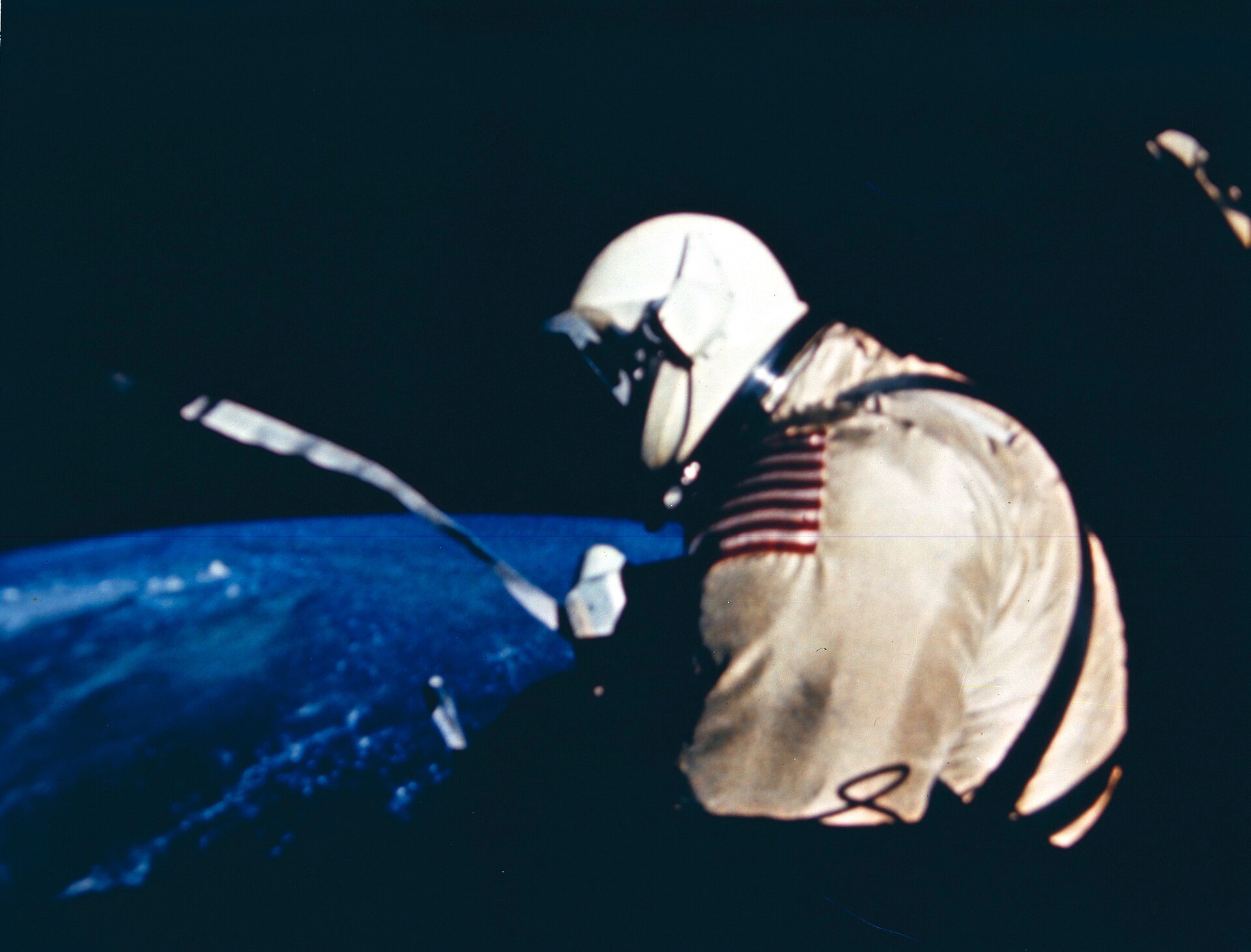
Twenty-Three Minutes Outside the Spacecraft
Ed White’s spacewalk looked effortless in photographs. Behind the view was a new engineering problem: how to keep a person alive, mobile and connected outside a spacecraft.
Ed White appears almost relaxed in the photographs: a white suit above a blue planet, one hand holding a small maneuvering device, a line curling back toward the spacecraft. On June 3, 1965, he became the first American to walk in space. The expression is misleading. There was no surface to walk on, and almost nothing about working outside a spacecraft could yet be treated as routine.
White and commander James McDivitt had launched that morning aboard Gemini IV. The Gemini program stood between the short flights of Mercury and the lunar ambitions of Apollo. Staying in orbit longer, maneuvering spacecraft and learning to work beyond a cabin were practical requirements for later missions. A spacewalk could make an extraordinary photograph, but NASA needed more than a spectacle. It needed to find out what an astronaut could actually do outside.

Keep reading in Yester
Coming soon to the App Store
Keep following the story
Sources
Image: NASA