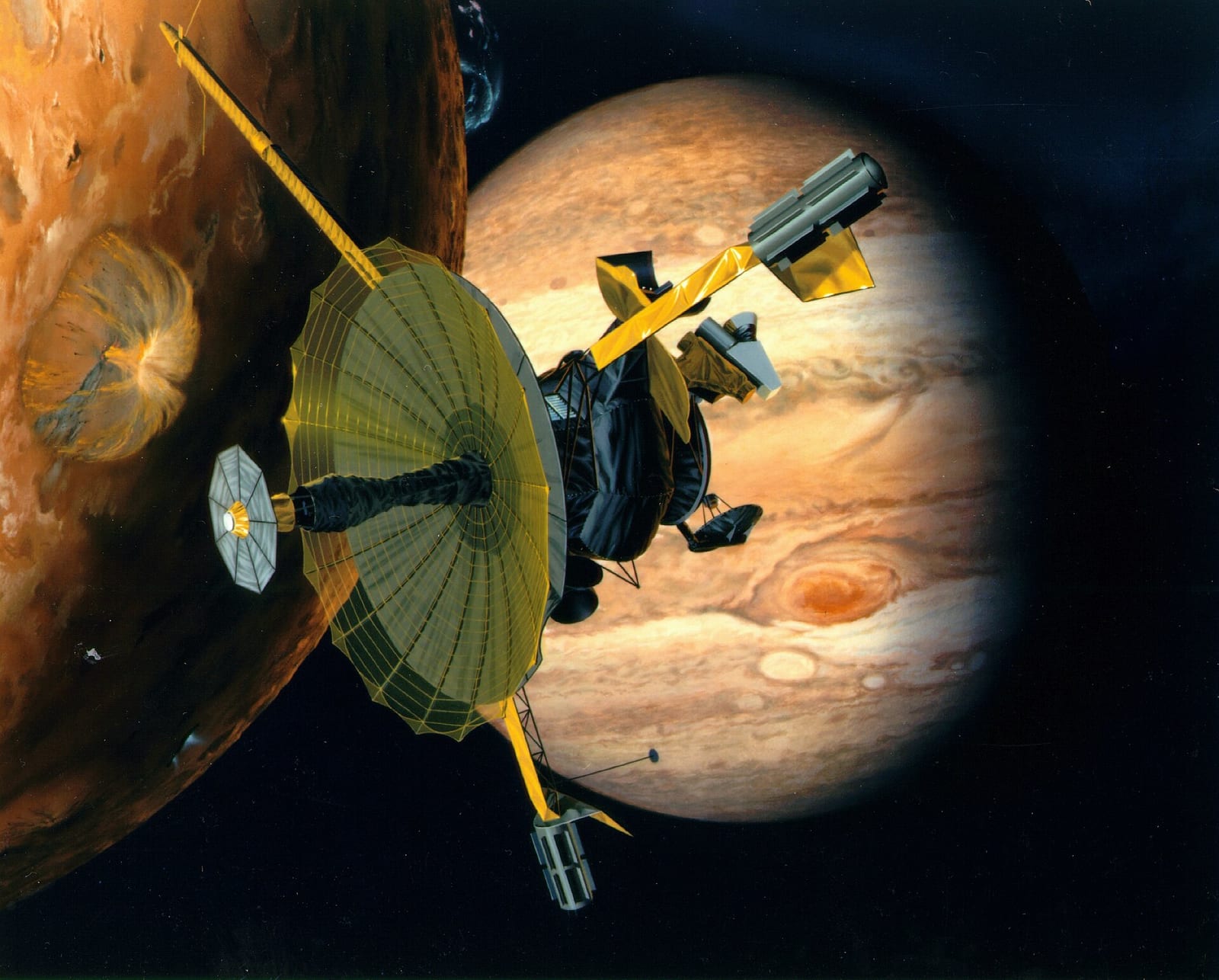
The Galileo Probe Plunges into Jupiter
A probe dropped into Jupiter’s atmosphere while its mothership began years in orbit.
On December 7, 1995, the Galileo mission achieved the first orbital insertion around an outer planet when it reached Jupiter, concluding a six-year journey that had used gravity assists at Venus and Earth. Managed by NASA's Jet Propulsion Laboratory, the mission carried an atmospheric entry probe designed to separate from the primary orbiter and descend directly into the Jovian atmosphere. The dual architecture addressed two distinct scientific goals: long-term observation of Jupiter and its moons from orbit, and in situ sampling of the gas giant's dense, turbulent atmosphere.
The engineering of the atmospheric probe required specialized components to endure one of the most violent descents in spaceflight history. Built by the Hughes Aircraft Company under the direction of NASA's Ames Research Center, the cone-shaped probe weighed 339 kilograms and stood just under a meter high. To withstand an atmospheric entry speed of about 47.6 kilometers per second and temperatures twice as hot as the surface of the Sun, it was protected by an ablative heat shield. Power came from a lithium sulfur dioxide battery made up of three modules of thirteen cells each, a chemistry chosen for its energy density and its ability to hold charge through years of storage.

Keep reading in Yester
Coming soon to the App Store
Keep following the story
Sources
- Galileo (NASA Science)
- 35 Years Ago: STS-34 Sends Galileo on its Way to Jupiter (NASA History)
- Galileo Probe Battery System, Hughes Space and Communications / NASA Ames (NASA Technical Reports Server)
- NASA braces for lawsuit (UPI Archives, 1989)
- Galileo Jupiter Arrival Press Kit (NASA/JPL, Dec 1995)
- Juno mission page (NASA Science)
- Galileo (spacecraft)
Image: NASA