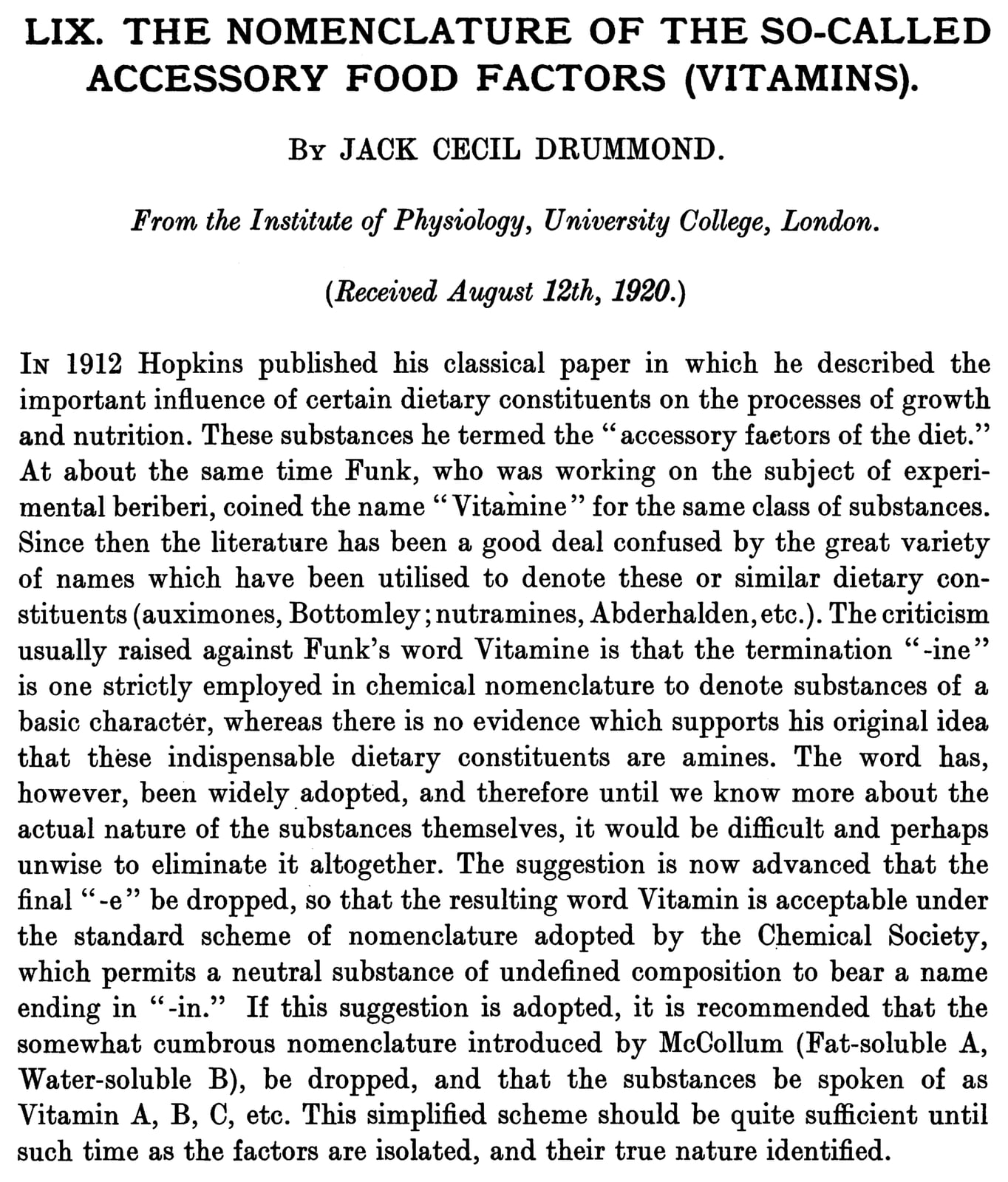
Casimir Funk Proposes Vitamines
A biochemist argued that some diseases came from missing dietary factors.
In 1912, the Polish biochemist Casimir Funk published a paper in the Journal of State Medicine that fundamentally reshaped nutritional science. Working at the Lister Institute of Preventive Medicine in London, Funk advanced the unifying theory that several widespread and debilitating afflictions were caused not by toxic agents or bacterial infections, but by the absence of minute organic components in the human diet. To describe these essential elements, he coined the word vitamine, joining the Latin vita, meaning life, with amine, denoting the nitrogenous chemical structure he believed was common to them all.
Funk was born Kazimierz Funk in Warsaw in 1884, the son of a dermatologist. He pursued his higher education in Western Europe, completing a doctorate in chemistry at the University of Bern in 1904 when he was twenty years old. Over the following years, he gained extensive laboratory experience across several prestigious European institutions, conducting research at the Pasteur Institute in Paris, the Wiesbaden Municipal Hospital, and the University of Berlin before taking up his post at the Lister Institute in the United Kingdom.

Keep reading in Yester
Coming soon to the App Store
Keep following the story
Sources
- Funk, Casimir (Complete Dictionary of Scientific Biography, via Encyclopedia.com); also Gale biographies on the same page
- Funk, Casimir (Encyclopaedia Judaica, Jewish Virtual Library)
- The Etiology of the Deficiency Diseases, Casimir Funk, Journal of State Medicine 20 (1912) (University of Helsinki scan)
- Casimir Funk
Image: Jack Drummond