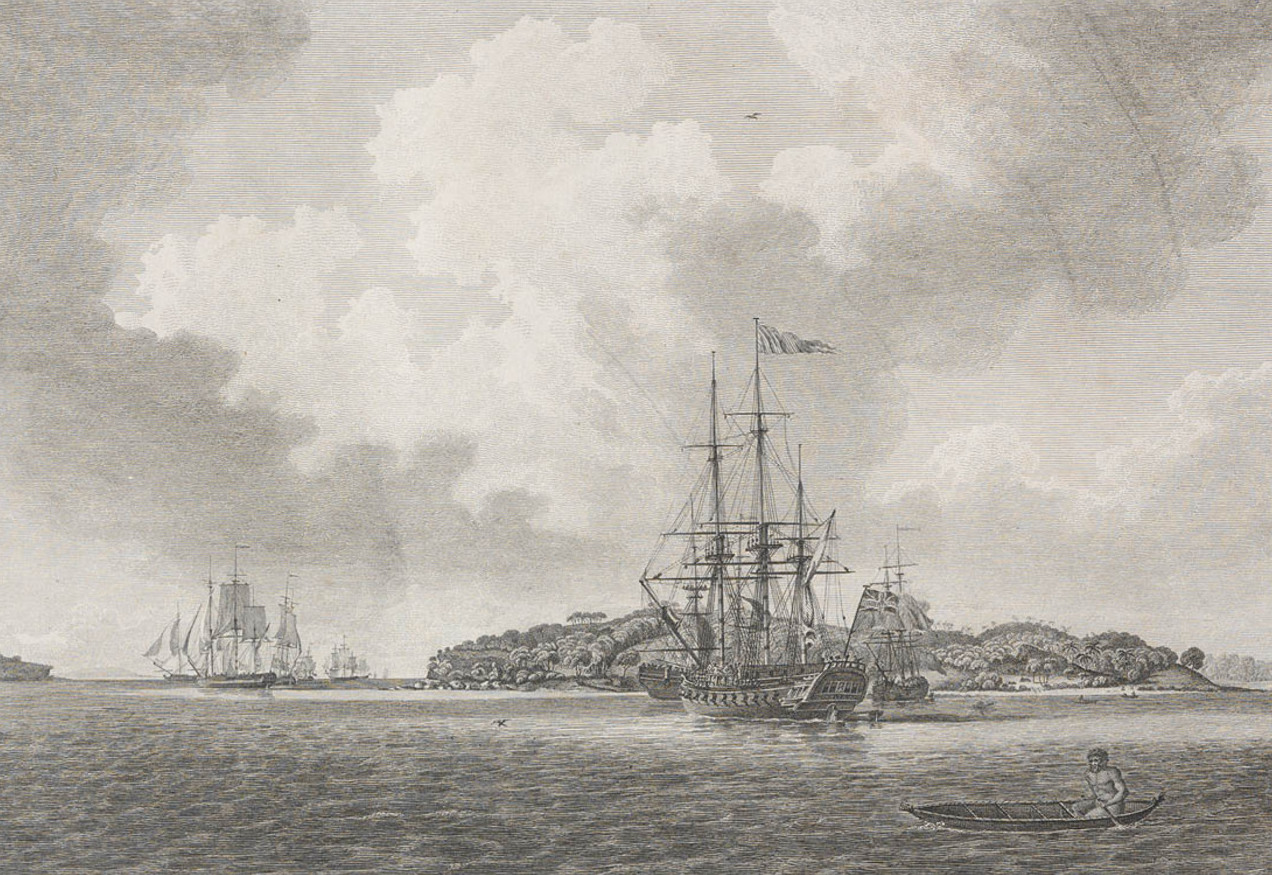
The First Fleet Arrives at Sydney Cove
British ships brought convicts and marines to found a penal colony.
In May 1787, an expedition of eleven British vessels departed Portsmouth to establish a distant penal settlement. The decision by Thomas Townshend, Lord Sydney, to colonize New South Wales followed the loss of Britain's American colonies, which had terminated the transportation of convicts across the Atlantic. British authorities also sought a naval base in the Pacific to counter French expansion. Under the leadership of Captain Arthur Phillip, the convoy comprised two Royal Navy escorts, HMS Sirius and HMS Supply, alongside three storeships and six convict transports. The ships carried tools, agricultural equipment, seeds, and medical supplies intended to sustain the outpost.
Accounts differ regarding the exact complement aboard, as complete musters for every transport and storeship have not survived. Estimates of the total who sailed range from around 1,400 to roughly 1,500 people. Between about 750 and 780 of them were convicts tried in Great Britain, sentenced to transportation for seven years, fourteen years, or life. A detachment from the New South Wales Marine Corps, commanded by Major Robert Ross, traveled on every transport to maintain order, often accompanied by their wives and children. Over the course of the 252-day journey, the vessels stopped at Tenerife, Rio de Janeiro, and Table Bay before traversing the Southern Ocean.

Keep reading in Yester
Coming soon to the App Store
Keep following the story

Sources
- First Fleet Ships (Museums of History NSW)
- The voyage (Museums of History NSW)
- Ship surgeon John White (Museums of History NSW)
- First Fleet journals, Memory of the World register (Australian Memory of the World)
- Convicts research guide (National Library of Australia)
- First Fleet, Digital Classroom (National Library of Australia)
- Convicts bound for Australia: First Fleet (State Library of New South Wales)
- First Fleet
Image: Original drawing by R. Cleveley, engraving by T. Medland.