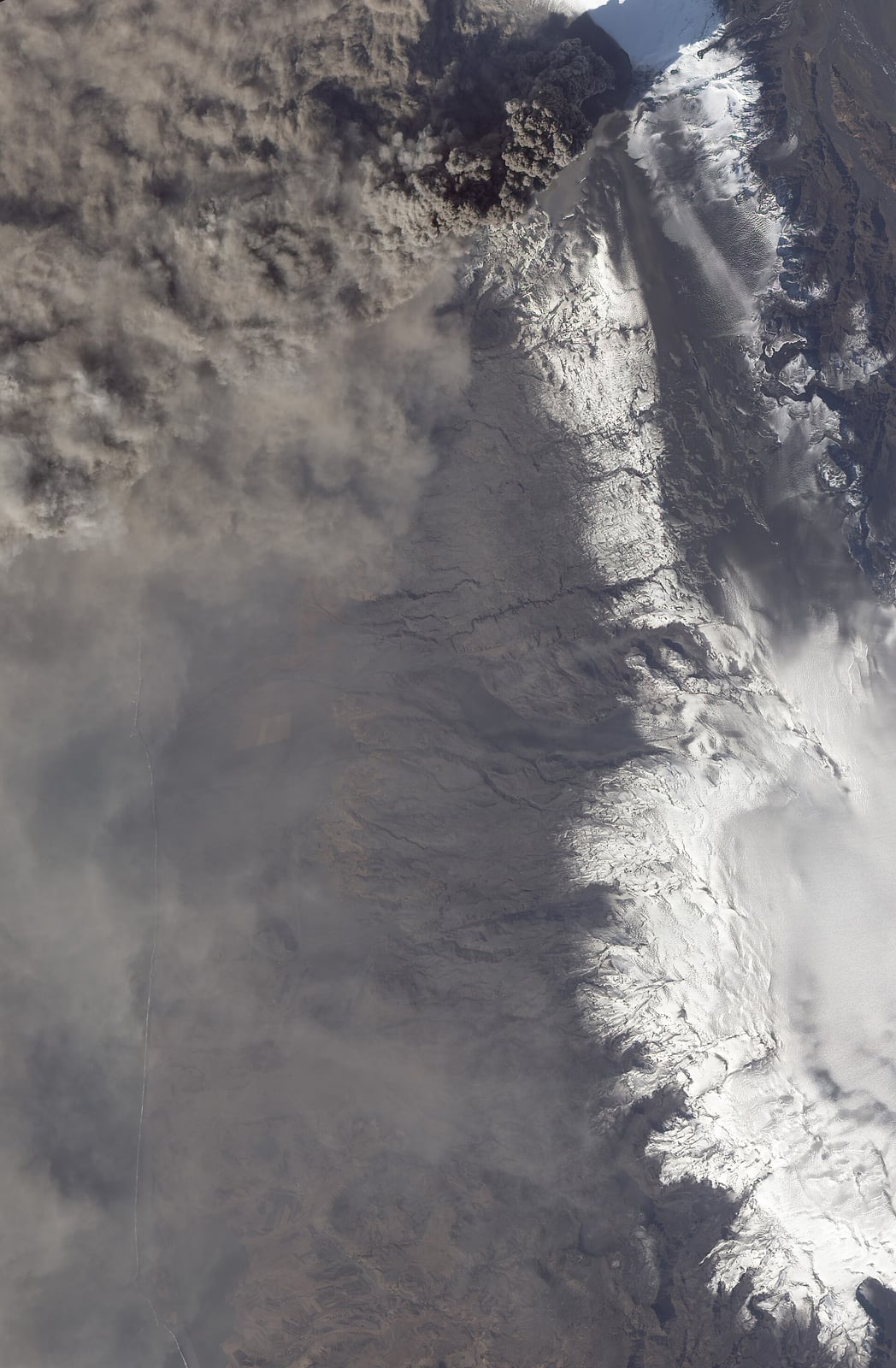
An Icelandic Volcano Grounds Europe’s Flights
An ash cloud closed much of European airspace for days.
Late on the evening of 20 March 2010, an effusive eruption began in southern Iceland when fissures opened near the Fimmvorduhals mountain pass beside Eyjafjallajokull. Preceded by weeks of increasing seismic tremors and crustal displacement detected by ground stations, this initial event generated modest lava fountains and slow-moving basaltic streams. This flank eruption produced relatively little ash, although a steam explosion on 22 March sent a plume of steam to about eight kilometres. About five hundred people living nearby were evacuated and some flights to and from Reykjavik were diverted or cancelled, but the eruption gave little indication of the severe international transport crisis that would develop just weeks later.
The character of the event altered drastically on the morning of 14 April 2010. Following a swarm of earthquakes overnight, a second eruptive phase broke through vents beneath the ice cap of the volcano's summit caldera. Interaction between the erupting trachyandesite magma and the overlying glacial ice triggered explosive activity. The sudden influx of meltwater chilled the molten material with extreme rapidity, shattering it into exceptionally fine, abrasive glass particles. Rated at 4 on the Volcanic Explosivity Index, this explosive phase sent ash plumes as high as about nine kilometres, and scientists estimated that the summit eruption produced about 0.11 cubic kilometres of tephra.

Keep reading in Yester
Coming soon to the App Store
Keep following the story
Sources
- Eyjafjallajökull: Eruptive History and Bulletin Reports (Smithsonian Institution Global Volcanism Program)
- The Largest Airspace Shutdown Since WWII: Volcanic Ash Prediction and its Challenges (Royal Meteorological Society)
- How volcano chaos unfolded: in graphics (BBC News)
- 2010 eruptions of Eyjafjallajökull
Image: NASA Goddard Space Flight Center from Greenbelt, MD, USA