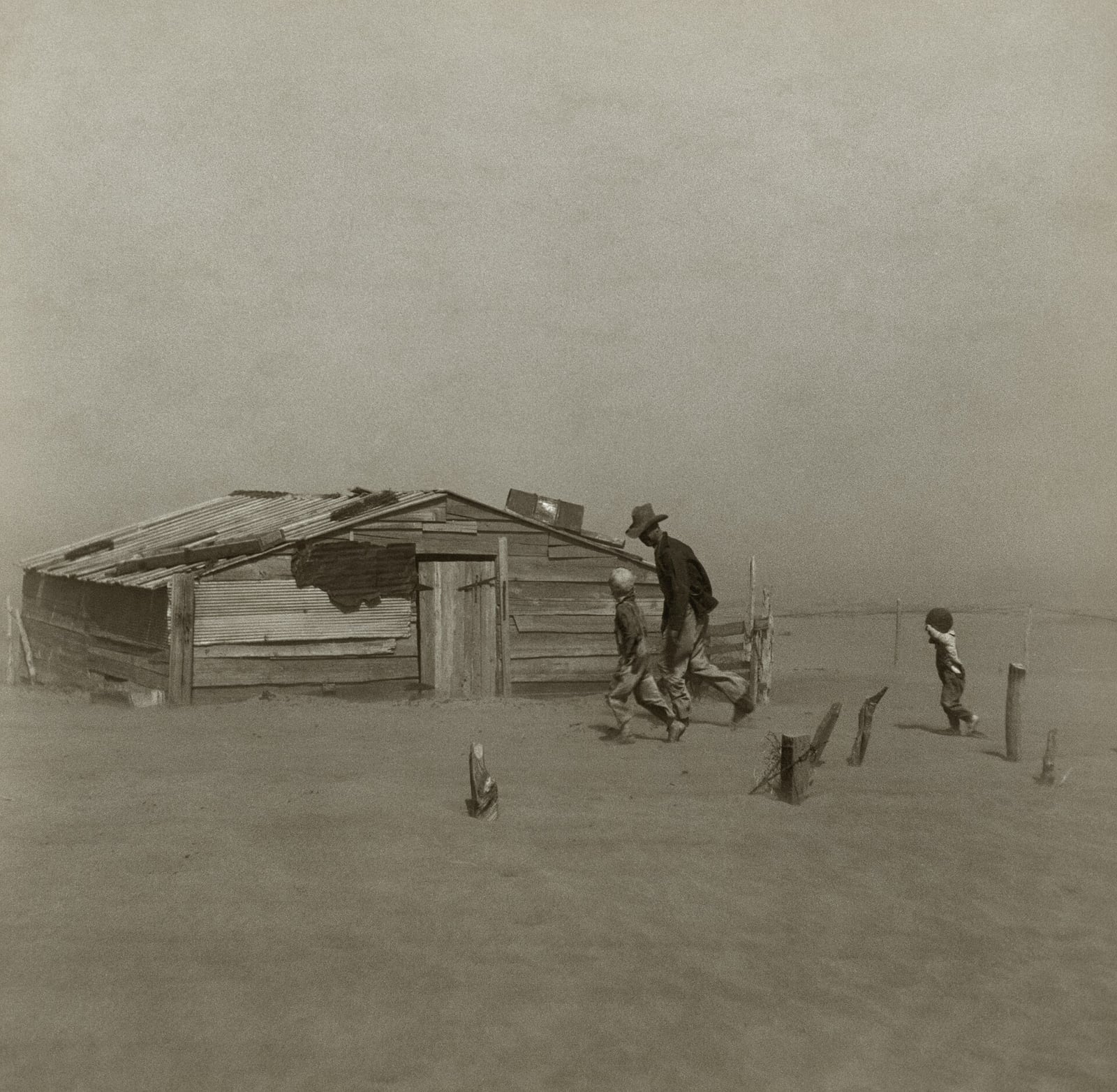
Black Blizzards Sweep the Dust Bowl
Drought and plowed-up grassland sent soil blowing across the plains.
On April 14, 1935, a massive cold front swept across the American plains, lifting dry topsoil into dense, rolling clouds that choked out daylight. Known as Black Sunday, this event propelled winds of sixty miles per hour across the southern High Plains and caused visibility to collapse to near zero. While reporting on the storm from Boise City, Oklahoma, Robert E. Geiger of the Associated Press filed a dispatch that is believed to contain the first use of the term Dust Bowl. Originally referring to the severely damaged territory across the Oklahoma and Texas panhandles, eastern New Mexico, southeastern Colorado, and western Kansas, the name soon identified the decade-long ecological and agricultural disaster itself.
The groundwork for the crisis began decades earlier as federal land policies, mechanized machinery, and high crop prices pushed vast tracts of arid prairie into cultivation. The Homestead Acts and their later expansions offered settlers acreage in regions receiving under twenty inches of annual rainfall, where deep-rooted native grasses had held the soil together. Unusually wet years supported the false assumption that rainfall would naturally follow the plow. During World War I and the 1920s, farmers converted millions of acres of shortgrass into wheat fields using gasoline-powered tractors and combines, removing the plant cover that historically survived high winds and dry spells.

Keep reading in Yester
Coming soon to the App Store
Keep following the story
Sources
- The Black Sunday Dust Storm of 14 April 1935 (National Weather Service, Norman OK)
- Dust Bowl (National Drought Mitigation Center, University of Nebraska-Lincoln)
- Surviving the Dust Bowl timeline (PBS American Experience)
- Shelterbelts, Encyclopedia of the Great Plains (University of Nebraska-Lincoln)
- FDR's 'Great Wall of Trees' continues to provide lessons (University of Nebraska-Lincoln News)
- Dust Bowl
Image: Arthur Rothstein