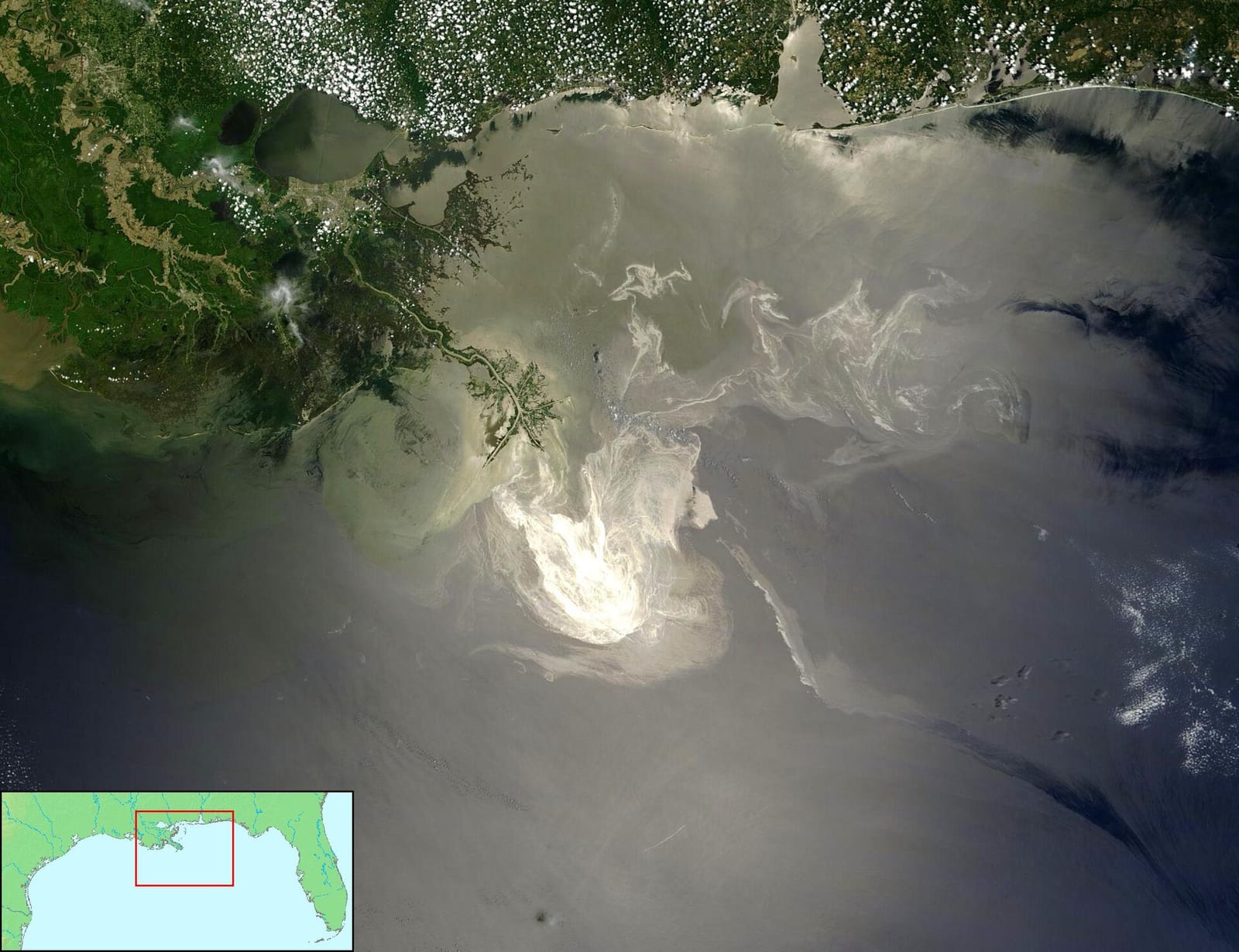
The Deepwater Horizon Explosion Begins a Massive Oil Spill
An oil rig blowout killed eleven workers and leaked oil for 87 days.
On 20 April 2010, the Deepwater Horizon drilling rig was operating on the BP-run Macondo Prospect approximately 50 miles southeast of Venice, Louisiana. That evening, the exploratory well blew out, and a sudden explosion and fire engulfed the rig. Of the 126 crew members on board, eleven workers were killed. The burning rig later sank into the Gulf of Mexico, and oil began pouring from the damaged well on the sea floor.
The disaster developed into the largest oil spill in the history of marine oil drilling operations, according to the Environmental Protection Agency. Over the course of 87 days, the damaged well released crude oil directly into the sea until it was capped on 15 July 2010. The EPA puts the total at about four million barrels of oil. The volume was contested in court, and in January 2015 the federal district court in New Orleans issued its findings of fact on the amount of oil spilled.

Keep reading in Yester
Coming soon to the App Store
Keep following the story
Sources
- Deepwater Horizon - BP Gulf of America Oil Spill (U.S. Environmental Protection Agency)
- Macondo Blowout and Explosion (U.S. Chemical Safety and Hazard Investigation Board)
- BP Exploration and Production Inc. case page (U.S. Department of Justice, Victim Notification)
- Stemming the Flow: Containment Dome, Top Kill, Containment to Collection, and Static Kill (National Commission on the BP Deepwater Horizon Oil Spill and Offshore Drilling, archived by IADC)
- Update: The Ongoing Administration-Wide Response to the Deepwater BP Oil Spill, 21 July 2010 (U.S. Department of the Interior)
- Deepwater Horizon oil spill
Image: NASA / GSFC , MODIS Rapid Response AND demis.nl AND FT2