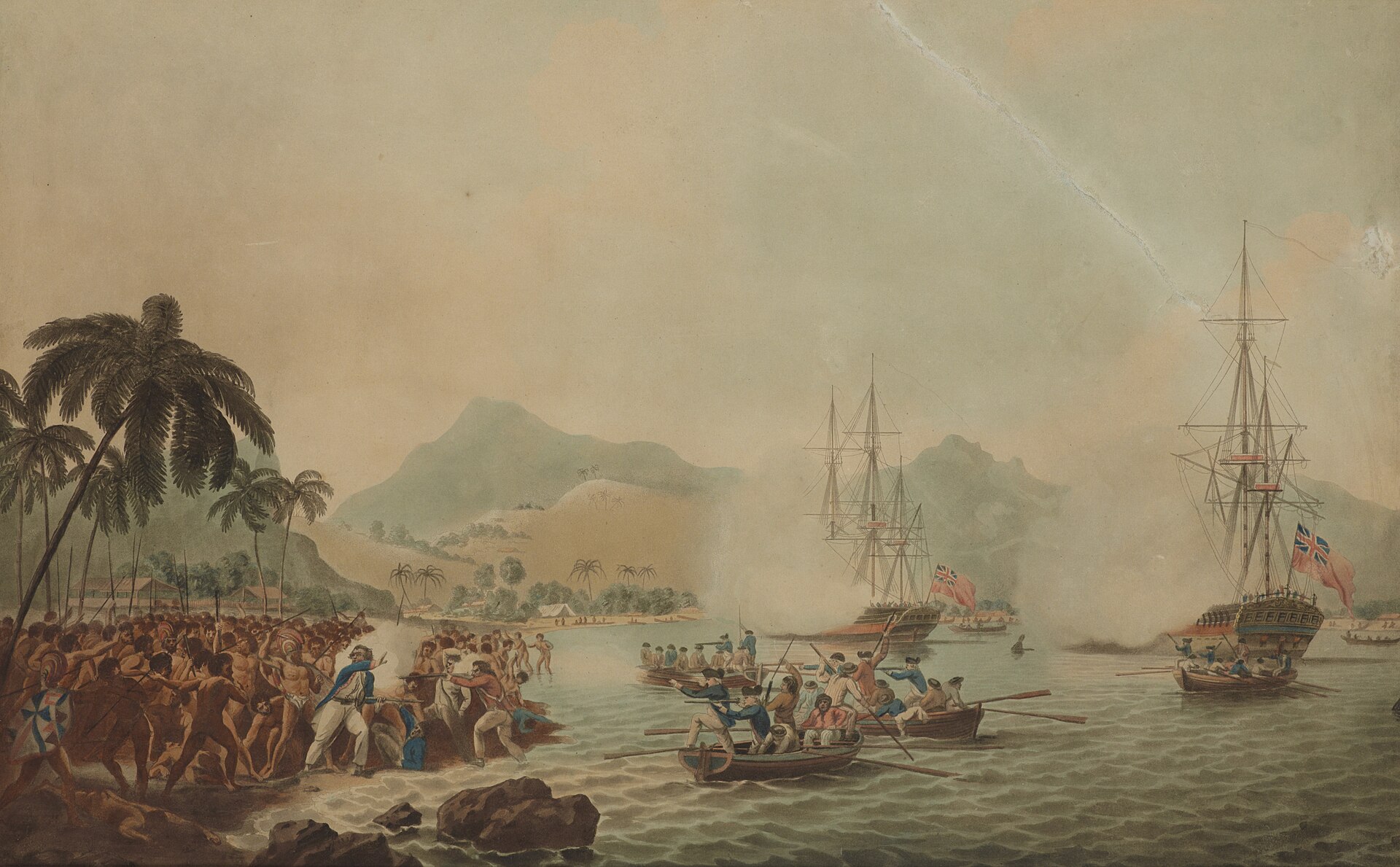
Cook Is Killed at Kealakekua Bay
A dispute on the shore of Hawaiʻi ended Cook’s third voyage.
On the morning of 14 February 1779, the British naval officer Captain James Cook stepped ashore at the village of Kaʻawaloa on Kealakekua Bay, intending to seize the ruling chief of Hawaii, Kalaniʻōpuʻu. Cook commanded HMS Resolution and HMS Discovery on a third expedition across the Pacific, having become the first known European to reach the Hawaiian Islands the previous year. After discovering that a cutter belonging to Discovery had been taken, he stationed armed boats across the bay and went ashore with Lieutenant Molesworth Phillips and nine marines. Cook aimed to take the island's high chief hostage aboard his flagship until the vessel was returned, repeating a coercive tactic he had previously used in Tonga and Tahiti.
Kalaniʻōpuʻu initially agreed to accompany Cook to the ship, but outside the village, one of his wives and several chiefs urged him to sit down and refuse. An estimated crowd of two to three thousand Hawaiians gathered on the beach, arming themselves with spears, daggers, stones, and woven mats. Word swiftly reached the gathering that an armed party across the bay had fatally shot a Hawaiian chief named Kalimu. As the atmosphere deteriorated, a warrior challenged Cook directly. Cook fired small shot, which failed to penetrate the man's mat armor, before firing a musket ball that killed another Hawaiian.

Keep reading in Yester
Coming soon to the App Store
Keep following the story
Sources
Image: Francis Jukes / John Cleveley the Younger