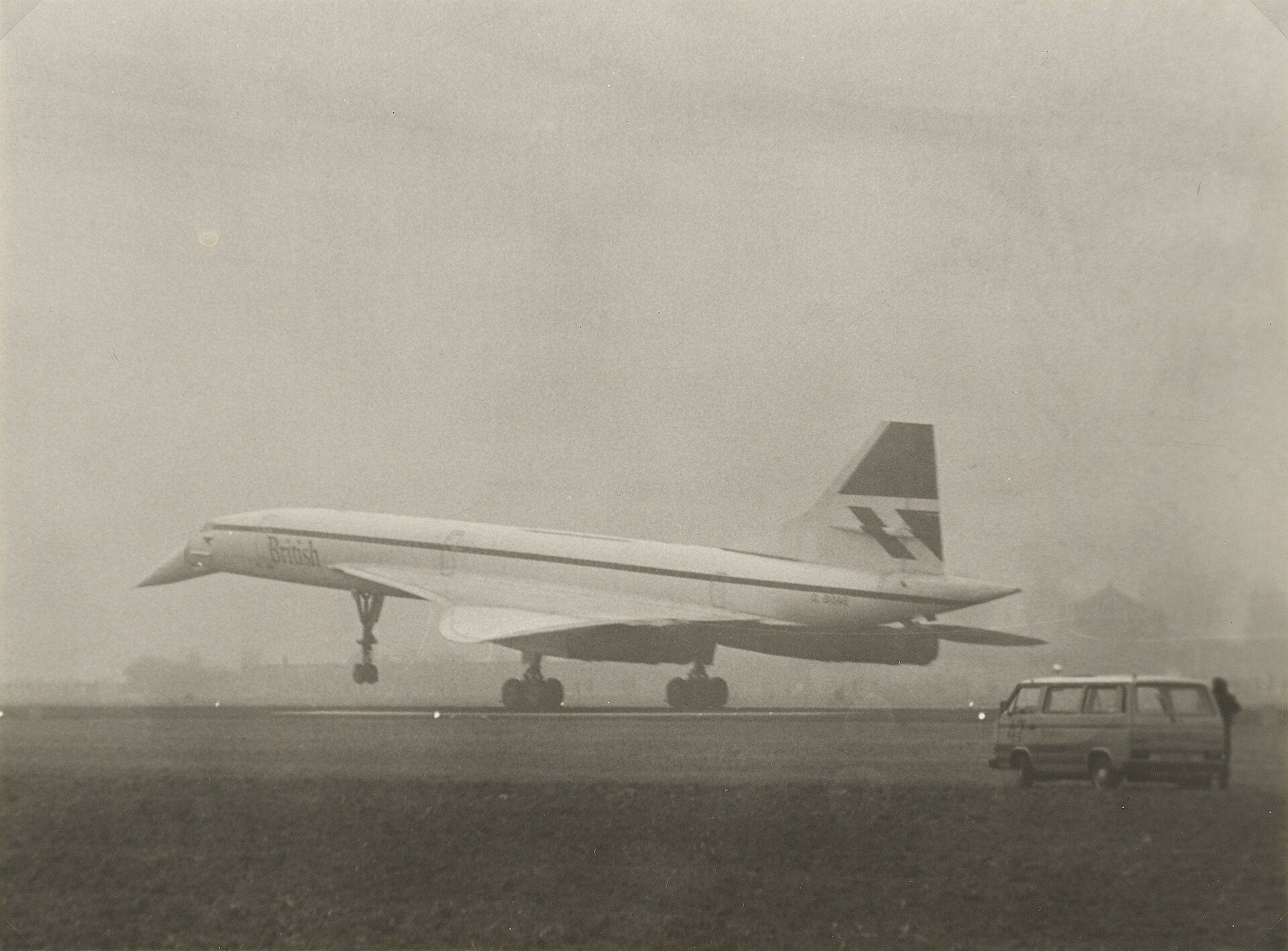
Concorde Makes Its Final Flights
The supersonic airliner retired after 27 years of service.
On 2 March 1969, the supersonic prototype Concorde 001 lifted off from Toulouse, marking the maiden voyage of an ambitious Anglo-French venture in civil aviation. Formalized by an international treaty signed on 29 November 1962, the program joined the British Aircraft Corporation and Sud Aviation in an effort to overcome the aerodynamic barriers of commercial supersonic travel. Early studies by the Royal Aircraft Establishment had demonstrated that conventional short-span wings produced insufficient low-speed lift, requiring excessively long takeoff runs. German-born aerodynamicists Johanna Weber and Dietrich Küchemann, working at the Royal Aircraft Establishment, championed the slender delta wing instead; research there in 1955 showed that such a wing at high angles of attack generated strong leading-edge vortices that greatly increased its lift.
This research crystallized into the ogival delta planform, a compound-curved wing designed to keep the centre of pressure near the centre of gravity during shifts in flight trim. Because friction with the atmosphere would cause severe heating above Mach 2, engineers kept cruising speeds to about Mach 2, allowing the airframe to be built from conventional aluminium alloys rather than experimental, heat-resistant metals. Powered by four Rolls-Royce/Snecma Olympus 593 turbojets equipped with reheat and variable intake ramps, the airliner introduced pioneering systems, including analogue fly-by-wire controls and an articulated droop nose to grant pilots adequate runway visibility during nose-high landings.

Keep reading in Yester
Coming soon to the App Store
Keep following the story

Sources
- The day Concorde flew into the history books (Airbus)
- Genesis of a Legend: The Origins of Concorde (Air France)
- Concorde, Fox Alpha, Air France (Smithsonian National Air and Space Museum)
- What Happened to the Concordes? (Smithsonian National Air and Space Museum)
- Obituary: Dr Johanna Weber (Royal Aeronautical Society)
- Fastest flight across the Atlantic in a commercial aircraft (Guinness World Records)
- Concorde makes its comeback (CNN)
- Concorde
Image: Anonymous Unknown author