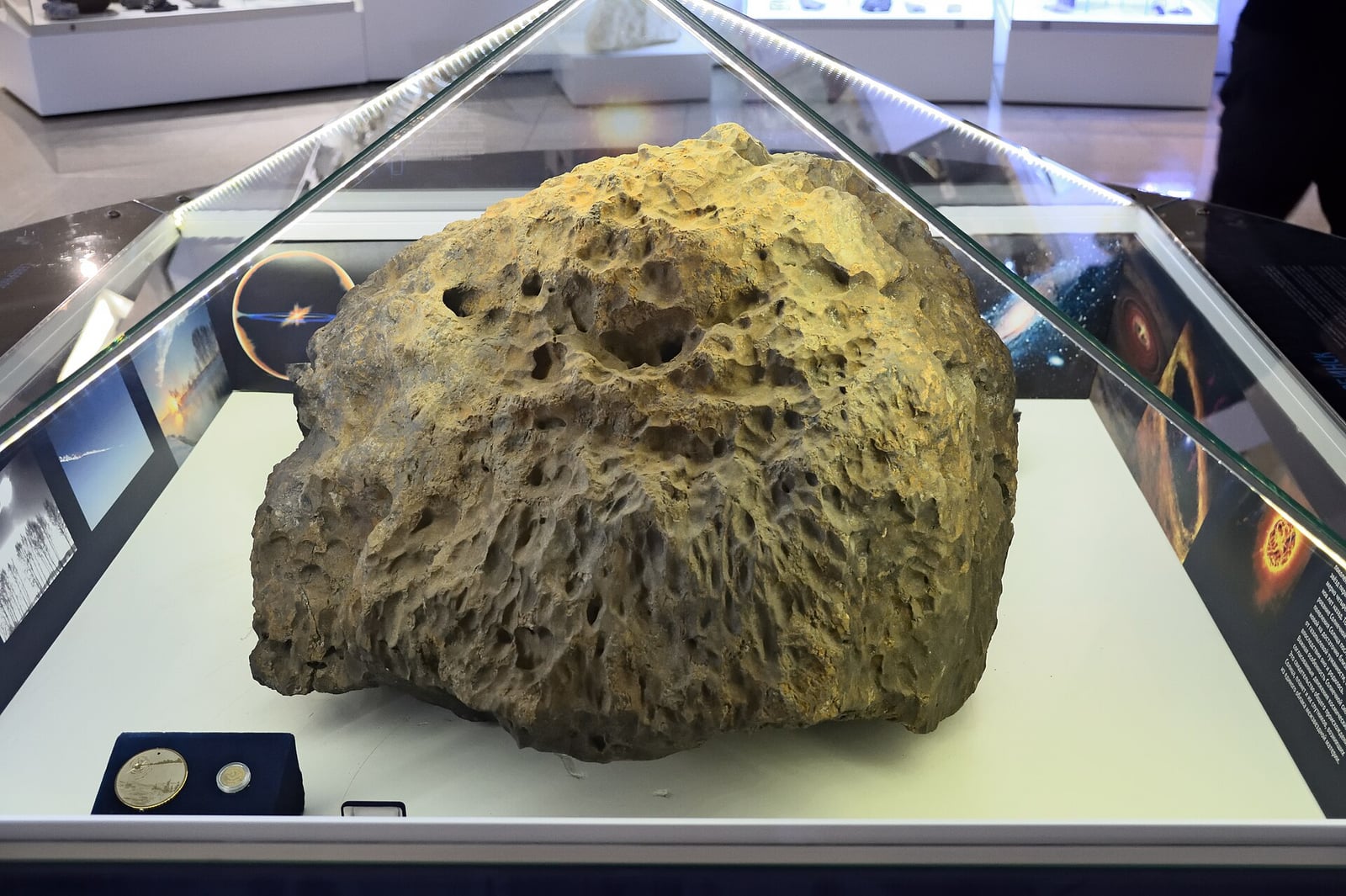
A Meteor Explodes over Chelyabinsk
A space rock burst in the morning sky, and its shock wave shattered windows across the city.
Shortly after dawn on 15 February 2013, an undetected space rock entered the atmosphere over Russia at an altitude of dozens of kilometres and an entry speed of roughly 19 kilometres per second. Originating from the asteroid belt between Mars and Jupiter, the object was an Apollo asteroid whose approach had been obscured from Earth by the glare of the morning Sun. With an estimated initial diameter of roughly 17 to 20 metres and an atmospheric mass around 10,000 tonnes, it descended on a shallow trajectory toward the southern Ural region.
As it plunged through increasingly dense air, friction and atmospheric resistance generated an intense fireball that briefly outshone the Sun and produced a thick, double-plumed trail of dust and gas. At an altitude near 30 kilometres above Chelyabinsk Oblast, the intense aerodynamic pressure caused the meteoroid to shatter in a massive airburst. The total kinetic energy absorbed by the atmosphere before impact was calculated from seismic and acoustic recordings to be equivalent to about 400 to 500 kilotonnes of TNT, though published estimates vary between studies.

Keep reading in Yester
Coming soon to the App Store
Keep following the story
Sources
- What was the Chelyabinsk meteor event? (The Planetary Society)
- Chelyabinsk Meteorite (Natural History Museum Vienna)
- Scientists Shed More Light on Chelyabinsk Meteorite (Sci.News, on Popova et al., Science 2013)
- IDC Infrasound Analysis of 2013 DPRK Event and Russian Fireball (CTBTO Science and Technology 2013 Conference)
- Russian meteor blast heard around the world (New Atlas)
- Chelyabinsk meteor
Image: Vsatinet