Ancestral Puebloans Build the Great Houses of Chaco
Multi-story buildings in a desert canyon became a regional center.
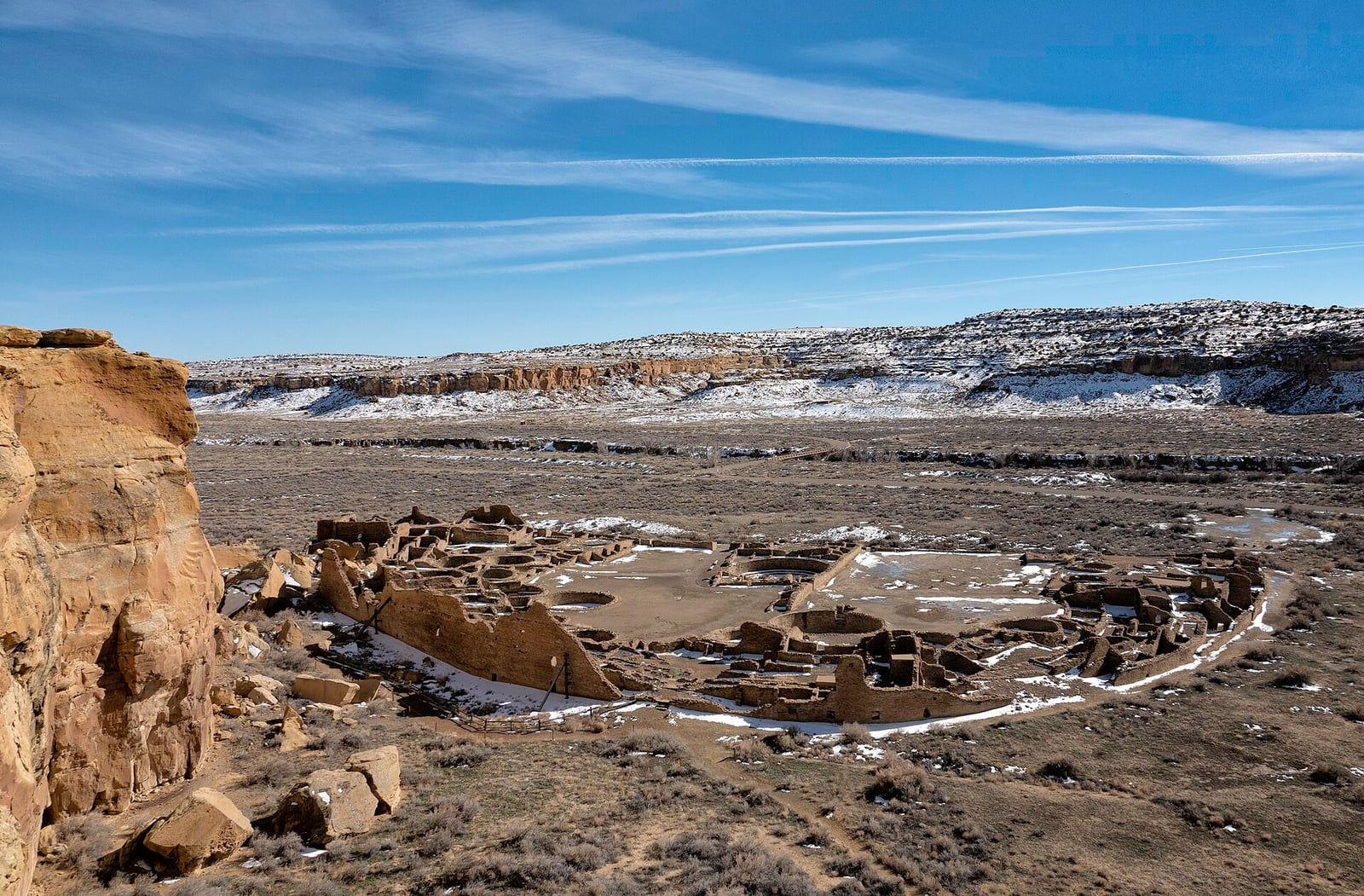
From the mid-800s, Ancestral Puebloan builders in the remote canyon of northwestern New Mexico began assembling a network of monumental settlements that would reshape the San Juan Basin. The region was arid and challenging, receiving only around nine inches of moisture a year, but early communities had farmed and constructed pit houses there for centuries. By the ninth century, stone residential units adjoining subterranean ceremonial chambers known as kivas expanded into large settlements. Across a nine-mile stretch of the canyon floor cut by the Chaco Wash, building efforts expanded into multi-story sandstone compounds that endured as some of the most ambitious engineering projects north of Mexico.
The hallmark of this architectural surge was the great house. These immense multi-story complexes ranged from about 50 to 650 rooms and featured thick load-bearing walls assembled with core-and-veneer masonry. Builders erected parallel facings of dressed sandstone bound with clay mortar, packed the interior gap with rubble, and finished the exteriors with precise veneers of smaller stone slabs. Complexes were designed in unified construction stages rather than piecemeal additions, frequently rising four or five stories in terraced rows facing southward toward open plazas. The largest of them, Pueblo Bonito, eventually enclosed some 650 rooms across nearly two acres, divided into two distinct symmetrical halves by a wall aligned precisely north to south.

Keep reading in Yester
Coming soon to the App Store
Keep following the story
Sources
- History and Culture, Chaco Culture National Historical Park (US National Park Service)
- Chaco Culture World Heritage Site (US National Park Service)
- Chacoan Roads (US National Park Service)
- Strontium isotopes reveal distant sources of architectural timber in Chaco Canyon, New Mexico (US Geological Survey)
- Transporting timbers to Chaco Canyon: How heavy, how many carriers and how far/fast? (US Geological Survey)
- Archaeogenomic evidence reveals prehistoric matrilineal dynasty, Kennett et al. 2017 (Nature Communications, via PMC)
- The A.D. 1130-1180 Megadrought in the Northern Southwest (Crow Canyon Archaeological Center)
- Chaco Culture National Historical Park
Image: John Fowler from Placitas, NM, USA