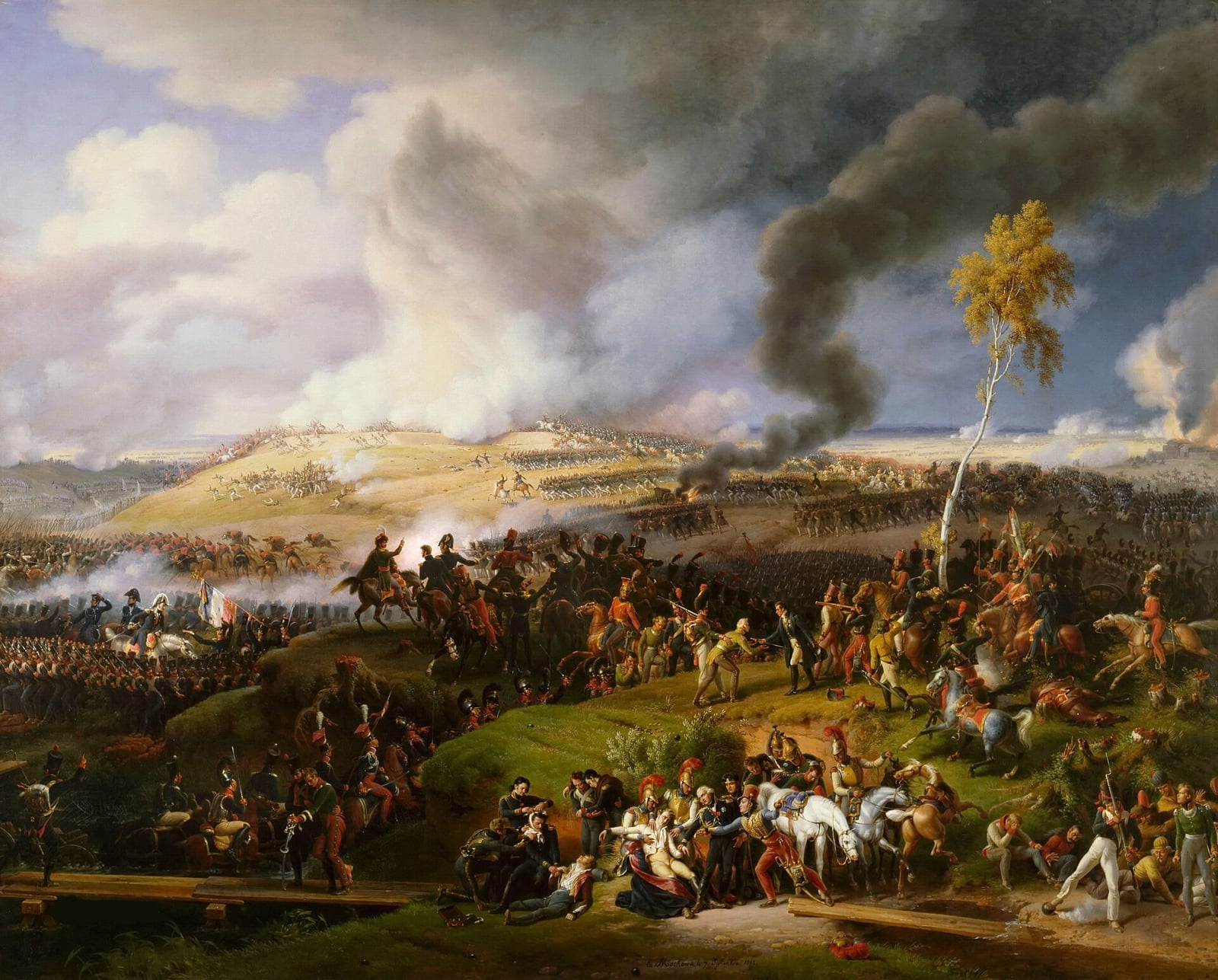
Napoleon and the Russian Army Clash at Borodino
The bloodiest day of the Napoleonic Wars opened the road to Moscow.
On 7 September 1812, the Grande Armee of Napoleon Bonaparte engaged the Imperial Russian Army near the village of Borodino, more than 100 kilometers west of Moscow. Napoleon had crossed the Niemen River in June at the head of an invasion force of more than half a million men, but disease, hunger, and relentless marching depleted his ranks. The Russian commander, Mikhail Bogdanovich Barclay de Tolly, had avoided decisive engagements by drawing the invaders deep into Russian territory. Popular pressure and imperial orders eventually forced a change in leadership. General Mikhail Kutuzov took command in late August, and while he recognized the wisdom of Barclay's delaying maneuvers, he chose a defensive stand at Borodino to block the highway to Moscow and preserve the morale of the nation.
Kutuzov arrayed an army estimated at roughly 125,000 to 135,000 men along an eight-kilometer defensive line, bolstered by hastily erected earthworks. These included the Raevsky Redoubt in the center-right and three arrow-shaped field fortifications known as the Bagration fleches on the left. Napoleon brought about 130,000 soldiers to the field. He declined flanking proposals from Marshal Louis-Nicolas Davout, opting instead for costly direct assaults against the Russian fortifications. Two days prior to the primary engagement, a preliminary clash over the Shevardino Redoubt had already cost thousands of casualties and signaled the ferocious nature of the coming struggle.

Keep reading in Yester
Coming soon to the App Store
Keep following the story
Sources
- Borodino (La Moskowa) (Fondation Napoleon)
- BAGRATION, Peter, Prince (Fondation Napoleon)
- Napoleon's Russian campaign: From the Niemen to Moscow (Fondation Napoleon)
- Clausewitz at War (HistoryNet)
- Napoleon's Invasion of Russia (World History Encyclopedia)
- Borodino (Encyclopedia of Modern Europe, via Encyclopedia.com)
- Napoleon enters Moscow (HISTORY)
- Battle of Borodino
Image: Louis Lejeune