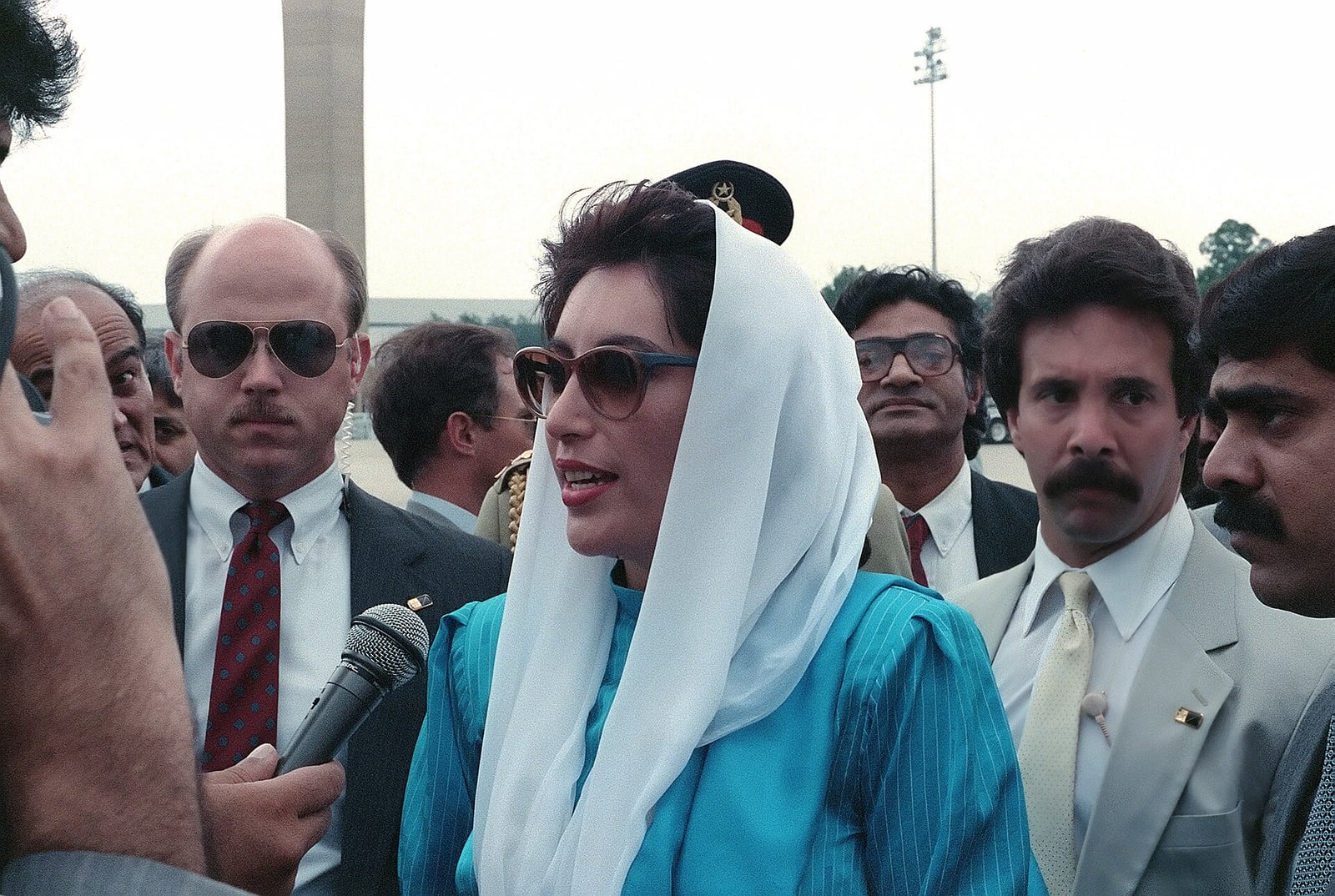
Benazir Bhutto Becomes Prime Minister of Pakistan
She became the first woman elected to lead a Muslim-majority country.
In November 1988, Benazir Bhutto led the Pakistan People's Party to a plurality in the country's parliamentary elections, winning more than 90 seats, the largest bloc in the National Assembly. Her victory paved the way for her appointment as prime minister, making her the first woman elected to head a democratic government in a Muslim-majority nation. At thirty-five years of age, she assumed leadership of a state navigating a fragile transition from military rule to constitutional democracy.
Born in Karachi in 1953 into a prominent landowning family, Bhutto grew up amid the upper echelons of national politics. Her father, Zulfikar Ali Bhutto, served as foreign minister and later founded the socialist Pakistan People's Party, eventually becoming the nation's president and prime minister. Benazir observed diplomatic affairs firsthand from a young age before traveling abroad to pursue undergraduate studies at Radcliffe College and further degrees in philosophy, politics, economics, and international law at the University of Oxford, where she was elected president of the Oxford Union.

Keep reading in Yester
Coming soon to the App Store
Keep following the story
Sources
- Pakistan: parliamentary elections National Assembly, 1988 (Inter-Parliamentary Union PARLINE archive)
- Pakistan People's Party (Library of Congress Country Studies, via countrystudies.us)
- Benazir Bhutto (CIDOB Barcelona Centre for International Affairs, political leader biography)
- Benazir Bhutto killed in attack (BBC News, 27 December 2007)
- Oxford friends remember 'fiery and fun' Benazir (Dawn, 29 December 2007)
- Benazir Bhutto
Image: SRA Gerald B. Johnson, United States Department of Defense