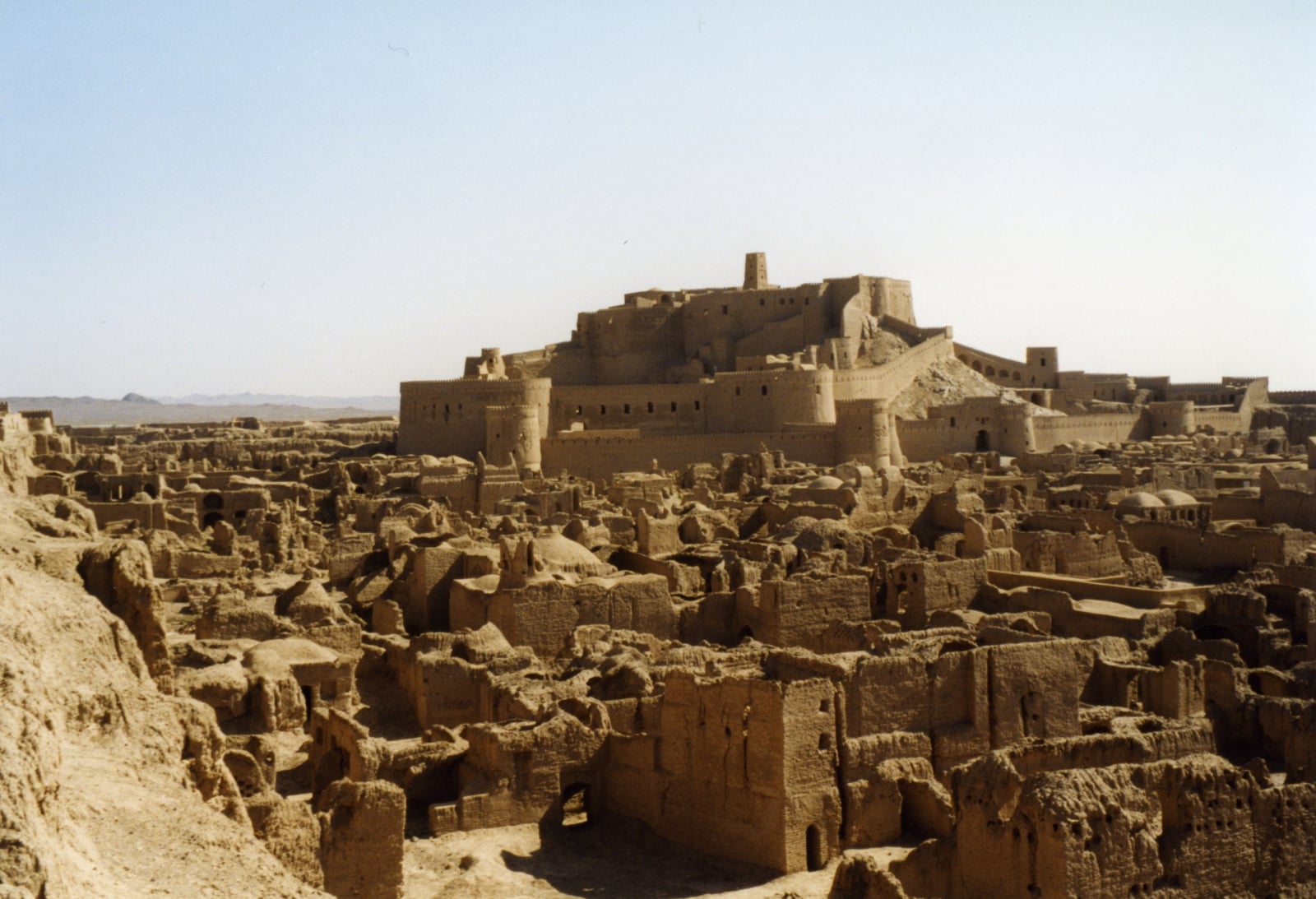
An Earthquake Destroys Bam and Its Mud-Brick Citadel
The quake killed tens of thousands and toppled the Arg-e Bam, a fortress city built of earth.
In the early morning hours of December 26, 2003, a severe earthquake struck the desert city of Bam in southeastern Iran. Occurring at 05:26 local time at a focal depth of roughly fifteen kilometers, the shock registered a moment magnitude of 6.6 according to the United States Geological Survey. Centered in Kerman province, the rupture took place along a previously unmapped blind fault within the broader deformation zone formed by the northward movement of the Arabian tectonic plate against the Eurasian plate. The resulting tremors produced catastrophic shaking, registering up to level ten on the Modified Mercalli intensity scale across the city and surrounding settlements.
The disaster struck while most residents were asleep inside their homes. Bam's architecture relied heavily on traditional sun-dried mud bricks and heavy earthen roofs that lacked structural framing or compliance with the national seismic code established in 1989. When the walls buckled beneath the intense ground motions, the heavy roofs collapsed straight downward, trapping occupants beneath debris with minimal protective air pockets. Choking dust quickly filled the collapsed structures, suffocating many victims before rescue teams could reach them. About 85 percent of housing and infrastructure was destroyed, leaving the city in ruins.

Keep reading in Yester
Coming soon to the App Store
Keep following the story
Sources
- Bam and its Cultural Landscape (UNESCO World Heritage Centre)
- Tehran lowers Bam earthquake toll (IRIN / The New Humanitarian, 30 March 2004)
- Bam: 18 years on (United Nations in the Islamic Republic of Iran, 26 December 2021)
- Iran: Bam Earthquake Appeal No. 25/03 Operations Update No. 24 (IFRC via ReliefWeb)
- Unreinforced Masonry Construction Caused High Death Toll in Iranian Quake (ENR, 29 December 2003)
- 2003 Bam earthquake
Image: Arian Zwegers