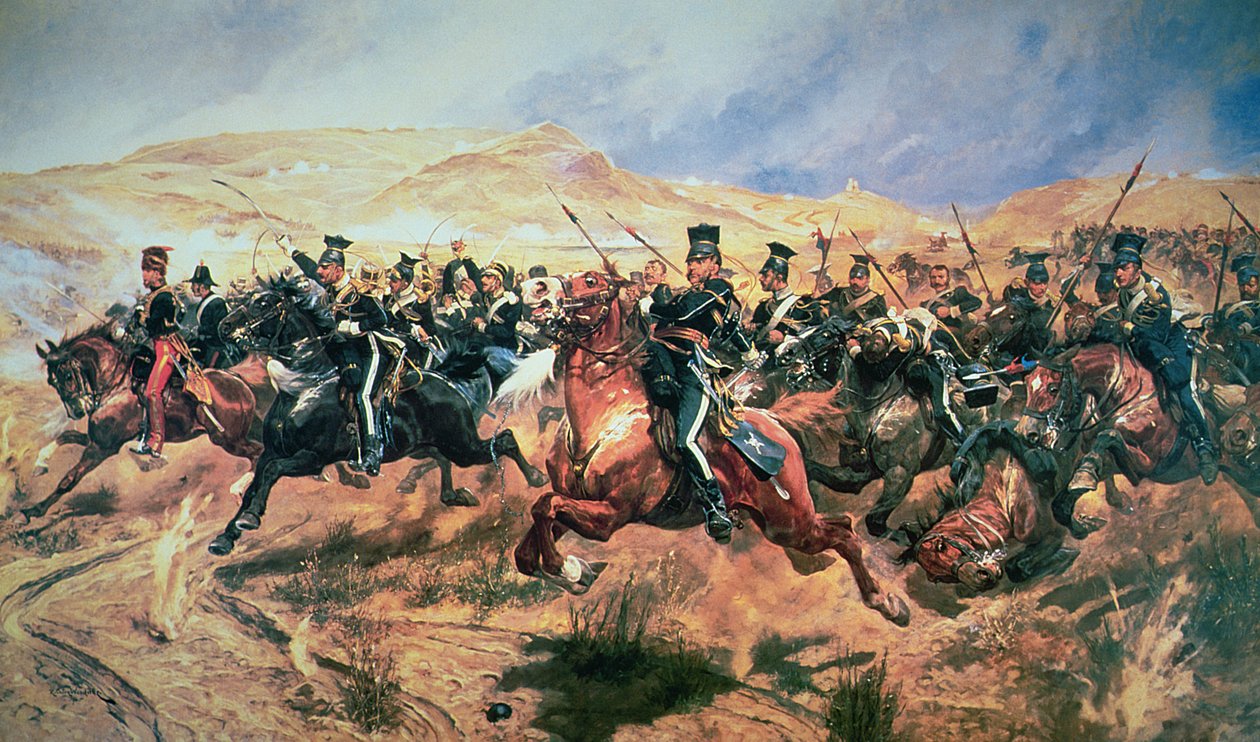
The Light Brigade Charges at Balaclava
A mistaken order sent British cavalry into a valley of guns.
At dawn on 25 October 1854, Russian forces moved in silence toward the coastal inlet of Balaclava on the Crimean peninsula. Following their defeat at the River Alma in September, imperial commanders sought to sever the vital logistics corridor connecting the British operational base at Balaclava to allied siege operations encamped outside Sevastopol. The Russian field commander, General Pavel Liprandi, deployed a striking force known as the Detachment of Chorgun, numbering by common estimates about 25,000 men. Facing them along the low ridge of the Causeway Heights stood an exposed outer perimeter of redoubts manned by Ottoman garrisons and advised by solitary British artillery personnel.
The engagement commenced around six in the morning with an intensive bombardment directed at the Ottoman positions on Canrobert's Hill. Despite fierce initial resistance from the defenders of the first redoubt, the position was overrun early in the morning, after which the remaining fortifications fell in quick succession. The retreat of the outer line exposed the inner approaches to Balaclava, defended primarily by the 93rd Highland Regiment, field artillery, and allied cavalry. A resolute stand by the Highlanders repulsed an advance by Russian horsemen, while General James Scarlett led the British Heavy Brigade in an uphill cavalry counterattack that scattered the principal Russian cavalry elements and forced Liprandi's troops onto the defensive.

Keep reading in Yester
Coming soon to the App Store
Keep following the story
Sources
Image: Richard Caton Woodville Jr.