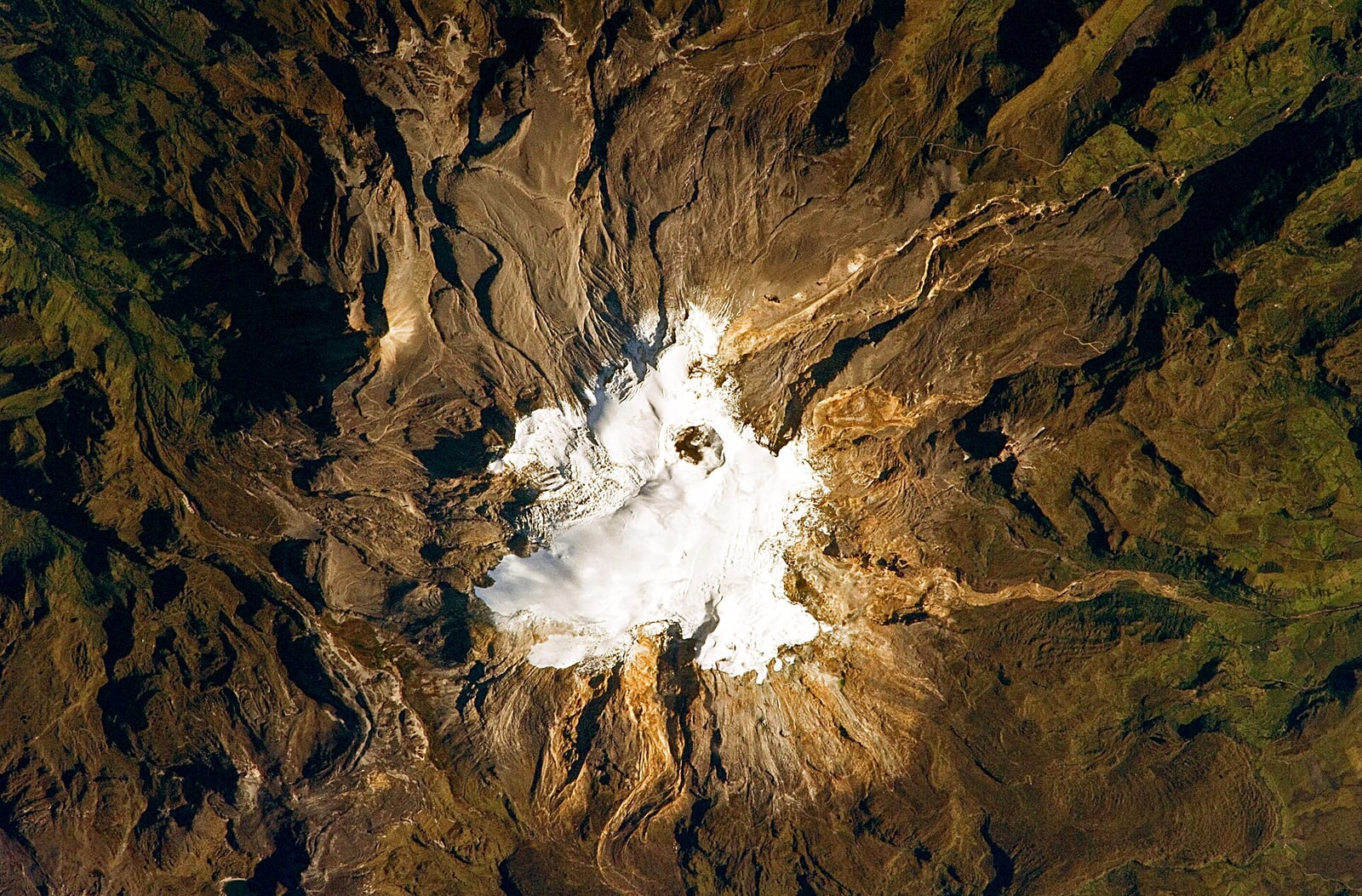
A Volcanic Mudflow Buries the Town of Armero
An eruption of Nevado del Ruiz sent mudflows that destroyed a town despite warnings.
On November 13, 1985, the Nevado del Ruiz stratovolcano in the department of Tolima, Colombia, erupted explosively after nearly seven decades of dormancy. Beginning around 9:09 p.m., the mountain blasted tephra into the atmosphere and unleashed hot pyroclastic flows across its summit. These discharges rapidly melted the volcano's glaciers and snowcaps, sending a series of enormous debris flows known as lahars surging down river channels at high speeds. The resulting torrents of mud, meltwater, and fractured rock descended upon settled valleys below, sweeping directly toward the agricultural center of Armero.
Armero sat several tens of kilometers from the summit on an alluvial fan formed by historical volcanic mudflows. Settlers had long cultivated the surrounding countryside, drawn by fertile volcanic soil that made the town a major producer of rice, cotton, and coffee. However, the exact geography that supported its agriculture placed it directly in the path of drainage corridors. Similar lahars had flattened earlier settlements on the site in 1595 and 1845. When the mud reached Armero around 11:30 p.m. in successive pulses, it swallowed 85 percent of the town, crushing structures and giving residents almost no time to flee.

Keep reading in Yester
Coming soon to the App Store
Keep following the story
Sources
- Preventing volcanic catastrophe: the U.S. International Volcano Disaster Assistance Program (U.S. Geological Survey)
- Keeping watch over Colombia's slumbering volcanoes (U.S. Geological Survey)
- Damage from Nevado del Ruiz Lahar (U.S. Geological Survey)
- Benchmarks: November 13, 1985: Nevado del Ruiz eruption triggers deadly lahars (EARTH Magazine, American Geosciences Institute)
- Lahars of Mount Pinatubo, Philippines, Fact Sheet 114-97 (U.S. Geological Survey)
- Armero tragedy
Image: The NASA Expedition 23 crew