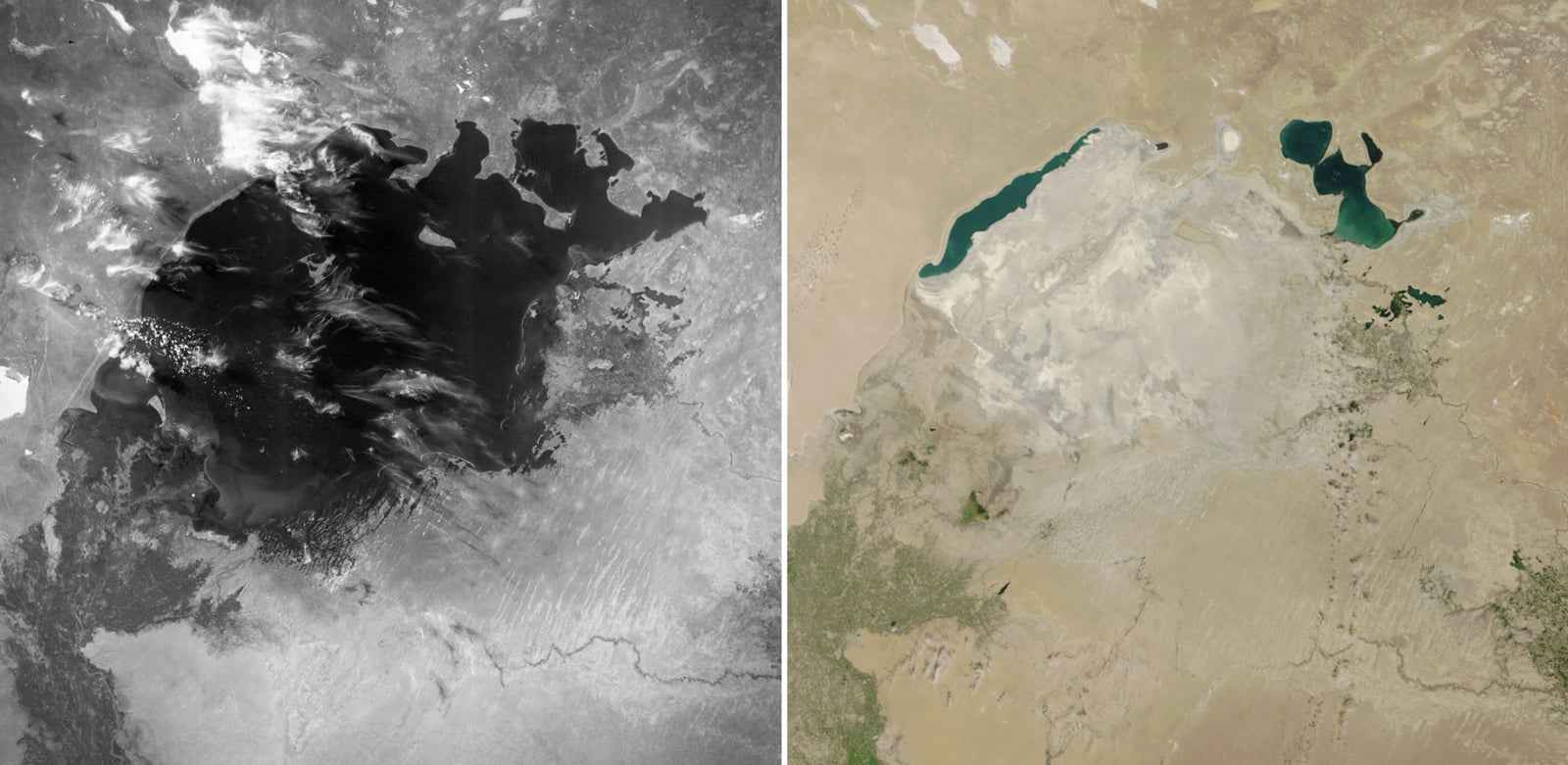
Irrigation Begins to Drain the Aral Sea
Soviet cotton schemes diverted the rivers that fed a great lake.
In 1960, the Aral Sea spanned roughly 68,000 square kilometres across Central Asia, ranking as one of the largest inland bodies of water in the world. Straddling modern Kazakhstan and Uzbekistan, this endorheic basin relied on two major lifelines: the Amu Darya flowing from the south and the Syr Darya from the east. In the early 1960s, Soviet economic planners launched an aggressive campaign to transform the surrounding arid plains into extensive fields of cotton, known within the state apparatus as white gold, alongside crops of rice, melons, and cereals. Achieving these production targets required diverting massive volumes of water directly from both feeder rivers into sprawling network canals.
The engineering of this regional irrigation infrastructure was fraught with inefficiency. Large-scale diversion for irrigation had begun by the late 1930s and expanded rapidly during the 1960s. The Qaraqum Canal, the largest irrigation canal in the Soviet Union, alone diverted 225 cubic kilometres from the Amu Darya between 1956 and 1986, none of which returned to the Aral. By 1960, between 20 and 60 cubic kilometres of freshwater were being redirected each year into agricultural fields rather than reaching the lake basin. Soviet hydrologists and planners recognized the environmental trade-off; during planning in the 1950s and 1960s, experts predicted that expanded irrigation would substantially shrink the sea and judged the cost worth paying.

Keep reading in Yester
Coming soon to the App Store
Keep following the story
Sources
- World of Change: Shrinking Aral Sea (NASA Earth Observatory)
- The future of the Aral Sea lies in transboundary co-operation, Global Environmental Alert Service, January 2014 (UNEP)
- Desiccation of the Aral Sea: A Water Management Disaster in the Soviet Union, by Philip Micklin, Science 241 (1988)
- The Aral Sea: The Devastation and Partial Rehabilitation of a Great Lake, ch. 1 to 2, ed. Micklin, Aladin and Plotnikov (Springer, 2014), sample
- The New Aquatic Biology of the Aral Sea, by Plotnikov, Aladin, Ermakhanov and Zhakova (Zoological Institute RAS; Springer, 2014)
- Aral Sea
Image: National Aeronautics and Space Administration (NASA), collage by Dylan240 .